Private well water can change significantly from one property to the next, so the right whole-house filter depends on your water test—not just the number of filtration stages.
We compared 10 well water filtration systems for home use across sediment control, contaminant coverage, flow capacity, installation features, and ongoing filter costs.
Best 10 Well Water Filtration Systems for Home Use Picks for 2026
Professional Well Water Coverage

- Three stages reduce sediment, metals, odors, chlorine, and chemicals.
- 15 GPM flow with 1-inch ports for whole-house coverage.
- Clear housing and pressure gauges simplify monitoring.
Best For: Small- to medium-sized homes using well or city water
Iron and Manganese Specialist

- Third-stage media targets iron up to 3.0 ppm and manganese up to 1.0 ppm.
- Three-stage design also handles sediment, chlorine, rust, tastes, and odors.
- DIY-friendly system delivers up to 15 GPM through 1-inch connections.
Best For: Homes with tested iron and manganese in well water
Maintenance-Focused Heavy-Metal Filtration

- GAC-plus-KDF filtration targets several heavy metals, chlorine, and VOCs.
- Pressure gauges and 180-day timers simplify maintenance planning.
- Adapters support either 3/4-inch or 1-inch NPT connections.
Best For: Homeowners prioritizing monitored, service-friendly filtration
High-Capacity Carbon Filtration

- Three stages target sediment, chlorine, rust, tastes, odors, and herbicides.
- Up to 15 GPM with 1-inch NPT connections supports whole-house flow.
- 100,000-gallon capacity and DIY-focused installation package.
Best For: Homes prioritizing chlorine, sediment, and odor reduction
Best Well-Water Iron Removal

- Reduces iron and manganese
- Seven-stage filtration
- 15 GPM whole-home flow
Best For: Well-water homes with iron, manganese, sediment, rust, or odors
Best Simple Whole-Home Setup
iSpring 2-Stage Filtration System
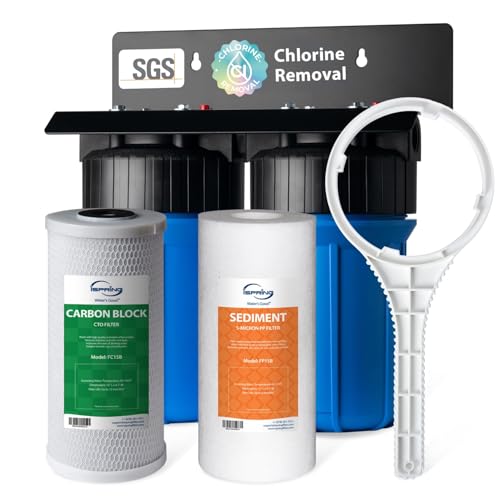
- 5-micron sediment filtration
- Reduces chlorine, taste, and odor
- Up to 50,000-gallon capacity
Best For: Families wanting no-power whole-house filtration
Best High-Flow UV Disinfection

- 110W dual-lamp UV treatment
- Rated flow up to 24 GPM
- Includes two extra bulbs
Best For: Homes prioritizing high-flow UV purification
Heavy-Duty Protection
Express Water Ultimate 3-Stage

- Reduces chlorine, scale, and several heavy metals
- Stainless steel frame with three pressure gauges
- 17 GPM maximum flow and 100,000-gallon capacity
Best For: Whole-home users prioritizing monitored filtration and anti-scale protection
Certified-Material Choice

- Up to 98% chlorine reduction
- 15 GPM flow with a stated 12-month filter life
- NSF/ANSI/CAN 372 lead-free material certification
Best For: Families wanting tested materials and lower-maintenance whole-house filtration
Long-Supply Value
3-Stage Well Water Filter System

- Includes nine cartridges for a stated 1.5–2 years
- Built-in shut-off valves simplify filter changes
- Targets sediment, chlorine, and odors while preserving minerals
Best For: Compact, budget-conscious filtration with replacement filters included
Professional Well Water Coverage – Elite Series GEN2 PRO-100-E
For small- to medium-sized homes comparing well water filtration systems for home use, the PRO+AQUA Elite Series offers three filtration stages for sediment, dissolved metals, odors, chlorine, VOCs, pesticides, and other chemicals. Its clear housing and pressure gauges also make routine monitoring more straightforward.
Best For: Homes with one to three bathrooms using well or city water and seeking whole-house filtration without electricity, backwashing, or regeneration.
Pros:
- Three stages target sediment, heavy metals, hydrogen sulfide odors, chlorine, VOCs, pesticides, and other chemicals.
- 15 GPM maximum flow rate and 1-inch ports support whole-house use.
- Clear housing and stainless steel pressure gauges help track filter condition.
- Includes a five-year manufacturer warranty and lifetime U.S. technical support after activation.
Cons:
- Filters are recommended for replacement every six months for best flow and filtration.
- Professional installation is specified in the product details.
- The system does not include electrical operation, but its listed power-source details are inconsistent with the no-electricity description.
With its broad contaminant coverage and monitoring features, this is a strong fit when well water quality varies and you want filtration at every household outlet. Confirm installation requirements and replacement-filter costs before buying.
Iron and Manganese Specialist – iSpring WGB32BM
The iSpring WGB32BM is designed for shoppers evaluating well water filtration systems for home use where iron and manganese are key concerns. Its three stages also address sediment, chlorine, rust, tastes, odors, herbicides, and industrial solvents while maintaining up to 15 GPM of flow.
Best For: Families whose well water has tested iron up to 3.0 ppm or manganese up to 1.0 ppm and who want whole-house treatment without removing TDS.
Pros:
- Dedicated third-stage media reduces iron up to 3.0 ppm and manganese up to 1.0 ppm.
- First-stage 5-micron sediment filtration and coconut-shell carbon block filtration provide layered treatment.
- 20-by-4.5-inch cartridges, 1-inch connections, and up to 15 GPM support whole-house flow.
- Designed for DIY installation with a manual and instructional videos.
Cons:
- Filter capacity is listed at 100,000 gallons or up to one year, depending on use and water conditions.
- It does not reduce total dissolved solids.
- The manufacturer warranty is one year and requires online registration for activation.
This model stands out when iron and manganese are the primary well-water problems rather than TDS reduction. Test your water first, since the stated reduction limits are specific and other contaminants may require additional treatment.
Maintenance-Focused Heavy-Metal Filtration – WF3-01 3-Stage System
For households comparing well water filtration systems for home use, the WF3-01 combines sediment and carbon filtration with a GAC-plus-KDF stage aimed at heavy metals, chlorine, odors, and VOCs. Pressure gauges, filter timers, relief valves, and included fittings make ongoing maintenance easier to plan.
Best For: Homeowners who want a monitored, service-friendly three-stage system with flexible 3/4-inch or 1-inch NPT connections.
Pros:
- Targets lead, mercury, arsenic, cadmium, chromium, chlorine, sediment, odor, and VOCs.
- Multiple pressure gauges help identify clogging and plan cartridge changes.
- Built-in 180-day timers, relief and drain valves, a housing brush, and a maintenance card support servicing.
- Includes adapters for 3/4-inch or 1-inch NPT plumbing.
Cons:
- The product details list installation as under-sink, despite the whole-house system description, so installation compatibility should be confirmed.
- Six-month timer intervals may mean more frequent maintenance than systems rated for one year.
- The supplied notes do not specify a manufacturer warranty.
The WF3-01 is appealing when visibility and maintenance convenience matter as much as contaminant reduction. Verify the intended installation location and plumbing requirements before purchasing for whole-house use.
High-Capacity Carbon Filtration – iSpring WGB32B
The iSpring WGB32B is a practical choice for shoppers seeking well water filtration systems for home use that focus on chlorine, sediment, rust, tastes, odors, herbicides, and related contaminants. Its three 20-by-4.5-inch cartridges are rated for up to 15 GPM and 100,000 gallons.
Best For: Households wanting DIY whole-house carbon filtration with strong flow and a one-year or 100,000-gallon cartridge rating.
Pros:
- Three-stage design uses a 5-micron sediment filter followed by two coconut-shell CTO carbon block filters.
- Rated to remove up to 99% of chlorine along with sediment, rust, tastes, odors, herbicides, and more.
- 1-inch NPT connections and up to 15 GPM support whole-house water delivery.
- DIY-oriented setup includes a wrench, manual, and individually wrapped cartridges.
Cons:
- It does not reduce total dissolved solids.
- Filter life depends on conditions despite the one-year or 100,000-gallon rating.
- The supplied specifications list a maximum TDS level of 300 ppm, which may limit suitability for some well-water sources.
This is a straightforward option when chlorine, sediment, and taste or odor issues are the main priorities. If your well water contains elevated metals, iron, manganese, or TDS, arrange testing and consider whether additional treatment is needed.
Best Well-Water Iron Removal – 3-Stage Well Water Filter
For homeowners comparing well water filtration systems for home use, the Waterdrop WHF3T-FG stands out when iron and manganese are major concerns. Its three-stage design combines sediment, carbon, iron, and manganese reduction, while the 15 GPM flow rate supports whole-home use.
Best For: Well-water homes dealing with iron, manganese, sediment, rust, odors, or chlorine.
Pros:
- SGS-tested reduction of 95.9% of iron and 99.7% of manganese.
- Seven-stage filtration addresses iron, manganese, lead, chlorine, odors, sediment, rust, and sand.
- 15 GPM flow rate and 1-inch inlet and outlet support household water demand.
- Includes three cartridges, a wrench, and expansion screws for installation.
Cons:
- The iron and manganese cartridge is expected to be replaced every 6–12 months.
- The 49-pound system is larger and heavier than simpler point-of-entry filters.
- Its maximum supported TDS level is 300 ppm.
This is a strong fit for well-water users who need targeted iron and manganese reduction rather than basic sediment and chlorine filtration. Plan for periodic cartridge replacement and confirm that the system’s dimensions and TDS limit suit your installation.
Best Simple Whole-Home Setup – iSpring 2-Stage Filtration System
The iSpring WGB21B is a practical option among well water filtration systems for home use when your priorities are sediment, chlorine, taste, and odor reduction. Its two replaceable 10-inch filters are mounted on a pre-assembled bracket and support up to 15 GPM.
Best For: Families wanting straightforward, no-power whole-house filtration with a long filter cycle.
Pros:
- A 5-micron sediment filter captures dirt, sand, silt, dust, rust, and scale particles.
- Carbon filtration reduces over 90% of chlorine and helps reduce bad tastes, odors, cloudiness, and VOCs.
- Up to 50,000 gallons of capacity can provide as much as a year of filtration for a family of four.
- Pre-assembled mounting bracket, pressure-release valve, and included wrench simplify installation and filter changes.
Cons:
- This system does not reduce TDS or remove dissolved minerals like a reverse-osmosis system.
- It is a two-stage design, so it does not specifically target iron or manganese in the supplied specifications.
- Replacement filters are required as part of routine maintenance.
The WGB21B makes sense for households seeking basic whole-house sediment and carbon treatment without electricity. If testing shows elevated iron, manganese, or TDS, you may need a more specialized treatment setup.
Best High-Flow UV Disinfection – 24 GPM UV Purifier
For shoppers evaluating well water filtration systems for home use with a focus on ultraviolet purification, this 110W whole-house unit offers two UV lamps and a rated 24 GPM flow. It is designed for well or city water and includes two extra replacement bulbs.
Best For: Homes needing high-flow UV purification and an included supply of replacement bulbs.
Pros:
- Two 55W lamps provide 110W of UV treatment at a stated 24 GPM flow rate.
- Includes two extra replacement bulbs, for four lamps total in the package.
- Stainless steel chamber is designed for corrosion resistance and durable installation.
- 3/4-inch MNPT connections and included brackets support flexible installation options.
Cons:
- UV purification is a different treatment approach from sediment, carbon, iron, or manganese filtration.
- Each bulb is rated for up to 1,500 hours and will require replacement.
- The unit requires a power source, unlike non-powered mechanical filtration systems.
This purifier is best considered when UV treatment and high flow are the priority. Because the supplied specifications do not describe sediment or chemical reduction, well-water owners may need prefiltration if their water contains particles, iron, manganese, or odors.
Heavy-Duty Protection – Express Water Ultimate 3-Stage
For homeowners comparing well water filtration systems for home use, the Express Water Ultimate Protection system is a heavy-duty option focused on sediment, chlorine, scale, and several heavy metals. Its freestanding stainless steel frame, pressure gauges, and 17 GPM maximum flow rate make it suited to whole-home installation.
Best For: Larger households wanting monitored, whole-home filtration with anti-scale and heavy-metal protection.
Pros:
- Three-stage filtration uses activated carbon, KDF, and polyphosphate.
- Designed to reduce chlorine and heavy metals including lead, arsenic, mercury, chromium, and cadmium.
- Includes a stainless steel stand, three pressure gauges, and pressure-release buttons.
- Supports a maximum flow rate of 17 GPM and a stated capacity of 100,000 gallons.
Cons:
- At 63 pounds and approximately 29 by 8.5 by 30 inches, it requires substantial installation space.
- Filter life is listed at six months, so replacement frequency may be higher than some competing systems.
- It requires manual operation and has no power source.
This is a feature-rich pick when scale control and heavy-metal reduction are priorities. The gauges and release buttons also make routine monitoring and filter changes more manageable, provided you have room for its larger freestanding design.
Certified-Material Choice – Waterdrop WHF3T-PG 3-Stage
The Waterdrop WHF3T-PG is a practical contender among well water filtration systems for home use, combining sediment, KDF, activated carbon, and carbon-fiber filtration. It is designed for well or municipal water and provides a steady 15 GPM flow rate for everyday whole-house use.
Best For: Families seeking a relatively low-maintenance whole-house system with certified lead-free materials and a one-year filter cycle.
Pros:
- Claims up to 98% chlorine reduction while addressing sediment, odors, heavy metals, and unwanted tastes.
- Materials are certified to NSF/ANSI/CAN 372 for lead-free content; the KDF media meets NSF/ANSI 42 requirements.
- Provides a 15 GPM flow rate and a stated 12-month filter life, depending on water quality.
- Includes three cartridges, a wrench, expansion screws, and installation instructions.
Cons:
- The stated operating temperature range is 40–100°F, so it should not be used below 40°F.
- Although marketed as 3-stage, the product materials describe an 11-stage filtration process and some supplied highlights reference seven-stage filtration, which may make comparison less straightforward.
- Installation is intended for a whole-house water-tank setup and may require compatible plumbing.
Waterdrop’s strongest advantages are its documented material testing, broad contaminant focus, and longer stated replacement interval. It is a balanced option for households that want whole-home coverage without moving up to the larger 17 GPM Express Water system.
Long-Supply Value – 3-Stage Well Water Filter System
For shoppers seeking well water filtration systems for home use with replacement cartridges included, this compact three-stage system supplies three complete filter sets. It targets sediment, chlorine, and odors while preserving natural minerals, and its built-in shut-off valves simplify filter changes on standard 3/4-inch plumbing.
Best For: Budget-conscious households that want a compact system and an extended starter supply of replacement filters.
Pros:
- Includes nine cartridges—three PP, three GAC, and three CTO filters—for a stated 1.5–2 years of supply.
- Two integrated shut-off valves allow filter changes without turning off the main water line.
- Designed to reduce sediment, chlorine, and odors without lowering TDS or removing natural minerals.
- Compact 14 by 13 by 10-inch housing can fit in an under-sink or utility-room installation.
Cons:
- Filter life is listed at six months per set, and actual replacement timing depends on water conditions.
- It does not lower TDS levels and is not presented as a comprehensive heavy-metal or scale-control system.
- The supplied details describe under-sink installation, so whole-home placement should be checked against your plumbing layout.
This system stands out for convenience and upfront filter value rather than advanced contaminant treatment. It is a sensible fit for basic sediment, chlorine, and odor concerns when preserving minerals and keeping maintenance costs predictable matter most.
How We Picked the Best Well Water Filtration Systems for Home Use
We focused on whole-house systems designed to treat water as it enters the home, rather than point-of-use pitchers or under-sink units. The selected options cover common needs for private wells, including sediment, chlorine, iron, manganese, heavy metals, and microbial concerns. We also considered filter-stage design, cartridge availability, rated flow, port size, pressure monitoring, installation complexity, and whether replacement media or UV components are required.
Because well chemistry varies, no system should be chosen solely from a product title or contaminant claim. Confirm performance against the manufacturer’s specifications and compare it with a current laboratory water analysis.
Quick Comparison
| What to Compare | Why It Matters |
|---|---|
| Filtration stages | Multiple stages can combine sediment, carbon, specialty media, or other treatment methods. |
| Flow rate and port size | These affect pressure, simultaneous fixture use, and compatibility with household plumbing. |
| Target contaminants | Carbon is not a universal solution for iron, manganese, arsenic, hardness, or bacteria. |
| Maintenance | Replacement intervals, filter cost, flushing, and UV lamp changes affect total ownership cost. |
Key Buying Factors for Well Water Filtration Systems for Home Use
Start with a Certified Water Test
Test for sediment, pH, hardness, iron, manganese, sulfur, nitrate, arsenic, lead, bacteria, and other locally relevant contaminants. A test identifies whether you need filtration, softening, oxidation, disinfection, or a combination.
Match the Media to the Problem
Sediment cartridges help with sand and particulate matter, while carbon commonly addresses chlorine, taste, and odor. Iron and manganese often require dedicated media or oxidation treatment. UV systems can reduce microbial risk but generally need clear, prefiltered water and electricity; they do not remove dissolved minerals or metals.
Check Capacity, Pressure, and Installation
Choose a rated flow suitable for peak household demand, and verify inlet and outlet sizes. Pressure gauges, bypass valves, mounting brackets, and clear service instructions can simplify installation and troubleshooting. If the well produces heavy sediment, add appropriate prefiltration to protect finer cartridges.
Budget for Replacement Filters
Compare cartridge life and replacement prices, not just the initial purchase cost. Follow the manufacturer’s schedule, and replace filters sooner if pressure drops, taste changes, or testing shows reduced performance.
Who Should Buy Which Well Water Filtration Systems for Home Use?
- For general sediment and taste concerns: Choose a conventional multi-stage system with sediment and carbon filtration.
- For iron or manganese: Prioritize a system specifically rated for those contaminants, and verify whether pretreatment is needed.
- For microbial concerns: Consider UV only after testing and prefiltration requirements are addressed.
- For larger households: Favor higher flow ratings, larger cartridges, and plumbing connections that minimize pressure loss.
- For simpler maintenance: Look for widely available replacement cartridges, pressure gauges, and clear access to a bypass valve.
The best choice is the system that matches your tested water chemistry, household flow demand, available installation space, and long-term maintenance budget.