Low water pressure can make showers frustrating, slow down appliances, and limit irrigation performance. The right booster system can improve flow, but the best choice depends on your water source, required pressure, and installation setup.
We compared 10 water pressure booster systems across pump capacity, controls, pressure range, self-priming performance, and intended use to help you narrow down the right fit for your home, garden, well, or RV.
Best 10 Water Pressure Booster Systems Picks for 2026
Best Smart Whole-Home Pick
EVO BOOST5 Variable-Speed Booster Pump

- 26.5 GPM flow with adjustable 22–92 PSI pressure
- App control and multiple built-in safety protections
- Stainless steel body with a 3-year full warranty
Best For: Multi-floor homes needing adjustable, app-controlled pressure
Best Tankless Installation
BACOENG Smart-Controller Booster Pump

- Designed for direct, tankless pipeline installation
- Automatic on/off operation with low-water protection
- 304 stainless steel liquid-contact components
Best For: Residential systems that do not use a pressure tank
Best Quiet Constant-Pressure Pick
Hanchen Variable-Speed Booster Pump

- Adjustable pressure with variable-frequency control
- Quiet operation rated at 45 dB or less
- Built-in check valves and dry-run status display
Best For: Quiet indoor use with adjustable, steady pressure
High-Flow Home Booster

- Up to 2100 GPH and 140-foot maximum head
- Adjustable pressure up to 50 PSI with digital display
- Automatic flow start/stop and protective features
Best For: High-flow residential, irrigation, RV, and marine applications
Versatile Diaphragm Booster
5.5GPM Self-Priming Pressure Pump

- Adjustable 30–75 PSI pressure range
- Self-priming design with 160-foot maximum lift
- Automatic faucet-activated start and stop
Best For: RV, marine, home, garden hose, and freshwater systems
Pressure-Tank Irrigation Pump
1.6HP Shallow Well Booster with Tank
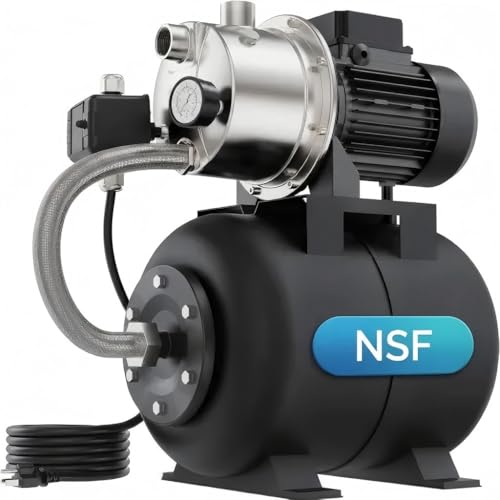
- Up to 1340 GPH and 164-foot maximum head
- Five-gallon tank with automatic 20–40 PSI switching
- Stainless steel housing and two-year warranty
Best For: Shallow wells, home water supply, irrigation, and lawn sprinklers
Best High-Pressure Garden Pick
5.5 GPM Diaphragm Booster Pump

- 5.5 GPM flow with 70 PSI switch setting
- Automatic faucet-start and shutoff operation
- Thermal protection and 131-foot lift capacity
Best For: Irrigation, RV use, garden hoses, and outdoor cleaning
Best Compact Automatic Choice
1/2 HP Smart-Control Booster Pump

- Automatic smart-controller operation
- 108-foot lift with 845 GPH listed flow
- Stainless steel body with pressure gauge
Best For: Home supply, shallow wells, garden irrigation, and sprinklers
Best Smart Whole-Home Pick – EVO BOOST5 Variable-Speed Booster Pump
For households comparing water pressure booster systems, the EVO BOOST5 stands out for combining variable-speed operation, app control, and whole-home capacity. Its 1.2 HP motor delivers up to 26.5 GPM, while the adjustable 22–92 PSI range is designed to maintain steady pressure across up to eight faucets on three floors.
Best For: Whole-house pressure boosting, multi-floor homes, and users who want remote monitoring and adjustable constant pressure.
Pros:
- Variable-speed motor automatically adjusts to water demand and can save over 50% energy versus standard pumps.
- Wireless Smart Life App control provides access to pressure, energy, temperature, and pump-status information.
- Stainless steel construction, built-in safety protections, and a 3-year full warranty support long-term use.
Cons:
- Its larger 20.7-inch length and 20.4-pound weight may require careful installation planning.
- Professional installation guidance may be useful for integrating the 1-inch NPT connections into an existing system.
With quiet operation rated at 50 dB and protection against dry running, overcurrent, and voltage faults, this is a feature-rich choice when consistent pressure and smart controls matter more than a compact footprint.
Best Versatile Utility Option – 1/2 HP 14 GPM Self-Priming Booster Pump
This 1/2 HP model is one of the more versatile water pressure booster systems for residential pressure boosting, irrigation, and water transfer. It supplies up to 14 GPM, offers automatic on-demand operation, and uses a standard 110V plug for relatively straightforward setup.
Best For: Home water pressure boosting, garden irrigation, lawn sprinklers, and shallow-well applications where a reinforced suction hose is available.
Pros:
- Self-priming pump produces up to 14 GPM and a listed maximum lift of 105 feet in the product description.
- Automatic controller starts with water flow and shuts down during dry pumping.
- Standard 1-inch ports, 110V plug, and 6.5-foot power cable support flexible installation.
Cons:
- The inlet must use a dedicated reinforced suction hose; an ordinary soft garden hose can collapse.
- The 180-day warranty is shorter than some competing options.
- Pressure adjustment requires using the push screw behind the controller.
This pump makes sense for buyers who need one unit for both pressure boosting and outdoor water tasks. The reinforced-hose requirement is important, especially for shallow-well or high-flow suction installations.
Best Tankless Installation – BACOENG Smart-Controller Booster Pump
The BACOENG is designed for buyers who want water pressure booster systems without adding a separate pressure tank. Its smart controller starts and stops the pump as water demand changes, making it suitable for direct installation in a household supply line.
Best For: Tankless household water-supply pressurization in homes, cabins, and similar residential systems.
Pros:
- Tankless design installs directly into the home water-supply pipeline.
- Smart controller monitors water conditions and stops operation when the inlet lacks water.
- 304 stainless steel liquid-contact components offer corrosion resistance and a food-grade construction standard.
Cons:
- The product notes acknowledge that the pump makes some noise during operation.
- Its listed maximum flow varies between the specifications and description, so buyers should confirm expected system performance.
- The 0.6 HP motor may be less suitable for demanding whole-house applications than higher-powered models.
A built-in check valve helps maintain pressure and reduce rapid cycling, while thermal overload protection adds an extra layer of motor protection. It is a practical choice when a tankless configuration is the priority.
Best Quiet Constant-Pressure Pick – Hanchen Variable-Speed Booster Pump
The Hanchen booster pump is a strong option among water pressure booster systems for buyers who want adjustable output and quieter operation. Its variable-frequency drive changes motor speed as demand shifts, helping maintain stable pressure while the control panel lets users select their preferred target.
Best For: Homes or apartments needing quiet, adjustable pressure for showers, faucets, shallow wells, or garden use.
Pros:
- Variable-speed operation maintains constant pressure and may save up to 50% electricity compared with traditional single-speed pumps.
- Simple up/down controls allow pressure adjustment for applications ranging from drip irrigation to stronger showers.
- Built-in check valves, automatic on/off operation, and dry-run status monitoring simplify everyday use.
Cons:
- The listed maximum lifting height is 26 feet, which may limit some high-lift installations.
- At 18.5 GPM, actual performance will depend on the plumbing layout and water demand.
With a 0.7 HP permanent-magnet motor rated at 45 dB or less, the Hanchen emphasizes comfortable indoor operation. Its compact 12.6-inch length and included check valves also make it appealing where installation space and convenience matter.
High-Flow Home Booster – 1.6HP Digital Pressure Pump
For households comparing water pressure booster systems, this 1.6HP model stands out for its high flow capacity, digital monitoring, and automatic operation. It delivers up to 2100 GPH, reaches a listed maximum head of 140 feet, and lets you adjust pressure up to 50 PSI for showers, faucets, irrigation, and other water systems.
Best For: Homes and outdoor setups that need high flow across multiple points, including showers, tankless water heaters, irrigation, RVs, camping, or marine systems.
Pros:
- High-capacity 1.6HP motor with up to 2100 GPH flow and 140-foot maximum head.
- Digital pressure display with adjustable control up to 50 PSI.
- Flow-activated start and stop helps reduce unnecessary operation.
- Stainless steel housing includes dry-run, thermal, and freeze-resistant protection.
Cons:
- The larger motor and high-flow design may be more than needed for a single low-demand fixture.
- It is a corded 110V unit, so installation requires a suitable electrical connection.
This is a strong choice when stable, high-volume pressure matters more than a compact footprint. Its display and protective features also make it easier to monitor and manage than a basic booster pump.
Versatile Diaphragm Booster – 5.5GPM Self-Priming Pressure Pump
This TDRRICH model is one of the more adaptable water pressure booster systems for homes, RVs, boats, and garden hoses. The 110V self-priming diaphragm pump provides up to 5.5 GPM, supports adjustable pressure from 30 to 75 PSI, and automatically starts when a faucet opens and stops when it closes.
Best For: RV water supplies, boats, homes, garden hoses, lawn irrigation, and freshwater washdown applications where adjustable on-demand pressure is useful.
Pros:
- Adjustable pressure range from 30 to 75 PSI.
- Self-priming design with a listed maximum lift of 160 feet.
- Automatic pressure switch starts and stops the pump with faucet use.
- Includes multiple connector sizes, a power cord, standard plug, and galvanized mounting base.
Cons:
- The 5.5 GPM capacity is lower than the high-flow pumps in this roundup.
- It is intended for fresh water use only.
- The listed warranty is 180 days, shorter than some competing options.
Choose this pump when installation flexibility and adjustable pressure are priorities. Its compact, self-priming design suits mobile and light-duty water systems, while the automatic switch simplifies everyday use.
Pressure-Tank Irrigation Pump – 1.6HP Shallow Well Booster with Tank
For buyers seeking water pressure booster systems for a home, cabin, farm, or irrigation setup, this Aquastrong shallow well pump combines a 1.6HP motor with a compact five-gallon pressure tank. It offers up to 1340 GPH, a listed 164-foot maximum head, and automatic operation through a 20 PSI start and 40 PSI shutoff pressure switch.
Best For: Shallow well water supply, residential use, garden irrigation, lawn sprinklers, and general water transfer where a pressure tank can help support automatic cycling.
Pros:
- 1.6HP motor provides up to 1340 GPH flow and 164-foot maximum head.
- Five-gallon pressure tank and gauge support automatic operation and pressure monitoring.
- Stainless steel housing resists corrosion, and the product is NSF certified according to the supplied notes.
- Includes overload protection, waterproof switch, adapters, PTFE tape, and a two-year warranty.
Cons:
- Its large assembled dimensions require more installation space than a standalone booster pump.
- The pump must be primed before startup and protected from freezing.
- It is designed for shallow-well applications, with listed suction up to 26 feet.
This model is best suited to fixed installations rather than portable use. The integrated tank, automatic pressure switch, and included installation accessories make it a practical option for irrigation and domestic water systems when space and priming requirements are manageable.
Best High-Pressure Garden Pick – 5.5 GPM Diaphragm Booster Pump
For homeowners comparing water pressure booster systems for garden work, RV use, or outdoor cleaning, this 110V diaphragm pump offers a practical blend of flow and automatic operation. It delivers up to 5.5 GPM with a 70 PSI pressure-switch setting and can self-prime up to 9.8 feet.
Best For: Irrigation, garden hoses, RV water use, and spraying or cleaning outdoor surfaces.
Pros:
- Provides up to 5.5 GPM and a 70 PSI pressure-switch setting.
- Automatically runs when a faucet opens and shuts off when it closes.
- Includes thermal overload protection and can lift water up to 131 feet.
- Designed for extended operation of more than one hour.
Cons:
- Requires a 110V AC corded electrical connection.
- Self-priming is limited to 9.8 vertical feet.
- Pressure adjustment may be needed for specific applications.
Its automatic pressure-switch operation and strong 5.5 GPM output make it a versatile choice among water pressure booster systems. The main fit consideration is whether your installation has the required power and stays within the pump’s priming limits.
Best Heavy-Duty Utility Option – 1.5 HP Automatic Booster Pump
This 1.5 HP automatic pump is a strong candidate for water pressure booster systems serving showers, faucets, irrigation, or water-transfer tasks. Its mechanical pressure switch starts and stops the pump automatically, while the self-priming design helps simplify setup.
Best For: Higher-demand household boosting, irrigation, drainage, pool circulation, and emergency water transfer.
Pros:
- Uses a 1.5 HP motor with up to 1,600 GPH flow.
- Offers a maximum lifting height of 120 feet.
- Mechanical pressure switch provides automatic start and stop control.
- Includes overheat and dry-run protection for safer operation.
Cons:
- The pressure switch does not support custom pressure adjustment.
- Its higher-power design may be more pump than smaller household jobs require.
- It is a corded electric unit, so installation requires suitable power access.
Choose this model when lift capacity and motor power matter more than fine pressure customization. It is especially suited to demanding transfer and irrigation applications, but buyers should account for its larger 1.5 HP format.
Best Compact Automatic Choice – 1/2 HP Smart-Control Booster Pump
For smaller home and garden installations, this 110V stainless-steel pump offers automatic control in a relatively compact package. It can move up to 845 GPH, lift water up to 108 feet, and uses a smart controller that responds when a faucet is opened or closed.
Best For: Home water supply, shallow-well support, lawn irrigation, and garden sprinkler systems.
Pros:
- Smart controller automatically starts and stops with faucet demand.
- Provides up to 845 GPH and a 108-foot vertical lift.
- Stainless-steel construction includes a built-in pressure gauge.
- Dry-run and thermal overload protection help protect the motor.
Cons:
- Its 1/2 HP motor has less capacity than higher-powered booster pumps.
- It requires a 110V electrical connection.
- The listed specifications contain differing flow-rate figures, so buyers should verify the expected operating output.
This is a sensible water pressure booster systems option when automatic control, corrosion resistance, and manageable size are priorities. Its 26-foot suction capability and 108-foot lift suit many shallow-well and irrigation uses, while the lower horsepower may not fit high-demand applications.
How We Picked These Water Pressure Booster Systems
We evaluated the listed pumps by comparing their horsepower, flow rate, maximum pressure or head height, voltage, control method, materials, and stated application. Whole-house and shallow-well models were weighed differently from compact diaphragm pumps designed for RVs, transfer work, or irrigation.
Because plumbing layouts vary, advertised performance should be treated as a starting point rather than a guaranteed flow rate at every fixture. Pipe size, elevation, inlet supply, fittings, and electrical capacity all affect real-world results.
Quick Comparison
| Best For | Features to Prioritize | Models in This Roundup |
|---|---|---|
| Whole-house boosting | Higher horsepower, automatic control, stainless construction | 1.2 HP, Hanchen, 1.6HP, 1.5HP |
| Shallow wells and irrigation | Self-priming design, higher head, durable pump housing | Aquastrong, TDRSUPER, 1/2 HP Household |
| RV and transfer use | Diaphragm pump, pressure switch, compact 12V/110V-style setup | TDRRICH, ECO-WORTHY |
| Convenient automation | Smart controller or automatic on/off operation | BACOENG, Hanchen, TDRSUPER |
Key Buying Factors for Water Pressure Booster Systems
Pressure, Flow, and Head Height
Pressure is usually listed in PSI, while flow is measured in GPM or GPH. PSI indicates force; flow indicates how much water the pump can deliver. Maximum head describes how high the pump can move water, but usable flow normally decreases as lift and plumbing resistance increase. Choose a pump that meets your actual fixture demand without relying only on the highest headline number.
Water Source and Pump Type
Confirm whether you are boosting municipal water, drawing from a shallow well, transferring from a tank, or supplying an RV or irrigation line. Self-priming jet pumps suit many shallow-well and garden applications, while diaphragm pumps are often practical for compact transfer and on-demand setups.
Controls and Installation
Automatic switches and smart controllers can start the pump when a tap opens and stop it when demand ends. Adjustable or variable-speed controls offer more flexibility, but they may require careful setup. Check voltage, inlet and outlet sizes, required check valves, wiring, ventilation, and local plumbing or electrical rules before installation.
Noise, Durability, and Maintenance
Stainless-steel housings can help resist corrosion, but every pump still needs protection from dry running, freezing, debris, and improper inlet conditions. A strainer, pressure tank, or check valve may be necessary depending on the system design.
Who Should Buy Which Water Pressure Booster Systems?
Choose a higher-capacity automatic booster when several household fixtures need better pressure at once. A self-priming shallow-well model is more appropriate for garden irrigation or a private well. For RVs, tanks, and intermittent transfer tasks, a compact diaphragm pump with an integrated pressure switch can be easier to manage. If your pressure varies throughout the day, prioritize adjustable pressure or variable-speed control.
Before buying, estimate peak simultaneous demand, verify your available power, and measure the existing pipe connections. If the source supply is severely restricted, a booster pump alone may not solve the problem; a storage tank, larger plumbing, filtration service, or professional diagnosis may be needed.