Large attics can trap substantial heat and moisture, putting extra strain on your air conditioner and potentially affecting insulation, roofing materials, and indoor comfort. The right roof ventilation fan can improve air movement across a broad attic space while helping manage summer heat.
This roundup compares 10 high-capacity options, including solar, hybrid, and electrically powered fans. We focus on airflow claims, coverage guidance, controls, construction, noise, installation considerations, and practical operating costs so you can choose a model suited to your home.
Best 10 Roof Ventilation Fans for Large Homes Picks for 2026
High-Capacity Solar Pick

- 2,800 CFM airflow
- Temperature and humidity controls
- AC backup with remote control
Best For: Large attics needing powerful, automated ventilation
Commercial-Grade Airflow
2400 CFM Industrial Upblast Fan

- 2,400 CFM exhaust capacity
- Direct-drive motor design
- Weather-resistant aluminum housing
Best For: Large garages, workshops, warehouses, and utility spaces
Quiet Hybrid Option

- 2,100 CFM airflow
- 45 dB listed noise level
- Solar panel with AC adapter
Best For: Residential attics and large rooms needing quieter automatic ventilation
Established Residential Choice
Master Flow 1250 CFM Power Fan

- Rated for attics up to 2,200 sq. ft.
- Energy-efficient PSC motor
- Galvanized steel and UL Listed
Best For: Conventional powered ventilation in medium-to-large attics
Solar Power Pick
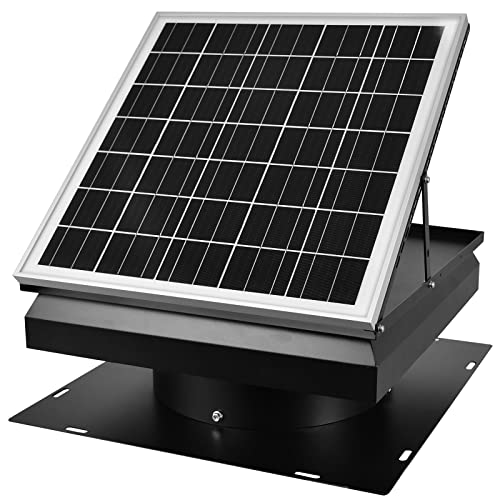
- 1,600 CFM airflow for large attic areas
- Integrated 32W panel with automatic operation
- IP68 motor and weather-resistant construction
Best For: Large attics needing high off-grid airflow
Large-Attic Electric Pick

- 1,500 CFM airflow for attics up to 2,800 sq. ft.
- Built-in thermostat controller
- Galvanized steel roof-mount construction
Best For: Large compatible attics with hard-wired power
Hybrid-Ready Pick
iLIVING 1150 CFM Solar Roof Fan
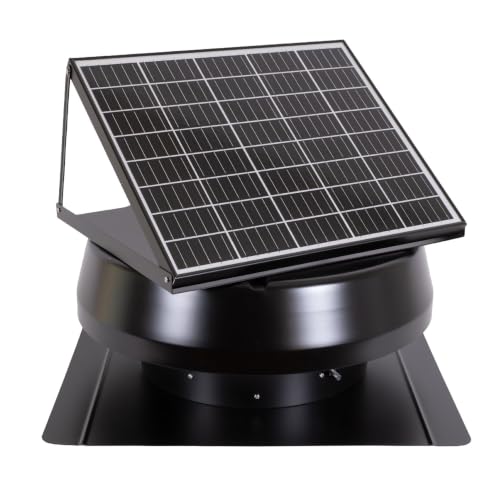
- 1,150 CFM coverage up to 2,900 sq. ft.
- Adjustable 40W solar panel
- Smart thermostat and optional AC/DC adapter
Best For: Large attics needing flexible solar positioning
Best Traditional Pick
Master Flow 1,500 CFM Roof Fan

- 1,500 CFM airflow for spaces up to 2,800 square feet
- Thermostat controller included
- Galvanized steel construction with built-in screen
Best For: Large attics needing hard-wired powered ventilation
Best Dual-Power Option
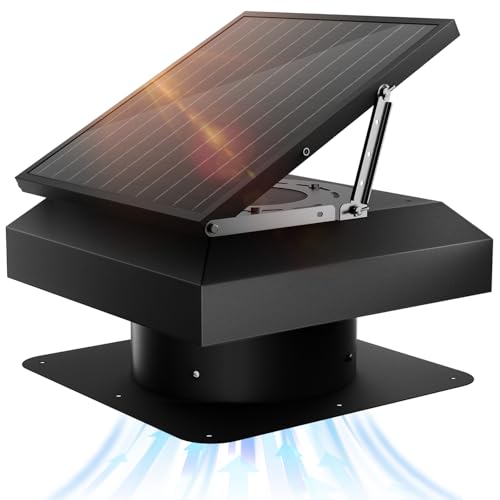
- 2,000 CFM airflow for spaces up to 2,500 square feet
- Solar-priority AC/DC auto-switching
- Four speeds with adjustable panel and thermostat
Best For: Attics needing flexible solar and household-power operation
Best Simple Solar Pick

- Up to 2,000 CFM from a 40W solar panel
- Automatic sunrise-to-sunset operation
- Pre-connected, DIY-friendly design
Best For: Sunny roofs and homeowners wanting low-maintenance daytime ventilation
High-Capacity Solar Pick – 42W Smart Solar Attic Fan
For large homes seeking roof ventilation fans for large homes, the VEVOR 42W Solar Attic Fan stands out with up to 2,800 CFM of airflow. Its MPPT solar regulator, temperature and humidity controls, remote, and AC-adapter backup make it a versatile option for keeping attic air moving in changing conditions.
Best For: Large attics, garages, RVs, or shops where high airflow, smart controls, and backup electric operation are priorities.
Pros:
- High 2,800 CFM capacity with a brushless DC motor.
- Temperature, humidity, and smoke-detection controls add automation.
- Solar operation can switch to electric power at sunset or in cloudy conditions.
- Weather-resistant panel supports adjustable positioning and outdoor installation.
Cons:
- Listed noise level is 60 dB, so it may not be the quietest option.
- Requires roof installation and suitable solar exposure for optimal solar performance.
This is a feature-rich choice when you want substantial ventilation without relying exclusively on grid power. Confirm roof compatibility, electrical requirements, and installation conditions before buying.
Commercial-Grade Airflow – 2400 CFM Industrial Upblast Fan
The PrecisionAuto Industrial Upblast Roof Exhaust Fan is a strong candidate among roof ventilation fans for large homes when the priority is moving heat, fumes, or smoke quickly. Its 2,400 CFM direct-drive motor and weather-resistant aluminum housing are designed for demanding roof-mounted ventilation.
Best For: Large workshops, garages, warehouses, kitchens, and other spaces that need high-volume AC-powered exhaust.
Pros:
- Provides substantial 2,400 CFM airflow.
- Direct-drive construction uses fewer moving parts and may reduce maintenance needs.
- Spun aluminum hood and skirt offer weather and corrosion resistance.
- Designed for roof curbs and installations with limited ductwork.
Cons:
- Its commercial and industrial design may be more than a typical residential attic requires.
- Uses AC power rather than solar power.
- Installation requires attention to roof-curb and mounting compatibility.
Choose this model when robust exhaust performance matters more than residential styling or solar operation. It is especially suited to larger utility spaces, but verify the electrical setup and roof mounting requirements first.
Quiet Hybrid Option – 40W Solar Hybrid Roof Fan
The OmniPV Solar Hybrid Attic Fan combines solar-powered ventilation with an AC adapter for flexible operation. For homeowners comparing roof ventilation fans for large homes, its 2,100 CFM capacity, 45 dB listed noise level, automatic thermostat, and weather-resistant aluminum construction offer a balanced blend of airflow and convenience.
Best For: Home attics, great rooms, garages, sheds, and shops where quieter solar-assisted ventilation is desirable.
Pros:
- Delivers up to 2,100 CFM using a brushless motor.
- Built-in thermostat automatically turns the fan on above 75°F.
- Includes a solar panel and AC adapter for flexible power options.
- Aluminum alloy housing is designed for UV, oxidation, corrosion, and water resistance.
Cons:
- Single-speed operation offers less adjustment than multi-speed models.
- Its 2,100 CFM capacity is lower than the highest-output option in this roundup.
- Thermostat control is centered on a 75°F threshold.
This model is a practical middle ground for residential spaces that need automatic attic cooling without a louder industrial-style fan. Its included mounting components and multiple installation options may also simplify fitting it to different structures.
Established Residential Choice – Master Flow 1250 CFM Power Fan
The Master Flow GAF ERV5WW is a straightforward powered roof fan for homeowners who prefer a conventional electric attic-ventilation setup. Among roof ventilation fans for large homes, its 1,250 CFM rating is specified for attics up to 2,200 square feet, while the galvanized steel housing and UL listing support a durable, code-conscious installation.
Best For: Attics up to 2,200 square feet with compatible 3:12 to 12:12 roof slopes.
Pros:
- Designed for attics up to 2,200 square feet.
- Energy-efficient PSC motor design helps reduce electricity use versus typical competing motors.
- Galvanized steel construction supports durability.
- UL Listed and approved for several regional building requirements.
Cons:
- Its 1,250 CFM capacity is lower than the other listed fans.
- Humidistat functionality is optional rather than included as standard.
- It requires compatible roof slope and powered installation.
This is a sensible option for a defined attic size and a traditional roof-mounted installation. Check the attic square footage, roof pitch, wiring, and whether the optional humidistat is needed before selecting it.
Solar Power Pick – 1600 CFM Solar Attic Fan
For homeowners comparing roof ventilation fans for large homes, this solar model stands out with 1,600 CFM of airflow and off-grid operation. Its integrated 32-watt monocrystalline panel starts the fan automatically in sunlight, while the weather-resistant construction suits attic, garage, workshop, and other roof-mounted applications.
Best For: Large attic spaces and homeowners who want high airflow without ongoing electricity costs or extra wiring.
Pros:
- Moves up to 1,600 CFM and is designed for attic spaces, garages, workshops, and similar areas.
- Solar-powered integrated design requires no additional wiring and operates automatically from sunrise to dusk.
- Weather-resistant construction includes an IP68 brushless motor, aluminum blades, and a corrosion-resistant mounting system.
- Rated for operation across a broad temperature range and designed to withstand winds up to 130 mph.
Cons:
- Performance depends on available sunlight, particularly for roof areas with shade.
- It does not provide nighttime operation from the included solar setup.
- Its 43 dB noise rating may be noticeable in especially quiet spaces.
This is a strong choice when maximizing airflow and avoiding electrical operating costs are priorities. Pairing it with existing vents, as suggested by the manufacturer, can help support whole-attic airflow.
Large-Attic Electric Pick – Master Flow 1500 CFM Roof Fan
The Master Flow ERV6BL is a practical option among roof ventilation fans for large homes, delivering up to 1,500 CFM for attic spaces up to 2,800 square feet. Its 120-volt hard-wired motor, built-in thermostat controller, and galvanized steel construction make it suited to permanent electric roof installations.
Best For: Homeowners with a compatible asphalt-style roof and an attic up to 2,800 square feet who prefer thermostat-controlled electric ventilation.
Pros:
- Provides up to 1,500 CFM of powered exhaust airflow.
- Designed to ventilate attic spaces up to 2,800 square feet.
- Includes a thermostat controller for temperature-responsive operation.
- Galvanized steel construction and a built-in screen support durable roof installation.
Cons:
- Requires a 120-volt hard-wired electrical connection.
- Not compatible with tile roofing systems.
- It lacks the off-grid operating benefit of a solar-powered model.
Choose this fan when dependable electric airflow and broad stated attic coverage matter more than solar operation. Confirm roof compatibility and electrical requirements before installation.
Hybrid-Ready Pick – iLIVING 1150 CFM Solar Roof Fan
The iLIVING ILG8SF301 offers a solar-powered approach to roof ventilation fans for large homes, with 1,150 CFM airflow and stated coverage up to 2,900 square feet. Its adjustable 40-watt panel and smart thermostat provide installation and temperature-control flexibility, while an optional AC/DC adapter kit is available separately for hybrid use.
Best For: Large attic spaces where adjustable solar-panel positioning and optional day/night hybrid operation are useful.
Pros:
- Rated at 1,150 CFM with coverage up to 2,900 square feet.
- Adjustable solar panel offers 0°, 15°, 30°, and 45° positioning.
- Smart thermostat includes a 50°F–122°F range with enable/disable control.
- IP68 waterproof brushless motor and a 15-year limited manufacturer warranty add durability support.
Cons:
- The AC/DC adapter kit for non-solar or night operation is sold separately.
- Its listed 65 dB noise level is higher than some quieter attic-fan options.
- At 1,150 CFM, it has less airflow than the 1,500 and 1,600 CFM alternatives in this roundup.
This model makes sense for buyers who want solar operation now but may add electric backup later. The adjustable panel is especially helpful when roof orientation limits direct sunlight.
Best Traditional Pick – Master Flow 1,500 CFM Roof Fan
For homeowners comparing roof ventilation fans for large homes, the Master Flow GAF ERV6 offers a straightforward hard-wired solution for attic spaces up to 2,800 square feet. Its 1,500 CFM airflow, thermostat controller, and galvanized steel construction make it a practical choice where dependable powered ventilation is preferred over solar operation.
Best For: Large attic spaces needing traditional, thermostat-controlled roof ventilation.
Pros:
- Moves up to 1,500 CFM and is rated for attic spaces up to 2,800 square feet.
- Includes a thermostat controller for temperature-based operation.
- Uses durable galvanized steel construction with a built-in screen.
- Weathered Wood finish can blend with some roof designs.
Cons:
- Requires hard-wired electrical installation.
- Not compatible with tile roofing systems.
This is a solid fit when you want conventional powered attic ventilation and have compatible roofing. Confirm the roof material and electrical requirements before installation.
Best Dual-Power Option – 2,000 CFM Solar Attic Fan
Among roof ventilation fans for large homes, this 40W solar model stands out for combining 2,000 CFM airflow with solar and household-power operation. Its adjustable panel, four-speed control, thermostat settings, and automatic power switching provide flexibility for attics up to 2,500 square feet.
Best For: Homeowners who want high airflow with solar priority and continuous AC/DC support.
Pros:
- Delivers up to 2,000 CFM for spaces up to 2,500 square feet.
- Automatically switches between solar and household power when the adapter is connected.
- Offers four speeds, adjustable solar-panel positioning, and a 68–113°F thermostat range.
- Includes an AC/DC adapter, temperature probe, mounting bracket, and screw kit.
Cons:
- Does not include battery backup.
- AC/DC adapter is required for performance mode and nighttime or cloudy-condition operation.
- Its listed installation type is wall mounted, so mounting plans should be verified for the intended roof application.
This model is more configurable than a basic solar fan, especially if continuous operation matters. Review the included cable lengths, mounting hardware, and power requirements before installing it in a large attic.
Best Simple Solar Pick – Controller-Free 2,000 CFM Fan
For shoppers seeking roof ventilation fans for large homes without complicated controls, this 40W solar attic fan provides up to 2,000 CFM of airflow through a controller-free design. The pre-connected components, metal housing, and automatic sunrise-to-sunset operation make it a low-maintenance option for attics and other utility spaces.
Best For: DIY-minded homeowners who prefer simple daytime solar ventilation without a thermostat or controller.
Pros:
- Provides 1,800–2,000 CFM of solar-powered airflow.
- Controller-free operation starts at sunrise and stops at dusk.
- Uses a hail-resistant metal housing and heavy-duty copper motor.
- Fan and solar panel arrive pre-connected for simpler setup.
Cons:
- Operates only while solar power is available; no nighttime or battery operation is specified.
- Has no thermostat, speed control, or backup household-power option.
- Support and manufacturer warranty are listed for one year.
This fan favors simplicity over control. It makes sense for a sunny roof where daytime heat removal is the priority, but it is less suitable if you need continuous airflow or temperature-based activation.
How We Picked the Best Roof Ventilation Fans for Large Homes
We compared the selected fans by stated airflow, recommended coverage, power source, control options, construction, and installation design. High CFM matters, but it is not the only measure of performance: a fan must also match the attic’s layout, existing intake ventilation, roof opening, and local climate.
We included solar models for low operating costs, hybrid units for more consistent operation during cloudy weather, and conventional powered fans for buyers who prioritize predictable output. Product specifications and coverage claims should be treated as starting points, since real-world results depend on ducting, attic obstructions, insulation, and proper intake vents.
Quick Comparison
| Type | Main advantage | Best suited to |
|---|---|---|
| Solar | Low ongoing energy use | Sunny roofs and cost-conscious homeowners |
| Hybrid solar | Solar operation with AC backup | Large homes needing steadier ventilation |
| Electric powered | Consistent airflow and thermostat control | Homes with convenient electrical access |
| Industrial exhaust | Very high airflow | Specialized buildings or unusually demanding spaces |
Key Buying Factors for Roof Ventilation Fans for Large Homes
Airflow and Attic Size
Compare the fan’s CFM rating with the manufacturer’s coverage recommendation, but avoid assuming that the highest number is automatically best. Large or divided attics may need multiple fans or a carefully planned ventilation system. Adequate soffit or intake ventilation is essential; an exhaust fan cannot perform well if replacement air has nowhere to enter.
Power Source and Controls
Solar fans are economical to operate and can run strongly in direct sunlight, though output may fall in clouds or late afternoon. Hybrid models add AC support for more dependable performance. Electric fans offer predictable operation and often include thermostats. Look for adjustable temperature settings, humidistats, remote controls, or variable-speed operation if you want more precise management.
Installation and Roof Compatibility
Check the required roof opening, mounting dimensions, roof pitch range, flashing requirements, and wiring needs before buying. Confirm compatibility with asphalt shingles, metal roofing, or other roof materials, and consider whether a professional roofer or electrician should handle the installation. Poor flashing can create a greater problem than attic heat.
Durability, Noise, and Weather Protection
Galvanized steel, stainless steel, weatherproof housings, sealed motors, and corrosion-resistant hardware are valuable for long-term roof exposure. Review noise information when bedrooms or living areas are below the attic. A thermostat can also reduce unnecessary runtime and fan wear.
Who Should Buy Which Roof Ventilation Fans for Large Homes?
Choose a solar model if your roof receives strong sunlight and you want to minimize electrical use. A hybrid solar fan is a better fit for a large home where ventilation should continue during variable weather. Select an electric roof-mount fan when consistent airflow, thermostat control, and reliable scheduled operation matter most. Industrial-style upblast equipment is generally better for specialized, high-demand applications than for a typical residential attic.
Before purchasing, verify the coverage estimate, roof dimensions, intake ventilation, local building requirements, and available power. For very large or complex homes, a roofing or HVAC professional can determine whether one fan, multiple fans, or a broader ridge-and-soffit ventilation plan will deliver the best result.