A well-chosen attic fan can reduce heat buildup, improve airflow, and help protect roofing materials without adding distracting motor noise to your home. The best quiet roof ventilation fans balance strong CFM ratings with efficient operation, dependable controls, and an installation approach that fits your roof.
This roundup compares ten roof-mounted and solar-assisted models, including smart fans, thermostat-controlled units, hybrid designs, and high-output options. Use the guide below to narrow your choice by attic size, wiring access, climate, and desired level of automation.
Best 10 Quiet Roof Ventilation Fans Picks for 2026
Smart QuietCool Ventilation

- Up to 1,950 CFM with three speeds
- App, thermostat, and humidistat control
- 20-foot cord and fire-safety shutoff
Best For: App-controlled attic ventilation
Sun-Powered Quiet Ventilation

- Solar-powered airflow up to 2,000 CFM
- Controller-free sunrise-to-sunset operation
- Weather-resistant metal construction
Best For: Sunlit DIY attic and outbuilding ventilation
High-Capacity Gable Ventilation

- Moves up to 2,339 CFM
- Adjustable built-in thermostat
- Galvanized housing with mounting brackets
Best For: Large compatible gable-mounted attics
Durable Roof Ventilation
Master Flow 1500 CFM Attic Fan

- Provides up to 1,500 CFM
- Includes a thermostat controller
- Galvanized steel housing with built-in screen
Best For: Compatible non-tile roof installations
Best Smart-Controlled Option
QuietCool Smart Roof Mount Attic Fan

- App control enables automated operation
- Two speeds and up to 1,266 CFM
- Built-in fire safety shutoff
Best For: App-controlled electric attic ventilation
Best High-Airflow Solar Hybrid
40W Solar Attic Fan With Thermostat
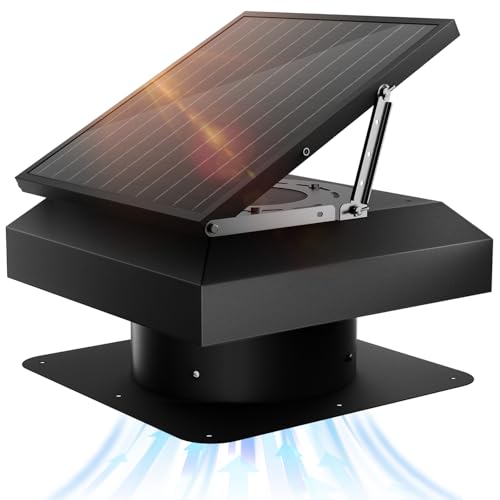
- Up to 2,000 CFM airflow
- Four speeds with thermostat control
- Solar and AC auto-switching
Best For: Large attics and utility spaces needing hybrid power
Best Quiet Solar Roof Fan

- Listed at 45 dB
- Up to 2,100 CFM with a brushless motor
- Built-in 75°F thermostat and AC adapter
Best For: Quiet solar-assisted ventilation for homes and outbuildings
Best Quiet Two-Speed Pick

- Up to 1,266 CFM on high
- Two speeds with adjustable thermostat
- 20-foot cord and fire safety shutoff
Best For: Attic cooling with flexible two-speed control
Best Efficient Standard Pick

- 1,000 CFM for attics up to 1,600 sq. ft.
- Thermostat controller included
- Galvanized steel construction
Best For: Standard hard-wired attic ventilation
Best Smart High-Airflow Pick

- Up to 1,922 CFM on high
- App control with thermostat and humidistat
- Two speeds and 20-foot power cord
Best For: High-airflow attic cooling with smart automation
Smart QuietCool Ventilation – Smart Roof-Mount Attic Fan
For shoppers comparing quiet roof ventilation fans, the QuietCool AFR SMT ES-2.0 combines three-speed operation, app control, and up to 1,950 CFM of airflow. Its brushless ECM motor, programmable controls, and plug-and-play power cord make it a flexible choice for attic ventilation.
Best For: Homeowners who want app-controlled attic ventilation with adjustable airflow.
Pros:
- Three speeds with up to 1,950 CFM of airflow
- Smart app control plus thermostat and humidistat functionality
- 20-foot power cord supports easier installation
- UV-resistant painted steel construction and built-in fire-safety shutoff
Cons:
- At 31 pounds, it is heavier than some alternatives
- Interchangeable roof flashings are sold separately
- Listed noise level is 50 dB, so it is not silent
This is the most feature-rich option in the group, especially for users who value remote control and automated operation. Confirm the required flashing and roof configuration before installation.
Sun-Powered Quiet Ventilation – 40W Solar Attic Fan
This solar model is a practical pick among quiet roof ventilation fans when you want to avoid household wiring. Its 40W panel powers up to 2,000 CFM, while the pre-connected, controller-free design starts at sunrise and shuts down at dusk.
Best For: DIY ventilation for attics, garages, sheds, greenhouses, or similar spaces with suitable sunlight.
Pros:
- Solar-powered operation requires no complex wiring
- Up to 2,000 CFM from a 12-inch metal-blade fan
- Weather-resistant IP65 design with hail-resistant metal housing
- Pre-connected components support plug-and-play setup
Cons:
- Operation depends on available sunlight
- No controller or adjustable settings are included
- At 25.4 pounds, roof installation may require extra handling
The solar design keeps operating costs and wiring demands low, but it offers less control than electric models. It is best suited to installations where daytime, sun-powered ventilation matches your needs.
High-Capacity Gable Ventilation – iLiving Automatic Attic Fan
The iLiving ventilator is a gable-mounted alternative to roof-mounted quiet roof ventilation fans. It provides 2,339 CFM, includes an adjustable built-in thermostat, and is designed to cool attic spaces up to 3,400 square feet.
Best For: Large attic spaces with a compatible gable opening and a preference for automatic thermostat control.
Pros:
- 2,339 CFM capacity for substantial air movement
- Adjustable built-in thermostat automates operation
- Galvanized steel housing includes mounting brackets
- ETL-listed design with a 14-inch steel propeller
Cons:
- Single-speed operation provides less airflow adjustment
- Listed noise level is 63 dB
- Requires hardwiring and gable-mount installation
With the highest stated airflow in this roundup, this fan favors capacity over quiet operation and flexibility. Check gable dimensions, wiring requirements, and acceptable sound levels before choosing it.
Durable Roof Ventilation – Master Flow 1500 CFM Attic Fan
The Master Flow ERV6BL is a straightforward electric roof-mount option for shoppers seeking quiet roof ventilation fans with thermostat control. It delivers up to 1,500 CFM, is rated for attics up to 2,800 square feet, and uses galvanized steel construction with a built-in screen.
Best For: Attics needing durable, thermostat-controlled roof ventilation for up to 2,800 square feet.
Pros:
- Up to 1,500 CFM of powered ventilation
- Thermostat controller supports automatic operation
- Galvanized steel construction is designed for durability
- Built-in screen helps protect the vent opening
Cons:
- Not compatible with tile roofing systems
- Installation uses hardwired electrical connections
- No adjustable speed specification is provided
This model keeps the feature set focused on roof-mounted ventilation and thermostat operation. It is a sensible fit for compatible roofing, but tile-roof owners should rule it out before comparing installation options.
Best Smart-Controlled Option – QuietCool Smart Roof Mount Attic Fan
For shoppers comparing quiet roof ventilation fans, this QuietCool model combines roof-mounted exhaust with app control and two-speed operation. Its listed 50 dB noise level, up to 1,266 CFM airflow, and built-in fire safety shutoff make it a practical choice for electrically powered attic ventilation.
Best For: Homeowners who want app-controlled attic cooling and adjustable operation from a standard AC outlet.
Pros:
- Smart app control supports automated fan operation.
- Two-speed PSC motor provides low- and high-speed settings.
- Delivers up to 1,266 CFM and includes a 20-foot power cord.
- One-piece metal construction has a UV-resistant paint coating.
Cons:
- Requires an AC electric outlet rather than solar power.
- Interchangeable roof flashings are sold separately.
- Its listed 50 dB noise level may not suit buyers seeking the quietest possible operation.
This is a strong fit when convenient app scheduling and two-speed control matter more than solar operation. Confirm that the available flashing matches your roof type before installation.
Best High-Airflow Solar Hybrid – 40W Solar Attic Fan With Thermostat
This solar hybrid fan stands out among quiet roof ventilation fans for its stated 2,000 CFM airflow, four-speed control, and solar-to-AC automatic switching. It is designed to ventilate spaces up to 2,500 square feet while providing thermostat-based operation and weather-resistant construction.
Best For: Attics, workshops, garages, and similar spaces where high airflow and solar-assisted continuous operation are priorities.
Pros:
- Provides up to 2,000 CFM of airflow for spaces up to 2,500 square feet.
- Four speed levels allow more control over ventilation performance.
- Automatically switches between solar and household power when the adapter is connected.
- Adjustable solar panel and thermostat settings support flexible installation and operation.
Cons:
- No battery backup is included.
- AC/DC adapter use is required for the performance mode and nighttime operation.
- The product details list wall mounting, so roof installation may require careful planning.
Choose this model if maximum listed airflow and flexible power options are more important than a simple plug-in setup. Its lack of battery backup means continuous overnight operation depends on the AC adapter.
Best Quiet Solar Roof Fan – OmniPV Solar Hybrid Attic Fan
With a listed 45 dB noise level, this OmniPV model is a compelling option for shoppers seeking quiet roof ventilation fans with solar operation. Its 40W panel, brushless DC motor, 2,100 CFM capacity, built-in 75°F thermostat, and included AC adapter support low-maintenance roof exhaust.
Best For: Homes, shops, garages, sheds, and other structures needing quiet, weather-resistant solar-assisted ventilation.
Pros:
- Listed 45 dB noise level supports quieter operation.
- Brushless motor delivers up to 2,100 CFM of airflow.
- Thermostat automatically turns the fan on above 75°F and off below that temperature.
- Includes a solar panel, AC adapter, flexible flashing, and mounting hardware.
Cons:
- Only one speed and one power level are listed.
- Thermostat threshold is preset at 75°F rather than adjustable.
- Solar performance depends on available sunlight.
This model balances strong airflow with the lowest listed noise level of the three products. Its single-speed design keeps operation simple, while the included AC adapter provides an alternative to relying only on sunlight.
Best Quiet Two-Speed Pick – QuietCool AFR PRO-1.3
For shoppers comparing quiet roof ventilation fans, the QuietCool AFR PRO-1.3 combines two-speed operation, adjustable thermostat control, and airflow up to 1,266 CFM. Its plug-and-play power cord may simplify installation where the roof setup and flashing are compatible.
Best For: Attic cooling with flexible two-speed control and straightforward corded installation.
Pros:
- Moves up to 1,266 CFM on high.
- Two-speed PSC motor can run as low as 75.5 watts on low.
- Includes an adjustable thermostat and 20-foot power cord.
- Built-in fire safety shutoff and UV-resistant painted finish.
Cons:
- Interchangeable flashings for multiple roof types are sold separately.
- Uses push-button control rather than app control.
The AFR PRO-1.3 is a practical middle-ground option for buyers who want adjustable operation and strong attic airflow without adding smart controls. Confirm the required flashing and roof-mount installation details before purchasing.
Best Efficient Standard Pick – Master Flow GAF PT6
The Master Flow GAF PT6 is a straightforward choice among quiet roof ventilation fans, offering 1,000 CFM of attic exhaust for spaces up to 1,600 square feet. Its thermostat controller and galvanized steel construction support a durable, conventional roof-vent setup.
Best For: Homeowners seeking standard hard-wired attic ventilation for larger attic spaces.
Pros:
- Provides airflow up to 1,000 CFM for attics up to 1,600 square feet.
- Uses up to 55% less electricity than typical competitors, according to the supplied product information.
- Includes a thermostat controller and heavy-duty internal screen.
- Galvanized steel construction with UL and regional approvals listed by the manufacturer.
Cons:
- Requires hard-wired installation rather than a plug-and-play cord.
- Not compatible with tile roofing systems.
- No noise rating or smart-control feature is specified in the supplied details.
This model suits buyers prioritizing conventional construction, thermostat-based operation, and broad attic coverage. Check roof compatibility and arrange appropriate electrical installation before choosing it.
Best Smart High-Airflow Pick – QuietCool AFR SMT PRO-2.0
For buyers who want quiet roof ventilation fans with connected controls, the QuietCool AFR SMT PRO-2.0 offers app operation, a thermostat, and a humidistat while delivering up to 1,922 CFM. Its two-speed design and 20-foot power cord add installation and operating flexibility.
Best For: Larger attic spaces where app control, automated operation, and high airflow are priorities.
Pros:
- Delivers up to 1,922 CFM on high.
- Smart app control supports automated fan operation.
- Includes thermostat and humidistat functions.
- Two speeds, a 20-foot cord, and built-in fire safety shutoff.
Cons:
- Its listed 50 dB noise level may not appeal to shoppers seeking the quietest possible operation.
- Interchangeable roof flashings are sold separately.
- Higher 265-watt rating may be more than needed for smaller attic spaces.
The AFR SMT PRO-2.0 is the strongest fit here for shoppers who value high airflow and smart automation. Its app-based controls and included power cord make it versatile, but verify that the roof installation and flashing requirements match your project.
How We Picked These Quiet Roof Ventilation Fans
We focused on roof and attic exhaust fans that prioritize practical noise control while still moving enough air for residential spaces. Our comparison considers advertised airflow, motor efficiency, thermostat or humidistat controls, power source, installation features, construction, and the convenience of smart or automatic operation.
Because published noise ratings and real-world installation conditions vary, treat silence claims as comparative rather than absolute. Roof structure, insulation, mounting, and duct or vent restrictions can all affect the sound you hear indoors.
Quick Comparison
| Fan type | Best for | Typical advantage | Potential trade-off |
|---|---|---|---|
| Smart electric roof fan | Precise, automated control | App access plus thermostat and humidistat settings | Requires electrical power and setup |
| Standard electric fan | Reliable everyday ventilation | Consistent output and straightforward controls | May need professional wiring |
| Solar fan | Low operating cost or off-grid installation | Uses sunlight and often avoids household power use | Output can vary with weather and installation angle |
| Hybrid solar fan | Year-round flexibility | Solar operation with AC backup | Usually costs more and has more components |
Key Buying Factors for Quiet Roof Ventilation Fans
Airflow and Attic Size
Compare CFM with your attic’s ventilation needs rather than choosing the largest number automatically. A high-output model may be useful for a large or especially hot attic, but balanced intake ventilation is essential. Soffit, ridge, or gable vents must provide enough replacement air; otherwise, the fan can underperform or pull conditioned air from the living space.
Noise, Speed, and Vibration
Look for two-speed operation, efficient motors, and solid mounting hardware. Lower speeds can reduce sound during mild weather, while vibration isolation and careful installation often matter as much as the motor’s published noise level.
Power and Controls
Solar models can reduce operating costs and simplify wiring, but they depend on available sunlight. Electric models provide predictable operation, while hybrid units offer a useful compromise. Thermostats automate heat-triggered ventilation; humidistats are valuable in damp climates. Smart controls add scheduling and remote monitoring but require a compatible network and app.
Installation and Durability
Confirm roof type, opening dimensions, power-cord length, and whether the fan includes a controller or thermostat. Galvanized steel and weather-resistant housings can improve durability, but proper flashing and sealing remain critical to prevent leaks.
Who Should Buy Which Quiet Roof Ventilation Fans?
- Choose a smart QuietCool model if you want app control, multiple operating speeds, and automatic temperature or humidity management.
- Choose a standard electric roof fan if dependable, consistent ventilation matters more than remote access.
- Choose a solar model for sunny locations, lower ongoing electricity use, or installations where running a new circuit is difficult.
- Choose a hybrid solar fan if you want solar savings but need AC-powered backup during cloudy periods or at night.
- Choose a higher-CFM unit for a larger attic only after confirming that intake vents and the roof structure can support the airflow.
Before buying, verify the manufacturer’s coverage guidance, local electrical requirements, roof warranty considerations, and whether professional installation is recommended. The quietest fan will not perform well if it is undersized, poorly sealed, or installed without adequate intake ventilation.