Choosing among heavy-duty well water filtration systems requires more than comparing filter stages. Well water can contain sediment, rust, iron, manganese, metals, odors, and microorganisms, so the right setup depends on your test results, flow needs, and maintenance plan.
This roundup compares 10 whole-house options, including multi-stage carbon systems, sediment prefilters, iron- and manganese-focused models, and UV purification. Use the guide below to match filtration performance with your household’s water quality and plumbing requirements.
Best 10 Heavy-Duty Well Water Filtration Systems Picks for 2026
Best Overall
PRO+AQUA Elite 3-Stage Filtration System

- Three-stage sediment, metals, and carbon filtration
- 15 GPM flow with 1-inch ports
- No electricity, backwashing, or regeneration required
Best For: Small to medium homes using well or city water
Best for Iron and Manganese
Express Water 3-Stage Deluxe System

- Targets iron and manganese impurities
- Stainless-steel freestanding frame
- 17 GPM flow and included pressure gauges
Best For: Homes with reddish-brown stains and iron- or manganese-related odors
Best for Monitoring

- Sediment, carbon, and GAC-plus-KDF stages
- 180-day timers and multiple pressure gauges
- Includes service valves, brush, and pipe adapters
Best For: Homeowners prioritizing straightforward filter maintenance
Best High-Flow UV Option

- Two UV lamps support 24 GPM flow
- Includes two extra replacement bulbs
- Stainless-steel chamber for well or city water
Best For: High-flow UV purification focused on whole-home water treatment
Iron-Focused Choice
iSpring WGB21BM Well Water Filter

- Two-stage carbon plus iron and manganese reduction
- Up to 15 GPM with 1-inch ports
- 50,000-gallon capacity; does not reduce TDS
Best For: Well homes dealing with iron and manganese
Longest Replacement Supply
3-Stage Well Water Filter System

- PP, GAC, and CTO three-stage filtration
- Includes nine filters for a stated 1.5–2 years
- Up to 15 GPM; does not reduce TDS
Best For: Families prioritizing included replacement filters
Balanced Whole-House Pick
- 5-micron sediment plus carbon block filtration
- Up to 50,000 gallons and 15 GPM
- Preassembled, no power needed, and does not reduce TDS
Best For: Homes needing general sediment and carbon filtration
Best Sediment Defense
Well Water Sediment & Rust Filter

- Reusable 30-micron pleated filter
- Reduces sediment, rust, sand, and scale
- High-flow 1-inch ports
Best For: Well-water sediment and rust control
Best Complete Cartridge Value
3-Stage 0.5-Micron Filter System

- 0.5-micron PP, GAC, and CTO stages
- Nine filters included in total
- 15 GPM flow with clear housings
Best For: Multi-stage well or city water filtration
Best Brass-Port Design
- 0.5-micron PP, GAC, and CTO filtration
- 15 GPM flow with 3/4-inch brass ports
- Two extra filter sets included
Best For: Whole-house filtration with convenient maintenance
Best Overall – PRO+AQUA Elite 3-Stage Filtration System
For households seeking heavy-duty well water filtration systems with broad contaminant coverage, the PRO+AQUA Elite Series combines sediment, specialty-media, and activated-carbon stages. Its 15 GPM flow rate, 1-inch ports, pressure gauges, and no-electricity design make it a practical whole-home option for small to medium households.
Best For: Small to medium homes with one to three bathrooms using well or city water.
Pros:
- Three stages target sediment, heavy metals, hydrogen sulfide odors, chlorine, VOCs, pesticides, and other chemicals.
- Clear sediment housing and stainless-steel pressure gauges simplify system monitoring.
- Requires no regeneration, backwashing, draining, or electricity.
- Includes a five-year manufacturer warranty and lifetime U.S. technical support.
Cons:
- Filters are recommended for replacement every six months.
- Professional installation is specified, which may add installation cost.
- Its 15 GPM maximum flow rate is lower than some high-flow systems.
The PRO+AQUA is a well-rounded choice when you want whole-home filtration across several contaminant categories without adding a powered or backwashing system. Its monitoring features and warranty support strengthen its long-term practicality.
Best for Iron and Manganese – Express Water 3-Stage Deluxe System
Among heavy-duty well water filtration systems, the Express Water Deluxe Series is particularly suited to homes dealing with iron and manganese-related staining, color, taste, or odor. Its freestanding stainless-steel frame, pressure gauges, and 17 GPM flow rate give it a durable, serviceable design for whole-house installation.
Best For: Well-water homes with reddish-brown stains, unpleasant taste or odor, and concerns about iron and manganese.
Pros:
- Designed specifically to significantly reduce iron and manganese impurities.
- Heavy-duty stainless-steel bracket and freestanding frame support a durable installation.
- Pressure-release buttons and gauges make filter changes and monitoring easier.
- 1-inch connections support up to 17 GPM at the specified pressure range.
Cons:
- Replacement timing varies with water quality and usage, with a six- to 12-month recommendation.
- The system is focused on cartridge filtration rather than a backwashing treatment process.
- Its 57-pound weight may make positioning and installation more demanding.
This system stands out for well water that leaves visible stains or has iron- and manganese-related odor issues. The included frame, gauges, and service controls make it a strong practical fit where durability and maintenance access matter.
Best for Monitoring – WF3 3-Stage Heavy-Duty Filter
The WF3 is one of the more maintenance-conscious heavy-duty well water filtration systems, pairing three 20-inch filters with multiple pressure gauges and built-in 180-day timers. Its sediment, carbon-block, and GAC-plus-KDF stages are designed to address suspended solids, odors, VOCs, chlorine, and several heavy metals.
Best For: Homeowners who want broad cartridge filtration with clear pressure and replacement reminders.
Pros:
- Three stages target sediment, bad taste and odor, VOCs, chlorine, and specified heavy metals.
- Multiple pressure gauges help identify clogging and plan cartridge replacement.
- Built-in 180-day timers, relief valves, drain valves, and a housing-cleaning brush support maintenance.
- Adapters allow conversion between 3/4-inch and 1-inch NPT connections.
Cons:
- The listed installation type is under-sink, despite the whole-house format, so installation compatibility should be verified.
- It has a 15 GPM maximum flow rate.
- Cartridge-based filtration requires regular replacement and housing cleaning.
The WF3 is appealing if you value reminders and service access as much as filtration coverage. Its included fittings and maintenance accessories can simplify upkeep, but confirm the intended installation location and plumbing arrangement before buying.
Best High-Flow UV Option – 110W Whole-House UV Purifier
For buyers comparing heavy-duty well water filtration systems with ultraviolet treatment, this 110W purifier emphasizes high flow rather than cartridge contaminant reduction. Two 55W lamps provide a stated 24 GPM capacity, while the stainless-steel chamber and included spare bulbs support extended use with well or city water.
Best For: High-flow whole-home UV purification where microbial treatment is the primary goal.
Pros:
- Two 55W UV lamps provide a stated 24 GPM flow rate.
- Includes two extra replacement bulbs for longer-term preparedness.
- Stainless-steel chamber is designed for corrosion resistance and durability.
- Can be used with whole-house, under-sink, RV, or compatible RO setups.
Cons:
- UV treatment is not described as reducing sediment, heavy metals, chlorine, VOCs, or other dissolved contaminants.
- It requires power for operation, unlike passive cartridge systems.
- The 3/4-inch MNPT connections may require adapters for some whole-home plumbing.
This is best viewed as a high-flow UV purifier rather than a complete sediment and chemical filtration system. For well water with broader contamination concerns, it may need to be paired with appropriate prefiltration; for UV-focused treatment, its flow capacity and extra bulbs are useful advantages.
Iron-Focused Choice – iSpring WGB21BM Well Water Filter
For households seeking heavy-duty well water filtration systems, the iSpring WGB21BM is a strong option when iron and manganese are key concerns. Its two-stage design combines a carbon block with a dedicated iron- and manganese-reducing filter, while maintaining a claimed flow rate of up to 15 GPM.
Best For: Homes with well water affected by iron, manganese, chlorine, odors, or VOC-related taste concerns.
Pros:
- Dedicated second-stage media targets iron and manganese.
- Carbon block helps reduce cloudiness, chlorine, bad tastes, odors, and certain VOCs.
- Preassembled bracket, included wrench, 1-inch ports, and up to 15 GPM flow simplify installation and maintenance.
- Filters can treat up to 50,000 gallons, with a stated life of up to one year.
Cons:
- Not intended as a complete solution for well or pond water with very high iron or manganese levels.
- Does not reduce TDS.
The WGB21BM stands out among heavy-duty well water filtration systems for its targeted iron and manganese treatment. Confirm your water-test results before buying, particularly if contamination levels are high or you need TDS reduction.
Longest Replacement Supply – 3-Stage Well Water Filter System
This three-stage system is a practical pick for shoppers comparing heavy-duty well water filtration systems with replacement costs in mind. It includes three complete sets of PP, GAC, and CTO cartridges, providing a stated 1.5–2 years of replacements for sediment, chlorine, and odor reduction.
Best For: Families wanting an all-in-one, non-TDS-reducing filter kit with a substantial supply of replacement cartridges.
Pros:
- Three-stage filtration addresses sediment, chlorine, odors, and other listed impurities.
- Nine included filters provide a stated 1.5–2 year supply.
- Built-in bypass and two shut-off valves can make filter changes more convenient.
- Rated flow reaches up to 15 GPM and the system fits standard 3/4-inch plumbing.
Cons:
- Filter life is listed at about six months per set, so maintenance remains necessary.
- Does not lower TDS or specifically target iron and manganese.
- Product details describe it as under-sink installation, so confirm the intended whole-house setup and plumbing compatibility.
Its included cartridge supply makes this system appealing for buyers who want fewer replacement purchases after installation. However, households with iron-specific well-water problems should look for a system designed and rated for those contaminants.
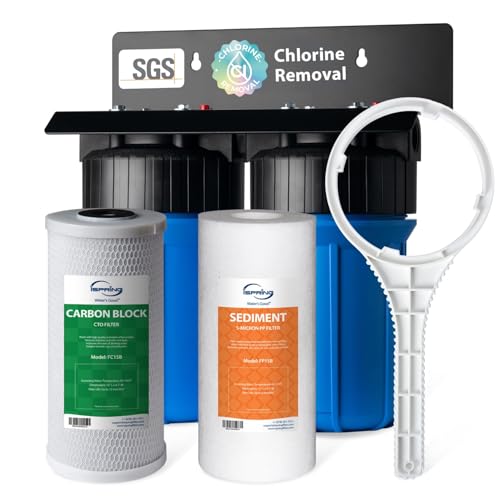
Balanced Whole-House Pick – iSpring WGB21B 2-Stage Filter
The iSpring WGB21B is a straightforward choice among heavy-duty well water filtration systems for homes that primarily need sediment and carbon filtration. Its two-stage setup uses a 5-micron polypropylene filter followed by a coconut-shell carbon block, with a stated capacity of up to 50,000 gallons.
Best For: Whole-house users seeking high-capacity sediment, chlorine, taste, and odor reduction without removing TDS.
Pros:
- 5-micron sediment stage captures dirt, sand, silt, dust, rust, and scale particles.
- Carbon block helps reduce chlorine, cloudiness, bad tastes, odors, and certain VOCs.
- 1-inch inlet and outlet ports support a claimed flow rate of up to 15 GPM.
- Preassembled mounting bracket, pressure-release valve, and included wrench support DIY filter changes.
Cons:
- Does not reduce TDS.
- Does not provide a dedicated iron- or manganese-reduction stage.
- Replacement filters are typically needed about once a year, depending on use and water quality.
Choose the WGB21B when sediment and general carbon filtration are your main goals and you want a high-capacity, no-power system. If testing shows elevated iron or manganese, the WGB21BM or another specialized treatment setup may be more appropriate.
Best Sediment Defense – Well Water Sediment & Rust Filter
For homeowners prioritizing sediment control, this heavy-duty well water filtration system uses a reusable 30-micron pleated filter to reduce dirt, sand, silt, rust, scale particles, and similar debris before it enters the home. Its clear housing also makes basic visual inspection easier.
Best For: Well-water users seeking high-flow sediment and rust filtration with a washable filter.
Pros:
- Reusable and washable 30-micron pleated filter helps reduce replacement needs.
- Targets sediment, dirt, sand, silt, rust, and scale particles.
- 1-inch inlet and outlet ports support a high-flow setup.
- Includes a wrench, bracket, filter, and built-in pressure-relief button.
Cons:
- Focused on sediment and particulate reduction rather than carbon-based taste or odor treatment.
- The filter requires periodic cleaning based on water conditions and usage.
This is a practical choice when visible sediment and rust are the main well-water concerns. The washable cartridge and included mounting hardware add convenience, while the 1-inch ports suit installations where maintaining flow is important.
Best Complete Cartridge Value – 3-Stage 0.5-Micron Filter System
This heavy-duty well water filtration system combines 0.5-micron PP sediment, GAC carbon, and CTO carbon-block cartridges to reduce sediment, rust, chlorine, odors, and unpleasant tastes. It includes three complete filter sets, making it a convenient option for households planning ahead for maintenance.
Best For: Small to medium households wanting multi-stage filtration, carbon treatment, and replacement cartridges included.
Pros:
- Three-stage filtration addresses particles, chlorine, odors, and taste.
- Includes nine filters—three complete replacement sets—for extended use.
- 15 GPM flow rate is designed to maintain pressure with multiple taps running.
- Clear housings allow visual monitoring of trapped debris.
Cons:
- Does not reduce TDS or remove healthy dissolved minerals.
- Listed with standard 3/4-inch connections, which may require adapters for other plumbing sizes.
- Actual cartridge life depends on water quality and household usage.
With sediment and two carbon stages, this system offers broader treatment than a particulate-only filter. The included cartridges and visual monitoring can simplify ownership, although buyers should confirm connection compatibility and understand that TDS remains unchanged.
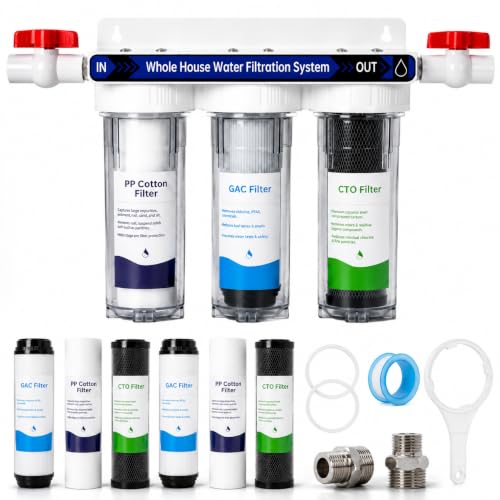
Best Brass-Port Design – 3-Stage 15 GPM Home Filter
Designed for city or well water, this heavy-duty well water filtration system uses a 0.5-micron PP sediment filter, GAC activated carbon, and CTO carbon block. The system reduces sediment, rust, chlorine, odors, and unpleasant tastes while supporting up to 15 GPM through reinforced 3/4-inch NPT brass ports.
Best For: Small to medium households needing whole-house filtration with brass ports, shutoff valves, and extra filter sets.
Pros:
- Three filtration stages combine fine sediment, carbon, and carbon-block treatment.
- 15 GPM capacity is intended to help maintain flow across multiple fixtures.
- Includes two extra filter sets, for nine cartridges total.
- Clear housings, shutoff valves, wrench, connectors, and plumber’s tape support maintenance and installation.
Cons:
- Does not reduce TDS or remove dissolved minerals.
- Filter life varies with water quality, usage, and local conditions.
- Uses 3/4-inch NPT ports, so plumbing compatibility should be checked before purchase.
This model is a well-rounded option for buyers who want particulate and carbon filtration in one system. Its brass ports, isolation valves, and included replacement sets make routine servicing more manageable, provided the 3/4-inch plumbing format fits the installation.
How We Picked These Heavy-Duty Well Water Filtration Systems
We focused on whole-house systems designed for well-water challenges rather than point-of-use drinking-water filters. The selection represents several useful treatment approaches: sediment removal, carbon filtration, iron and manganese reduction, heavy-metal reduction, washable prefilters, and ultraviolet disinfection. We also considered advertised flow rates, port sizes, filter availability, pressure monitoring, included replacement supplies, and whether a system is intended for well water, city water, or both.
Specifications can vary by installation and water chemistry. Before buying, confirm the manufacturer’s performance claims against an independent well-water test.
Quick Comparison
- Best for broad three-stage treatment: Choose a system combining sediment, carbon, and a specialized media filter.
- Best for iron and manganese: Look for models specifically rated for those contaminants instead of relying on standard carbon alone.
- Best for microbial concerns: Add or select a UV purifier, preferably after sediment and carbon prefiltration.
- Best for heavy sediment: Prioritize a washable or pleated sediment filter that can handle frequent loading.
- Best for lower maintenance costs: Compare replacement-filter prices, included extras, and expected service intervals.
Key Buying Factors for Heavy-Duty Well Water Filtration Systems
Test the Water First
A laboratory test should guide the purchase. Check for iron, manganese, hardness, pH, sulfur odor, arsenic, lead, nitrates, bacteria, and turbidity. A filter marketed for one contaminant may not address another, and severe iron, hardness, or sulfur problems may require dedicated treatment equipment.
Match Flow Rate and Connections
Compare the system’s rated gallons per minute with simultaneous shower, laundry, appliance, and irrigation demand. Undersized systems can reduce pressure. Also verify 3/4-inch or 1-inch port compatibility, available installation space, housing clearance, and whether pressure gauges or bypass valves are included.
Understand Filter Stages
Sediment filters protect downstream media, carbon improves chlorine and odor performance, and specialized media may target iron, manganese, or metals. A UV stage addresses microorganisms but does not remove sediment or dissolved chemicals; it needs clear water and regular lamp replacement to work properly.
Plan for Maintenance
Check how often cartridges, UV bulbs, or washable elements must be serviced. Choose transparent housings only when they are rated for your installation, and install shutoff and bypass valves where practical. Keep replacement parts readily available before the first change is due.
Who Should Buy Which Heavy-Duty Well Water Filtration Systems?
Choose a three-stage system with iron and manganese media if rusty staining or metallic taste is confirmed. Select a sediment-focused setup if your main problem is sand, grit, or cloudy water. For tested microbial contamination, pair prefiltration with a properly sized UV purifier. If lead, arsenic, or other heavy metals are present, use a system specifically certified or documented for that contaminant rather than assuming a generic cartridge will provide adequate reduction.
Homeowners with modest demand may prefer a compact two-stage system, while larger households should favor higher flow ratings and larger housings. If your well has changing or severe water chemistry, consult a licensed water-treatment professional before relying on a standard cartridge system.