A well-sealed studio door helps control sound leakage, drafts, temperature swings, and unwanted light. The right seal depends on your door’s gap size, frame design, traffic level, and whether you need a removable or permanent installation.
We’ve selected 10 heavy-duty options, including kerf-style weatherstripping, aluminum door sweeps, adhesive rubber seals, silicone strips, and garage-style bottom seals, so you can match the product to your studio setup.
Best 10 Heavy-Duty Studio Door Seals Picks for 2026
All-Season Perimeter Seal
Extreme Temperature Door Weatherstrip

- Three-piece top-and-side door seal kit
- Helps block drafts, noise, dust, and pests
- Made for year-round weatherproofing
Best For: Standard doors needing full perimeter coverage
Large-Gap Kerf Seal
40-Foot Exterior Kerf Weather Stripping

- Fits closed-door gaps from 3/8 to 5/8 inch
- Presses into compatible kerf grooves
- Helps reduce drafts, dust, light, and noise
Best For: Exterior kerf frames with oversized gaps
Heavy-Duty Bottom Barrier

- Seals bottom gaps up to 1 3/8 inches
- Flexible rubber/vinyl seal on aluminum frame
- Suitable for residential and commercial doors
Best For: Doors needing a durable threshold seal
Sound-Reducing Kerf Barrier
Large-Gap Door Seal for Grooved Frames

- Covers gaps from about 3/10 to 7/8 inch
- 60 feet of foam-backed weatherstripping
- Helps reduce noise, water, dust, and light
Best For: Grooved studio doors needing large-gap coverage
Best Overall Door Perimeter Seal
Aluminum Vinyl-Covered Foam Kit

- Three-piece top-and-side door seal set
- Closes gaps up to 3/4 inch
- Adjustable screw-on aluminum retainers
Best For: Studio, exterior, or interior door jambs
Best Flexible Bottom Seal

- 17-foot trim-to-fit rubber seal
- Dual-layer U-shaped sealing design
- Fits 5/16-inch double T-track systems
Best For: Compatible garage-style studio door bottoms
Best Long-Length Perimeter Option
Heavy-Duty TPE Top and Side Seal
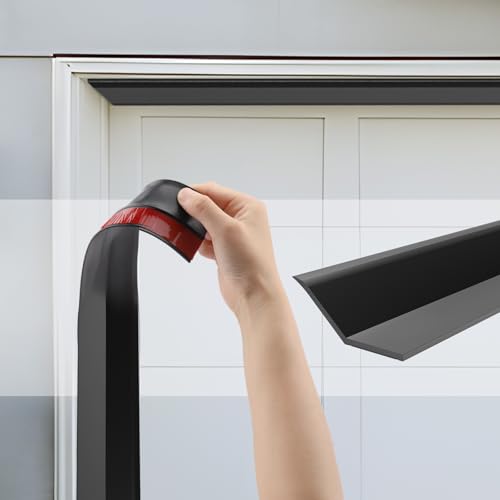
- 36 feet of top-and-side seal material
- Weather-resistant TPE construction
- Peel-and-stick setup with nails included
Best For: Large garage-style door perimeters
Wide Silicone Coverage

- 3-inch width covers gaps up to 1.5 inches
- Flexible silicone resists weathering and aging
- 20-foot roll for doors, windows, and sliding panels
Best For: Wide door and window gaps, including glass and sliding doors
Large-Gap Rubber Protection
Extra-Thick D-Shaped Door Seal

- 15 mm profile suits 4-to-9 mm gaps
- 40-foot roll covers multiple frames
- Flexible rubber resists cold, heat, and aging
Best For: Large door-frame gaps requiring a thick rubber profile
All-Season Perimeter Seal – Extreme Temperature Door Weatherstrip
For heavy-duty studio door seals that address more than ordinary drafts, this three-piece weatherstrip set creates a perimeter barrier against heat, cold, air leaks, dust, pests, and some outside noise. Its aluminum, rubber, and vinyl construction is suited to year-round weatherproofing.
Best For: Standard doors needing top-and-side coverage for seasonal drafts and air leakage.
Pros:
- Includes one 36-inch top piece and two 84-inch side pieces.
- Designed for hot and cold temperature protection.
- Helps reduce drafts, energy loss, dust, pollen, pests, and outside noise.
- Installs quickly without special tools.
Cons:
- Brown finish may not suit every studio door.
- Designed for standard-door perimeter coverage rather than oversized openings.
This is a practical all-around choice when a studio door needs coverage along the top and both sides. Buyers should confirm the included lengths and door dimensions before ordering.
Large-Gap Kerf Seal – 40-Foot Exterior Kerf Weather Stripping
This kerf-style option is a strong fit for heavy-duty studio door seals when the closed door leaves a 3/8- to 5/8-inch gap. The press-in PVC-and-foam strip is made for exterior door frames with pre-cut kerf grooves and helps reduce drafts, light, dust, energy loss, and some outside noise.
Best For: Kerf-groove exterior door frames with larger perimeter gaps.
Pros:
- Enlarged profile fits 3/8- to 5/8-inch gaps.
- Provides 40 feet of weatherstripping for broad coverage.
- Flexible PE-clad foam supports compression and rebound.
- Press-in installation requires no adhesive.
Cons:
- Only intended for frames with pre-cut kerf slots.
- Not designed for flat frames or door bottoms.
- Requires measuring and testing to ensure the door still closes and latches.
Its large-gap profile makes it worth considering for a studio door with a compatible kerf frame. Verify the groove and gap measurements first, since this is not a universal adhesive seal.
Heavy-Duty Bottom Barrier – Randall Aluminum Door Sweep
When the main leak is beneath the door, this heavy-duty aluminum sweep provides a focused solution for studio door seals. Its thick vinyl/rubber bottom seal covers gaps up to 1 3/8 inches and helps limit drafts, debris, moisture, light, and pests.
Best For: Interior or exterior residential and commercial doors with a substantial bottom gap.
Pros:
- Covers bottom gaps up to 1 3/8 inches.
- Flexible seal conforms to the threshold.
- Helps block drafts, dust, dirt, moisture, light, and pests.
- Includes screws and is made in the USA.
Cons:
- At 36 inches, it may require modification for wider doors.
- Addresses the door bottom rather than the full perimeter.
- Requires screw installation on the lower door face.
This sweep is a sensible complement or standalone fix when sound, climate, or pest intrusion is concentrated at the threshold. Measure door width and bottom clearance before installation.
Sound-Reducing Kerf Barrier – Large-Gap Door Seal for Grooved Frames
For studios prioritizing broad gap coverage and noise reduction, this notched weatherstrip combines a PE outer layer with high-density PU foam. It is designed for door frames with grooves and helps address wind, dust, water, light, and noise around larger gaps.
Best For: Grooved door frames with 1/8-inch slots and gaps from about 3/10 to 7/8 inch.
Pros:
- Provides 60 feet of material for doors of various sizes.
- Designed to reduce noise, light, wind, dust, and water intrusion.
- Fits larger gaps from approximately 3/10 to 7/8 inch.
- Includes four foam gaskets for cushioning or fit adjustment.
Cons:
- Requires a compatible grooved frame and 1/8-inch groove.
- Measurements should be confirmed before purchase.
- Not presented as an adhesive seal for flat frames.
The extended 60-foot length and large-gap range make this a flexible choice for compatible studio doors. Its kerf-only design means frame compatibility is the key buying consideration.
Best Overall Door Perimeter Seal – Aluminum Vinyl-Covered Foam Kit
For heavy-duty studio door seals around the top and sides of an entry or interior door, this three-piece aluminum-and-foam kit offers adjustable coverage. Its compression seal is designed to close gaps up to 3/4 inch while helping limit drafts, dust, and outside air.
Best For: Studio, exterior, or interior doors that need an adjustable perimeter seal around the jamb and header.
Pros:
- Complete set includes two 84-inch side pieces and one 36-inch top piece.
- Seals gaps up to 3/4 inch and conforms to slightly uneven frames.
- Slotted aluminum retainers allow contact to be adjusted during installation.
- Includes matching screws and uses durable, vinyl-covered foam.
Cons:
- Designed for the door perimeter, not the bottom threshold.
- Installation requires screw mounting and frame adjustment.
- The brown finish may not suit every studio door.
This is the most directly applicable option for a studio door that needs a sturdy top-and-side seal. Its adjustable aluminum holders make it a practical choice when the frame is not perfectly uniform.
Best Flexible Bottom Seal – EPDM Garage Door Seal
This EPDM rubber seal is a heavy-duty studio door seal alternative for blocking air, dust, rain, and debris beneath a compatible garage-style door. Its 17-foot length can be trimmed for a custom fit, while the dual-layer U-shaped design creates two sealing barriers.
Best For: Garage-style studio doors with a compatible 5/16-inch double T-track bottom channel.
Pros:
- High-density EPDM remains flexible from -40°F to 240°F.
- U-shaped O-ring construction provides dual protection against air and moisture.
- 17-foot roll can be measured, trimmed, and installed as needed.
- End plugs help seal the center channel and prevent shifting.
Cons:
- Metal tracks are not included.
- Fits a specific 5/16-inch double T-end track profile.
- It seals the door bottom rather than the top and sides.
Choose this option when the studio door has the required track system and the main problem is an under-door gap. Its temperature-resistant EPDM construction is suited to demanding indoor or outdoor conditions.
Best Long-Length Perimeter Option – Heavy-Duty TPE Top and Side Seal
For large garage-style studio doors, this 36-foot TPE strip provides long-length coverage across the top and sides. The weather-resistant material is intended to reduce drafts, dust, moisture, and insects, with peel-and-stick installation plus included nails for reinforcement.
Best For: Large top-and-side garage door gaps where extended coverage and straightforward DIY installation are priorities.
Pros:
- Provides 36 feet of perimeter seal material.
- Heavy-duty TPE is designed to withstand rain, snow, dust, and temperature extremes.
- Peel-and-stick installation is supplemented by included nails.
- Includes caps, nails, and an instruction manual.
Cons:
- Intended for top and side perimeters, not the door bottom.
- Adhesive installation depends on a properly prepared mounting surface.
- The 2.2-inch-wide strip may require measuring and cutting for the specific frame.
This is a useful choice when a studio or garage door needs extensive perimeter coverage and a relatively simple installation method. The included nails offer a secondary fastening option for a more secure fit.
Wide Silicone Coverage – 3-Inch Silicone Door Seal
For heavy-duty studio door seals where broad coverage matters, this 3-inch silicone strip is designed for side and bottom gaps up to 1.5 inches. Its flexible, 0.08-inch-thick construction helps block drafts, dust, water, and some noise around doors and windows.
Best For: Frameless sliding doors, glass doors, wooden doors, and other wide gaps where a flexible silicone seal is suitable.
Pros:
- Wide 3-inch profile fits gaps up to 1.5 inches.
- Flexible silicone resists hot and cold weather, corrosion, and aging.
- Adheres to surfaces including glass, metal, wood, tile, marble, and plastic.
- 20-foot roll can be cut to the needed length.
Cons:
- Requires a clean, flat, dry surface for best adhesion.
- May need a hair dryer in winter to warm the adhesive surface.
- Measure carefully because its wide profile is intended for larger gaps.
This is a practical choice when a studio door needs broad, flexible coverage rather than a narrow frame seal. Its silicone material and multi-surface adhesive make it versatile for doors, windows, and sliding panels.
Large-Gap Rubber Protection – Extra-Thick D-Shaped Door Seal
For heavy-duty studio door seals around oversized frame gaps, this extra-thick D-shaped rubber strip is sized for openings from 4 to 9 mm. The 40-foot roll provides substantial coverage, while the flexible rubber construction is designed to handle temperature changes without becoming brittle.
Best For: Large gaps around door frames, exterior doors, windows, cabinets, and other applications needing a thick compression-style seal.
Pros:
- Extra-thick 15 mm profile is intended for larger gaps.
- 40 feet of material covers multiple doors or frames.
- Rubber construction offers flexibility, resilience, temperature resistance, and aging resistance.
- Self-adhesive backing can be cut to size for installation.
Cons:
- Only suitable for gaps within the stated 4-to-9 mm range.
- Requires a clean, dry surface and ideally adhesion promoter for best results.
- Needs about 24 hours after installation to become firmly set.
Among these heavy-duty studio door seals, this is the better fit when the gap is genuinely large and a thick D-profile is needed. Measure the frame first, since the substantial 15 mm thickness is not intended for narrow clearances.
Long-Run Frame Sealing – 50-Foot D-Shape Rubber Strip
This 50-foot rubber strip is a useful option for heavy-duty studio door seals when you need extended frame coverage for moderate gaps. Its 6 mm D-shaped profile fits gaps from 2.5 to 5.5 mm, and the included scissors simplify cutting sections to length.
Best For: Door and window frames with moderate gaps, especially projects requiring several long runs of weather stripping.
Pros:
- 50-foot length supports multiple door or window installations.
- D-shaped rubber profile fits 2.5-to-5.5 mm gaps.
- Self-adhesive backing supports straightforward installation after surface preparation.
- Included tailor scissors help cut the strip to size.
Cons:
- Not designed for gaps larger than 5.5 mm.
- Adhesive needs a clean, dry surface and about 24 hours to set firmly.
- Its 6 mm thickness may not suit very narrow clearances.
This model balances long-run coverage with a slimmer profile than the extra-thick alternative. It is a sensible pick for studios sealing several standard-to-moderate frame gaps, provided the measurements fall within its specified range.
How We Picked These Heavy-Duty Studio Door Seals
We focused on products suited to demanding door-sealing jobs rather than lightweight interior draft stoppers. The selection covers common studio needs: large or uneven gaps, sound and temperature control, durable threshold contact, and sealing along the top, sides, or bottom of a door.
We also considered installation method, material, coverage length, adjustability, and compatibility with residential, commercial, and garage-style doors. Because door dimensions vary, verify measurements and mounting requirements before buying.
Quick Comparison
| Seal Type | Best For | Key Advantage |
|---|---|---|
| Kerf weatherstripping | Doors with compatible kerf channels | Secure, clean installation |
| Aluminum door sweep | Heavy traffic and bottom gaps | Rigid, durable mounting |
| Adhesive D-shaped rubber | Quick frame sealing | Easy installation and flexible coverage |
| Silicone strip | Irregular side or bottom gaps | Soft, conforming contact |
| Garage-style bottom seal | Wide thresholds and oversized doors | Long lengths and broad coverage |
Key Buying Factors for Heavy-Duty Studio Door Seals
Measure the Gap First
Measure the gap at several points with the door closed. Choose a seal that compresses enough to close the opening without making the door difficult to latch. Oversized seals can drag, while undersized products may leave sound and air paths open.
Match the Installation Style
Kerf seals fit doors or frames with a dedicated groove. Adhesive-backed strips work best on clean, smooth, dry surfaces and may require careful surface preparation. Screwed or aluminum sweeps generally offer better long-term security on high-use doors.
Choose the Right Material
EPDM rubber and TPE are useful for outdoor exposure and temperature changes. Silicone remains flexible across a broad temperature range. Vinyl-covered foam can provide cushioning, but it may be less suitable for severe abrasion or frequent dragging.
Consider Sound, Light, and Threshold Clearance
Weatherstripping can reduce air movement and high-frequency noise, but it is not a substitute for acoustic construction. For recording rooms, seal the entire perimeter and check that the bottom seal does not interfere with the threshold, hinges, or door sweep.
Who Should Buy Which Heavy-Duty Studio Door Seals?
- For a purpose-built studio or commercial door: Choose a kerf system or heavy-duty aluminum sweep when the frame supports a secure mechanical installation.
- For large perimeter gaps: Look for long kerf kits or thick D-shaped rubber seals that can cover wider openings.
- For fast, low-cost installation: Adhesive silicone or rubber strips are practical when the frame is smooth and the door receives moderate use.
- For garage-style or oversized doors: A dedicated EPDM or TPE bottom seal is better suited to broad thresholds and exterior exposure.
- For maximum durability: Favor mechanically fastened products and replaceable contact sections over thin, permanently bonded foam.
Before installation, clean the mounting surface, cut each piece accurately, and test the latch after fitting. A consistent, gentle compression around the perimeter usually provides a better balance of sealing performance and everyday usability.