Cleaning tall, oversized, or hard-to-reach windows is time-consuming and potentially risky. The latest window-cleaning robots use suction, spray systems, sensors, and automated path planning to handle much of the work for you.
This roundup compares 10 energy-efficient window cleaning robots, focusing on practical performance factors such as power use, coverage, safety backups, water management, and ease of operation.
Best 10 Energy-Efficient Window Cleaning Robots Picks for 2026
Compact Convenience
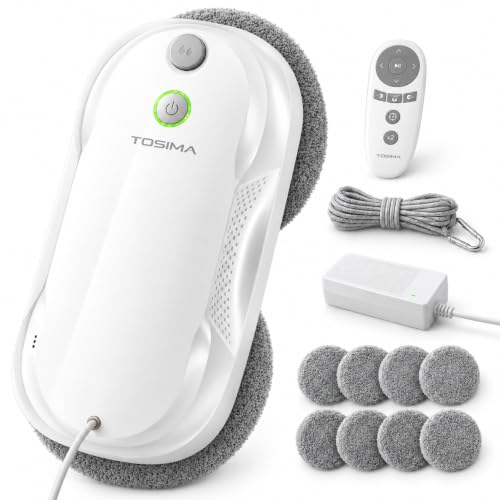
- Compact design suits apartments and smaller homes
- Adaptive suction reaches up to 6400Pa
- Triple safety system with 25-minute backup power
Best For: Small-space glass cleaning with remote control and added safety
Spray-Control Value

- Four-nozzle spray system distributes moisture evenly
- Six cleaning modes with remote control
- Includes extra mops, nozzles, and maintenance tools
Best For: Adjustable spray coverage and flexible cleaning routes on smooth glass
High-Window Coverage

- Round body targets broad surface coverage
- Variable suction reaches 6400Pa
- Supports windows, mirrors, skylights, and tile walls
Best For: High windows and homes with multiple smooth surfaces to clean
Best High-Coverage Pick
WISEBOT AI Window Cleaning Robot

- AI navigation with spot-cleaning mode
- Triple spray and 200 ml water tank
- Square body for improved edge coverage
Best For: Large, tall, balcony, and exterior glass surfaces
Best Overall Safety Features
Curalk 6400Pa Window Cleaning Robot

- 6400Pa variable-frequency suction
- Backup battery and 178-inch safety rope
- Dual spray with edge and corner detection
Best For: High or hard-to-reach windows needing added safety
Best Budget-Friendly Controls
BSD16 AI Window Cleaning Robot

- AI 5.0 path planning with edge detection
- Dual spray and double-helix cleaning heads
- Remote with three automatic modes
Best For: Indoor windows, mirrors, and doors needing simple remote control
Compact Convenience – Tosima W5
The Tosima W5 is a practical choice among energy-efficient window cleaning robots for apartments, condos, and smaller homes. Its compact design, adaptive suction, dual spray system, and automatic navigation help simplify routine glass cleaning without bulky equipment or ladders.
Best For: Smaller homes and users who want compact, remote-controlled cleaning with multiple safety features.
Pros:
- Compact, lightweight design is easy to handle and store.
- Adaptive suction reaches up to 6400Pa and adjusts to the surface.
- Triple safety system includes edge detection, a safety rope, and up to 25 minutes of backup power.
- Replaceable spray components can make maintenance easier.
Cons:
- Its 6-inch cleaning path may require more passes on larger windows.
- Designed primarily for smooth glass surfaces.
The W5 balances a small footprint with strong suction and straightforward controls. It is especially appealing when storage space is limited and safety during elevated window cleaning is a priority.
Edge-Cleaning Specialist – ECOVACS WINBOT MINI 2
The ECOVACS WINBOT MINI 2 stands out among energy-efficient window cleaning robots for narrow or hard-to-reach glass. Its compact body, ultrasonic mist, edge-focused brushes, and app-controlled cleaning modes are suited to windows, mirrors, doors, and floor-to-ceiling glass.
Best For: Narrow windows and users who want close edge coverage with app-based control.
Pros:
- Compact dimensions help it access tight glass areas.
- Four corner brushes and thin side wings reach within 1 mm of edges.
- Ultrasonic atomization helps limit over-wetting.
- Offers five cleaning modes and up to 8000Pa suction.
Cons:
- For heavily soiled glass, multiple cycles or pad cleaning may be necessary.
- Requires anchoring the safety rope before use.
- App control may be less convenient for shoppers who prefer a physical remote.
With organized WIN-SLAM 4.0 routes and dedicated Edge Clean mode, the MINI 2 is a strong fit for routine maintenance where corner touch-ups are a common frustration.
Spray-Control Value – Tosima WA9C Pro
The Tosima WA9C Pro is one of the more flexible energy-efficient window cleaning robots for shoppers who want adjustable spray coverage and remote operation. Its four-nozzle system, six cleaning modes, and safety monitoring support routine cleaning across smooth glass windows, mirrors, and glass doors.
Best For: Users who want multiple route options, adjustable spray volume, and a comprehensive accessory kit.
Pros:
- Four precision nozzles distribute moisture across the glass.
- Six cleaning modes include N-shape, Z-shape, and manual operation.
- Air-pressure monitoring, a drop sensor, and up to 25 minutes of backup power add protection.
- Includes four mops, replacement nozzles, an unclogging kit, and a water bottle.
Cons:
- Its listed suction range of 2600–3200Pa is lower than some alternatives.
- The 6-pound weight may make handling less convenient.
- The safety rope must be anchored for overhead work.
The WA9C Pro is a sensible option when spray control and hands-on route selection matter more than maximum suction. Its included maintenance accessories also help support ongoing use.
High-Window Coverage – X6 Window Cleaning Robot
The X6 is designed for shoppers comparing energy-efficient window cleaning robots for high windows and mixed smooth surfaces. Its round body, variable 6400Pa suction, dual spray, edge detection, and smart navigation support cleaning on windows, mirrors, skylights, and tile walls.
Best For: High or hard-to-reach windows and homes with glass, mirrors, skylights, and tile surfaces.
Pros:
- Round design is claimed to cover 95% of the surface area and reduce blind spots.
- Variable 6400Pa suction adjusts to help maintain grip.
- UPS backup keeps the unit attached for up to 30 minutes during a power cut.
- Works on glass, mirrors, skylights, and tile walls.
Cons:
- Heavily soiled glass may need two cleaning passes.
- Results depend on using an appropriate amount of water and replacing dirty pads.
- It uses a corded electric power source during operation.
The X6 combines broad surface compatibility with high suction and a slim round form. It is a practical match for regular maintenance of elevated or varied smooth surfaces, provided the included safety cable is used.
Best High-Coverage Pick – WISEBOT AI Window Cleaning Robot
For shoppers comparing energy-efficient window cleaning robots, the WISEBOT stands out with AI route planning, triple-spray wet cleaning, and a 200 ml tank designed for larger glass surfaces. Its square form and edge-cleaning mode also target corners more effectively than typical round designs.
Best For: Large, tall, balcony, or exterior windows where broader coverage and reduced ladder use matter.
Pros:
- AI navigation includes edge detection, frameless-glass detection, obstacle recognition, and spot cleaning.
- Triple-spray system and 200 ml tank support wider wet-cleaning coverage.
- Square design, corner pads, and dedicated edge mode improve edge and corner access.
- Safety rope, anti-fall sensors, power-failure alarm, and UPS backup provide layered protection.
Cons:
- The feature-rich design may be more than needed for quick, light-duty cleaning.
- Wet cleaning requires filling and maintaining the water tank and microfiber cloth.
WISEBOT is a strong choice when coverage and navigation flexibility take priority. Its spray system, spot-cleaning function, and square edge design make it particularly suitable for demanding glass-cleaning jobs.
Best Visible-Tank Option – Tosima X1 Window Cleaning Robot
The Tosima X1 is a practical option among energy-efficient window cleaning robots, using dual-nozzle ultrasonic water atomization to apply water in the direction of travel. Its visible 85 ml tank, automatic S-shaped path, and remote control keep everyday cleaning straightforward.
Best For: Indoor glass cleaning on large or small windows, including overhead sunroom windows.
Pros:
- Dual nozzles atomize water in the direction of travel to help reduce smearing.
- Viewing window makes the remaining 85 ml of water easy to monitor.
- Automatic S-shaped cleaning works on windows from 30 × 30 cm, with manual remote adjustments.
- Backup battery keeps the robot attached for about 25 minutes during a power outage.
Cons:
- Its 85 ml tank is smaller than the 200 ml tank listed for some competing models.
- The supplied specifications identify indoor usage, so it may be less suited to exterior cleaning.
The X1 focuses on convenient everyday operation rather than extensive automation. The visible tank and flexible remote control are useful for users who want clear status monitoring and hands-on direction changes.
Best Compact Pick – ECOVACS WINBOT MINI
For routine upkeep, the ECOVACS WINBOT MINI is a compact choice among energy-efficient window cleaning robots. Its lightweight design, app control, dual ultrasonic spray nozzles, and three cleaning modes make it convenient for apartments, narrow windows, and frequent touch-ups.
Best For: Indoor maintenance cleaning, small windows, narrow glass areas, and first-time robot users.
Pros:
- Compact, lightweight body is easy to handle for everyday cleaning.
- Dual ultrasonic spray nozzles support wet cleaning of dust, fingerprints, and light stains.
- App control, intelligent path planning, and three cleaning modes offer flexible operation.
- Strong suction, anti-slipping technology, and a 9-stage protection system support stable use.
Cons:
- Designed primarily for light dirt and dust; heavily soiled glass may need repeated cycles.
- The supplied usage details specify indoor cleaning.
- App control requires a compatible smartphone.
WINBOT MINI is best viewed as a convenient maintenance cleaner rather than a heavy-duty restoration tool. Its small footprint and simple setup make it appealing for frequent indoor touch-ups where quiet operation is important.
Best Overall Safety Features – Curalk 6400Pa Window Cleaning Robot
For shoppers comparing energy-efficient window cleaning robots, the Curalk model combines variable-frequency suction with automated spraying and intelligent navigation. Its backup battery, safety rope, and edge detection make it a practical option for indoor or outdoor glass, while multiple cleaning modes help handle everyday dust, water stains, and grime.
Best For: High or hard-to-reach windows where extra fall protection and flexible cleaning modes matter.
Pros:
- 6400Pa variable-frequency suction adapts to different dirt levels and glass surfaces.
- Triple safety system includes backup battery, air-pressure anti-drop protection, and a 178-inch safety rope.
- Dual-direction spray, edge and corner detection, and three cleaning modes support streak-free results.
- Includes 10 replacement microfiber mop pads.
Cons:
- The manufacturer advises pre-moistening pads and applying solution to the glass rather than pouring it into the machine.
- Its listed tank capacity varies between the title and notes, so buyers should confirm the exact capacity.
With strong suction and extensive safety equipment, this is a well-rounded choice for users prioritizing secure cleaning on elevated or exterior glass. Its preparation requirements are worth noting before use.
Best Premium Station Design – ECOVACS WINBOT W2 PRO Omni
The ECOVACS WINBOT W2 PRO Omni stands out among energy-efficient window cleaning robots for its dual power system and multifunction station. It can run on battery power for up to 110 minutes or operate while plugged in, making it suitable for both smaller areas without outlets and larger glass surfaces near a socket.
Best For: Users who want flexible battery or corded operation, organized storage, and advanced navigation.
Pros:
- Battery mode provides up to 110 minutes of cleaning, equivalent to 55 square meters according to the supplied notes.
- Plugged-in operation supports continuous cleaning and reduces repeated full discharges.
- Six-in-one multifunction station serves as a control panel, charger, stabilizer, and portable storage solution.
- Three-nozzle spraying, WIN-SLAM 4.0 path planning, and 12-stage protection support efficient operation.
Cons:
- The supplied specifications list indoor usage, so outdoor applications should be confirmed before purchase.
- The multifunction station and larger overall system may require more storage space than a basic robot.
This is the most feature-rich option in the group for shoppers who value flexible power management and a dedicated station. Its long battery runtime and intelligent path planning are especially useful across varied indoor window sizes.
Best Budget-Friendly Controls – BSD16 AI Window Cleaning Robot
For buyers seeking energy-efficient window cleaning robots with straightforward controls, the BSD16 pairs AI 5.0 path planning with dual spray and an infrared remote. It is designed for windows, mirrors, and doors, using edge detection and microfiber pads to address dust, fingerprints, smudges, and general glass buildup.
Best For: Indoor glass cleaning when remote control and selectable cleaning modes are priorities.
Pros:
- AI 5.0 path planning and edge detection help the robot navigate frames and obstacles.
- Dual water nozzles and double-helix cleaning heads support deeper cleaning.
- Infrared remote offers three automatic modes plus manual control.
- Triple safety system includes 3000Pa suction, UPS power storage, and a high-strength safety rope.
Cons:
- Its 3000Pa suction is lower than the 6400Pa model in this roundup.
- The supplied details specify indoor usage, so exterior or high-rise use should be verified.
- The listed 50ml capacity is smaller than the tank capacities stated for the other featured models.
The BSD16 is a practical pick for routine indoor glass care, especially if you prefer remote-operated cleaning modes. Its safety backup and navigation features add reassurance, though its smaller capacity and lower suction may make it less suited to demanding jobs.
How We Picked the Best Energy-Efficient Window Cleaning Robots
We evaluated these models by looking beyond maximum suction claims. Efficient window-cleaning robots should balance cleaning power with sensible water use, reliable navigation, safe operation, and manageable setup. We considered spray design, cleaning modes, edge and corner coverage, cord or battery convenience, noise, visible water capacity, and protection against drops or loss of suction.
Because window surfaces vary, we also favored products with adaptable suction and path planning rather than models that depend on constant manual repositioning. Always confirm that a robot is compatible with your glass type, frame design, and minimum window dimensions before buying.
Quick Comparison
| What to Compare | Best For | Why It Matters |
|---|---|---|
| Adaptive suction | Large or varied glass surfaces | Maintains contact while avoiding unnecessary power use |
| Water atomization or multi-nozzle spray | Efficient cleaning | Distributes moisture evenly and can reduce waste |
| Edge-cleaning design | Framed windows and corners | Helps reduce untreated borders |
| Safety backups | Exterior or high windows | Limits risk if power or suction is interrupted |
| Portable station or battery support | Frequent cleaning | Simplifies charging, storage, or operation between windows |
Key Buying Factors for Energy-Efficient Window Cleaning Robots
Power and Efficiency
Higher suction is not automatically better. Look for adaptive control that maintains a seal without running at maximum output continuously. Check whether the robot requires a wall connection, includes backup power, or supports charging while working.
Spray and Water Management
Dual or multi-nozzle systems can cover glass more evenly, while ultrasonic atomization may use a fine mist instead of soaking the surface. A visible tank makes refilling easier, but larger tanks can add weight. Use the recommended solution and avoid overspray near frames, seals, or electronics.
Navigation and Coverage
AI-assisted path planning, multiple cleaning modes, and sensors can improve consistency. Edge detection is especially useful on framed windows, although no robot should be expected to eliminate every missed corner. Measure your windows and check the product’s minimum and maximum supported dimensions.
Safety Features
For exterior glass, prioritize a tether, emergency battery, suction-loss alerts, automatic return behavior, and clear status indicators. These features matter more than a small difference in stated suction pressure.
Who Should Buy Which Energy-Efficient Window Cleaning Robots?
Choose a compact model if you have smaller panes, limited storage, or want easier handling. Larger homes with broad glass areas may benefit from a high-capacity tank, longer operating range, or a portable multifunction station. Buyers focused on corners should prioritize edge-cleaning hardware and square navigation. If you clean infrequently, a straightforward dual-spray model may offer better value than advanced automation. For high exterior windows, select the model with the strongest safety system and the clearest operating instructions, then supervise every cleaning cycle.