Commercial-grade kerosene heaters deliver the high heat output needed for drafty warehouses, construction sites, workshops, garages, and agricultural buildings. The right model can warm a large work area quickly while remaining portable enough to reposition as needed.
This roundup compares 10 forced-air kerosene heaters across several output classes, from compact 125,000-BTU units to heavy-duty models rated at 400,000 BTU. Use the buying guide below to match heat output, fuel capacity, controls, portability, and job-site demands.
Best 10 Commercial-Grade Kerosene Heaters Picks for 2026
Warehouse Heat Powerhouse
Remington 140,000 BTU Kerosene Heater

- 140,000 BTUs for spaces up to 3,500 square feet
- Multi-fuel operation with thermostat and fuel gauge
- Five-point safety system and steel construction
Best For: Large warehouses, garages, barns, and workshops
Diagnostic-Ready Workhorse
Dura Heat DFA135C 135K BTU Heater

- 135,000 BTUs for coverage up to 2,900 square feet
- Digital temperature display and diagnostics
- Wheels, lift handles, and multi-fuel capability
Best For: Construction sites, workshops, garages, and warehouses
Rugged Jobsite Specialist
LB White Tradesman K125 Heater
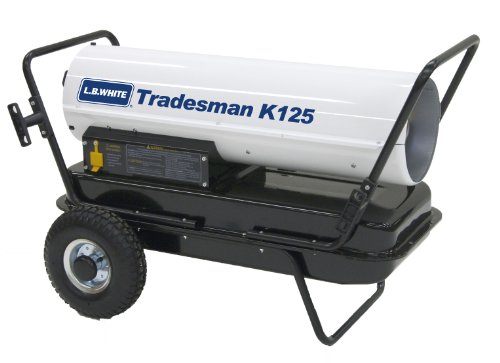
- 125,000 BTUs for directional forced-air heat
- Dual-prong ignition and heavy-duty enclosed motor
- LCD diagnostics, fuel gauge, and brass fittings
Best For: Construction, industrial, shop, and garage heating
Maximum Output Option

- 215,000 BTUs with listed coverage up to 13,996 square feet
- 13.5-gallon tank supports up to eight hours of heat
- Thermostat, wheels, and multiple safety protections
Best For: Large, well-ventilated warehouses, sites, barns, and workshops
Heavy-Duty Site Heater
DEWALT 215,000 BTU Forced Air Kerosene Heater

- 215,000 BTU forced-air output
- Designed for well-ventilated work areas
- One-year warranty included
Best For: Construction sites, barns, warehouses, and workshops
Extended-Run Commercial Heater
ROVSUN 200K Portable Kerosene Heater

- 200,000 BTU output with 637 CFM airflow
- 13.2-gallon tank supports 8+ hours of runtime
- Thermostat, wheels, and safety shutoffs included
Best For: Large open workspaces and extended jobsite heating
Versatile Mid-Size Heater
Reddy Heater 135,000 BTU Forced Air Heater

- Heats up to 3,200 square feet
- Multi-fuel compatible with electronic diagnostics
- Wheels, thermostat, and safety protection included
Best For: Garages, workshops, and medium-sized worksites
Best Flexible-Fuel Pick
VEVOR 175,000 BTU Forced-Air Heater

- 175,000 BTUs for spaces up to 36,021 cubic feet
- 13.2-gallon tank with up to 9.5 hours of runtime
- Uses kerosene or diesel and includes thermostat control
Best For: Large workshops, barns, warehouses, and construction areas
Best Mid-Range Commercial Option

- 180,000–220,000 BTUs for areas up to 5,300 square feet
- Supports kerosene, diesel, fuel oils, JP8, and other listed fuels
- Electronic thermostat, overheat protection, wheels, and lift handles
Best For: Construction sites, workshops, garages, and warehouses
Best for Extra-Large Spaces

- 400,000 BTUs for areas up to 8,500 square feet
- 29-gallon tank with listed runtime up to 9.5 hours
- Commercial-grade build with pneumatic wheels and safety shutoffs
Best For: Large warehouses, construction sites, workshops, and outdoor work areas
Warehouse Heat Powerhouse – Remington 140,000 BTU Kerosene Heater
For buyers comparing commercial-grade kerosene heaters, the Remington REM-140T-KFA-B delivers 140,000 BTUs and is rated to heat spaces up to 3,500 square feet. It runs on several approved fuels, including K-1 kerosene and diesel, and includes practical controls for jobsite use.
Best For: Warehouses, construction areas, garages, barns, workshops, and other large spaces needing portable forced-air heat.
Pros:
- Heats up to 3,500 square feet with 140,000 BTUs.
- Supports K-1 kerosene, diesel, JP8/Jet A, and fuel oil.
- Includes a thermostat, air-pressure gauge, fuel gauge, and electric ignition.
- Five-point safety system includes high-temperature shutoff and flameout protection.
Cons:
- Its large pedestal design may be less convenient in tight spaces.
- Requires an approved power source and regular maintenance.
With steel construction, lift handles, and a 10-hour runtime claim on a full tank, this Remington is a strong option when dependable, high-output heat matters more than compact size.
Diagnostic-Ready Workhorse – Dura Heat DFA135C 135K BTU Heater
The Dura Heat DFA135C is a commercial-grade kerosene heater with 135,000 BTUs, a large fuel tank, and coverage listed at up to 2,900 square feet. Its digital temperature display and diagnostics make it a practical choice for users who want straightforward monitoring in demanding work areas.
Best For: Construction sites, workshops, garages, warehouses, and other indoor or outdoor workspaces.
Pros:
- 135,000 BTU output covers up to 2,900 square feet.
- Multi-fuel capable with kerosene, diesel, fuel oil, JP-8, and Jet-A compatibility.
- LED digital temperature indicator and diagnostics simplify monitoring.
- Lift handles, flat-free tires, and a large fuel tank support portability and runtime.
Cons:
- At 59.5 pounds, it is substantial to move manually.
- Its manufacturer warranty is limited to defects.
The piggyback power plug, thermostat, wheels, and portable cabinet design give this Dura Heat a useful balance of jobsite mobility and operating convenience.
Rugged Jobsite Specialist – LB White Tradesman K125 Heater
Among commercial-grade kerosene heaters, the L.B. White Tradesman K125 stands out for heavy-duty components and serviceability. Its 125,000 BTU forced-air output, dual-prong electronic ignition, LCD display, and fuel gauge are designed for demanding construction and industrial applications.
Best For: Construction sites, shops, industrial areas, garages, and outdoor workspaces requiring directional heat.
Pros:
- 125,000 BTUs provide strong directional forced-air heat.
- Runs on kerosene, No. 1 diesel, and No. 1 fuel oil.
- Dual-prong electronic ignition supports reliable startups.
- LCD temperature/error display and fuel gauge help with monitoring and troubleshooting.
Cons:
- Fuel compatibility is narrower than some multi-fuel models.
- The product information identifies it as gas-powered despite its kerosene fuel designation.
- Its torpedo form is better suited to work areas than finished living spaces.
Brass fuel fittings, an enclosed motor, and a one-year warranty make the K125 a compelling pick for buyers prioritizing rugged construction and straightforward field service.
Maximum Output Option – GarveeTech 215,000 BTU Heater
The GarveeTech ZB215 is the highest-output option in this commercial-grade kerosene heaters roundup, producing 215,000 BTUs and listing coverage up to 13,996 square feet. Its 13.5-gallon tank, thermostat, wheels, and safety systems are aimed at large, well-ventilated work environments.
Best For: Construction sites, warehouses, workshops, barns, and other large, well-ventilated areas.
Pros:
- 215,000 BTUs provide the strongest output in this selection.
- 13.5-gallon tank offers up to eight hours of continuous heat according to the supplied specifications.
- Supports K-1 kerosene, No. 1 diesel, and No. 2 diesel.
- Includes thermostat control, overheating shutdown, flameout protection, and safety guards.
Cons:
- Its large size may be excessive for smaller garages or workshops.
- The unit is intended for outdoor use and well-ventilated environments.
- Fuel consumption is listed at 1.62 gallons per hour.
Choose the ZB215 when maximum heat and long tank capacity are the priority. Its steel construction and wheeled design help offset its large footprint, while K-1 kerosene is recommended for optimal performance.
Heavy-Duty Site Heater – DEWALT 215,000 BTU Forced Air Kerosene Heater
For buyers comparing commercial-grade kerosene heaters, this DEWALT model emphasizes high-output forced-air heating for demanding, well-ventilated work environments. Its 215,000 BTU output and heavy-duty design make it suited to large open areas where fast heat matters.
Best For: Well-ventilated construction sites, barns, warehouses, and workshops.
Pros:
- Powerful 215,000 BTU heat output.
- Forced-air heating is designed for rapid heat distribution.
- Backed by a one-year warranty from the date of purchase.
Cons:
- Its 68.8-pound weight and large footprint may limit portability.
- Best suited to well-ventilated areas rather than enclosed spaces.
This is a straightforward choice when maximum heating capacity is more important than compact size. The forced-air format and heavy-duty construction fit commercial work areas, provided ventilation requirements can be met.
Extended-Run Commercial Heater – ROVSUN 200K Portable Kerosene Heater
Among commercial-grade kerosene heaters, the ROVSUN 200K stands out for its adjustable thermostat, large fuel tank, and multi-fuel compatibility. It delivers 200,000 BTU of forced-air heat with a 637 CFM outlet airstream for large, open, or poorly insulated spaces.
Best For: Warehouses, construction sites, barns, farms, workshops, multi-car garages, and other large open areas.
Pros:
- 200,000 BTU output and 637 CFM airflow provide fast heating.
- 13.2-gallon tank offers up to eight-plus hours of runtime under normal conditions.
- Includes a 40–110°F thermostat, LED display, overheat protection, and flame-out protection.
- Wheel kit, support feet, and handle frame improve site-to-site portability.
Cons:
- Designed for outdoor use and large ventilated spaces, not typical enclosed rooms.
- Its 44.1-inch width and heavy-gauge construction may be cumbersome in tight areas.
- Only one fuel type should be used at a time.
The ROVSUN is a strong option for users who need sustained, controllable heat and easier mobility across a jobsite. Its long runtime and safety controls add practical value for extended commercial use.
Versatile Mid-Size Heater – Reddy Heater 135,000 BTU Forced Air Heater
This Reddy Heater offers a practical balance of capacity, portability, and controls for buyers seeking commercial-grade kerosene heaters. Its 135,000 BTU forced-air output is rated to heat up to 3,200 square feet, while the 500 CFM airflow helps spread heat quickly.
Best For: Garages, workshops, construction sites, warehouses, and other spaces up to 3,200 square feet.
Pros:
- 135,000 BTU output and 500 CFM airflow provide fast heat coverage.
- Runs on kerosene, #1 or #2 fuel oil, diesel, or jet fuel.
- Electronic start, LED diagnostics, fuel gauge, and built-in thermostat simplify operation.
- Wheels, handles, and frame support portability.
Cons:
- Lower heat output than the 200,000- and 215,000-BTU models in this roundup.
- Its 10-gallon tank is smaller than the ROVSUN’s 13.2-gallon tank.
- Coverage is specified at up to 3,200 square feet, so larger spaces may require more capacity.
The Reddy Heater is a sensible middle-ground choice for users who want commercial features without stepping up to the largest output class. Its multi-fuel design and diagnostic display are particularly useful for flexible garage and jobsite heating.
Best Flexible-Fuel Pick – VEVOR 175,000 BTU Forced-Air Heater
For buyers comparing commercial-grade kerosene heaters for workshops, barns, warehouses, and job sites, the VEVOR delivers 175,000 BTUs and coverage up to 36,021 cubic feet. Its thermostat, large tank, and support for kerosene or diesel make it a practical choice for extended heating in demanding spaces.
Best For: Large workshops, construction areas, barns, warehouses, and other spaces needing portable, thermostatically controlled heat.
Pros:
- 175,000 BTU output with listed coverage up to 36,021 cubic feet.
- 13.2-gallon tank provides up to 9.5 hours of runtime under stated conditions.
- Supports kerosene and diesel, with a thermostat, fuel gauge, and overheat protection.
Cons:
- Fuel consumption is listed at 1.3 gallons per hour under normal conditions.
- At 49.2 pounds, it is portable but not especially lightweight.
- Although listed for indoor and outdoor use, it is a fuel-burning forced-air heater that requires appropriate ventilation and operation practices.
The VEVOR stands out when fuel flexibility and longer intervals between refills matter. Its thermostat and safety shutoff features add convenience, while the high output suits sizable work areas.
Best Mid-Range Commercial Option – Reddy Heater 220,000 BTU
The Reddy Heater RFA220CV-2 is a strong option among commercial-grade kerosene heaters for construction sites, garages, workshops, and warehouses. Its 180,000-to-220,000-BTU output is designed to heat up to 5,300 square feet, while multiple fuel options provide operational flexibility.
Best For: Contractors and shop owners who need high-output portable heat, broad fuel compatibility, and straightforward job-site mobility.
Pros:
- Adjustable 180,000-to-220,000-BTU output for areas up to 5,300 square feet.
- Compatible with K-1 kerosene, diesel, fuel oils, JP8, and other listed fuels.
- Includes an electronic thermostat, overheat protection, wheels, and lift handles.
Cons:
- The 58.3-pound cabinet design may be cumbersome for frequent solo handling.
- Its listed use is focused on garages, workshops, construction sites, warehouses, and similar areas rather than small rooms.
- Fuel compatibility should be checked against the manufacturer’s operating requirements before use.
With a 13-gallon tank, up to 10 hours of stated runtime, and a two-year manufacturing-defect warranty, this Reddy model balances substantial output with useful portability. It is well suited to users who value fuel flexibility and commercial-grade construction.
Best for Extra-Large Spaces – Reddy Heater 400,000 BTU
For the largest spaces in a commercial-grade kerosene heater roundup, the Reddy Heater RFA400T2 offers 400,000 BTUs and listed coverage up to 8,500 square feet. Its high-velocity forced-air design, 29-gallon tank, and heavy-duty wheels target demanding construction, warehouse, workshop, and outdoor heating applications.
Best For: Large warehouses, construction sites, workshops, garages, and outdoor work areas requiring maximum listed heat output.
Pros:
- 400,000 BTUs with stated heating coverage up to 8,500 square feet.
- 29-gallon tank offers a listed runtime of up to 9.5 hours.
- Commercial-grade cabinet includes 13-inch pneumatic wheels, lift handles, thermostat, flame-out shutoff, and overheat protection.
Cons:
- At 165 pounds, it is substantially heavier than the other listed models.
- Its 32-by-57-by-32.9-inch footprint requires considerable storage and operating space.
- The high-output design is likely excessive for smaller garages or limited work areas.
This Reddy model is designed for buyers who need the highest capacity in this group rather than compact portability. Its large tank and safety controls support extended operation, while the pneumatic wheels help reposition the otherwise heavy unit.
How We Picked the Best Commercial-Grade Kerosene Heaters
We focused on forced-air heaters designed for demanding spaces rather than residential room heating. The selected models cover a broad range of output levels, including approximately 125,000 to 400,000 BTU, so shoppers can compare options for workshops, garages, barns, warehouses, and larger construction areas.
We also considered practical job-site features such as thermostat controls, tank capacity, wheels, handles, portability, fuel flexibility, and the reputation of the product line. Because performance depends on building conditions, fuel quality, ventilation, and ambient temperature, BTU ratings should be treated as a starting point rather than a guarantee of coverage.
Quick Comparison
- 125,000–140,000 BTU: Suitable for smaller workshops, garages, enclosed construction areas, and moderate supplemental heating.
- 175,000–220,000 BTU: A versatile range for larger shops, barns, warehouses, and cold-weather job sites.
- 400,000 BTU: Intended for very large, open, or especially drafty commercial and industrial spaces.
- Thermostat models: Better for maintaining a target temperature instead of running continuously at full output.
- Large-tank models: Useful when longer operating intervals and fewer refills matter more than minimum weight.
Key Buying Factors for Commercial-Grade Kerosene Heaters
Heat Output and Space Conditions
Choose output based on square footage, ceiling height, insulation, outdoor temperature, and air leakage. An oversized heater may cycle frequently or waste fuel, while an undersized model may run continuously without reaching a comfortable temperature.
Fuel Type and Runtime
Check the manual for approved fuels before buying. Many models support kerosene and diesel, while some also accept No. 1 or No. 2 fuel oil. Fuel capacity affects runtime, but actual consumption rises with higher heat settings and colder conditions.
Portability and Job-Site Design
Wheels and a sturdy handle make a major difference when moving a heater across concrete, gravel, or unfinished floors. Consider total weight, cord length, clearance requirements, and whether the unit will be transported frequently.
Safety and Ventilation
Forced-air kerosene heaters generally produce combustion exhaust and require proper ventilation. Follow the manufacturer’s clearance, fuel-storage, startup, shutdown, and indoor-use instructions. Never use one in an occupied area unless the specific model and location are approved for that application, and always install required carbon-monoxide protection.
Who Should Buy Which Commercial-Grade Kerosene Heaters?
For smaller commercial spaces: Choose a 125,000- to 140,000-BTU model for workshops, garages, and moderately sized work areas.
For general job-site use: A 175,000- to 220,000-BTU heater offers a strong balance of coverage, portability, and heating power for larger or draftier spaces.
For very large buildings: Consider a 400,000-BTU unit when the area is expansive, poorly insulated, or frequently exposed to cold air. Confirm that the electrical supply, ventilation, fuel logistics, and required clearances can support the heater safely.