When electricity is unavailable or expensive, the right kerosene heater can provide dependable heat for a room, garage, workshop, or emergency kit without relying on a power outlet.
This roundup compares 10 budget kerosene heaters across compact wick models, high-output convection heaters, forced-air units, and versatile heater-stove designs. Focus on ventilation, fuel handling, room size, and safety features before choosing.
Best 10 Budget Kerosene Heaters Picks for 2026
Compact Pick

- 10,000 BTU output for smaller spaces
- Up to 14 hours from a 1.2-gallon tank
- Push-button start and multiple safety features
Best For: Portable heating in rooms and spaces up to about 400 square feet
Large-Room Value

- 23,000 BTU convection heating
- Listed coverage up to 1,000 square feet
- Tip-over protection and cool-touch design
Best For: Larger indoor rooms, garages, and home offices
Long-Burn Portable

- 10,500 BTUs for up to 450 square feet
- Up to 15 hours on a 1.1-gallon tank
- Lightweight design with UL-listed safety system
Best For: Portable room heating and emergency preparedness
High-Output Garage Heater

- 50,000 BTUs for up to 1,250 square feet
- Up to 11 hours from a 4-gallon tank
- Forced-air design with automatic safety shut-off
Best For: Large garages and outdoor-oriented work areas
Best High-Output Pick
Sengoku 23,500 BTU Portable Heater

- 23,500 BTU output for large heating zones
- Up to 12 hours per 1.9-gallon fill
- Cordless ignition and multiple safety features
Best For: Garages, basements, and larger hard-to-heat spaces
Best Small-Space Value
Kero World 10,000 BTU Wick Heater

- Radiant heat for spaces up to about 450 square feet
- Up to 14 hours on one tankful
- Battery ignition and no electricity required
Best For: Small rooms and emergency backup heating
Best Camping Combo
Portable 9,000 BTU Heater and Stove

- 2-in-1 heater and stove design
- 15–17 hours of stated runtime
- Compact, adjustable, and easy to carry
Best For: Camping and small emergency heating areas
Best Budget Pick
9,000 BTU Portable Kerosene Heater

- 8,000-10,000 BTU adjustable output
- 15-21-hour claimed runtime
- Includes cooking surface and accessories
Best For: Affordable emergency and multipurpose heating
Best Long-Run Option
Garvee 9,000 BTU Heater and Stove

- Up to 20 hours of claimed runtime
- 360-degree surrounding heat
- Automatic shutoff and cooking grate
Best For: Extended heating for small spaces and outdoor use
Best Higher-Output Value
10,000 BTU Kerosene Heater and Stove
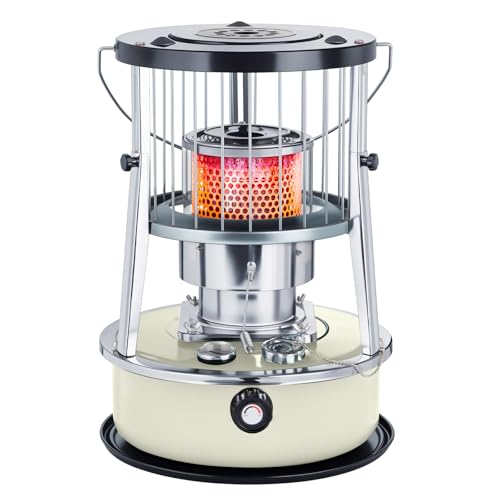
- 9,000-10,000 BTU output
- Up to 20 hours of claimed runtime
- Stated coverage up to 500 square feet
Best For: Higher-output home and emergency heating
Compact Pick – Sengoku HeatMate 110
For shoppers comparing budget kerosene heaters, the Sengoku HeatMate 110 offers a compact 10,000-BTU option for smaller spaces. Its 1.2-gallon tank can provide up to 14 hours of heat, while push-button ignition and built-in safety features simplify operation.
Best For: Bedrooms, home offices, garages, camping, patios, and other spaces up to about 380–400 square feet.
Pros:
- Up to 14 hours of runtime from a 1.2-gallon tank
- Portable design with push-button start and no electricity required
- Automatic shut-off, tip-over switch, safety grills, and flame adjustment
Cons:
- Its 10,000-BTU output is intended for smaller areas than high-output models
- Listed as an indoor-use model despite notes mentioning outdoor applications
The HeatMate 110 is a practical budget choice when portability and long burn time matter more than maximum heating capacity.
Large-Room Value – Dyna-Glo RMC-95C6B
The Dyna-Glo RMC-95C6B stands out among budget kerosene heaters for its 23,000-BTU convection output and stated coverage of up to 1,000 square feet. Its floor-mounted design includes tip-over protection and a cool-touch exterior design.
Best For: Larger indoor rooms, garages, home offices, and other areas needing more coverage than compact heaters provide.
Pros:
- 23,000 BTUs with listed coverage up to 1,000 square feet
- Convection heating distributes warmth throughout the space
- Tip-over protection and cool-touch design
Cons:
- Its boxy, floor-mounted form may take more space than compact pedestal models
- The supplied notes do not specify tank capacity or burn time
Choose this Dyna-Glo when broader coverage is the priority and you prefer a convection heater for indoor garage or home use.
Long-Burn Portable – Kero World KW-12
The Kero World KW-12 is a lightweight option for shoppers seeking budget kerosene heaters with a straightforward portable design. It produces 10,500 BTUs, heats up to 450 square feet, and can run for up to 15 hours on a 1.1-gallon tank.
Best For: Smaller homes, bedrooms, garages, workshops, and emergency backup heating where portability and extended runtime are useful.
Pros:
- Up to 15 hours of operation on a 1.1-gallon tank
- Lightweight 12-pound compact design
- Radiant and convective heat with a Sure Seat Chimney System and UL listing
Cons:
- 10,500 BTUs is suited to smaller spaces rather than large rooms
- The supplied notes do not provide a detailed automatic shut-off feature list
With its low weight and long stated burn time, the KW-12 is a sensible pick for portable warmth and power-outage preparedness.
High-Output Garage Heater – Mr. Heater MH50KR
For shoppers who need substantially more output than typical budget kerosene heaters, the Mr. Heater MH50KR delivers 50,000 BTUs with forced-air circulation. It is rated for up to 1,250 square feet and uses a 4-gallon tank for up to 11 hours of heat.
Best For: Large garages and outdoor-oriented work areas where high-output forced-air heating and portability are important.
Pros:
- 50,000-BTU output with listed coverage up to 1,250 square feet
- 4-gallon tank provides up to 11 hours of operation
- Overheat and no-flame safety sensors with automatic shut-off
- Accepts kerosene, JP8, diesel, and listed fuel oils
Cons:
- Requires a grounded 115-volt outlet, so it is not cordless
- Listed for outdoor use and may be oversized for small rooms
- Forced-air operation can be less quiet than convection heating
This model makes the most sense when fast, high-volume heat for a large garage matters more than silent operation or cordless convenience.
Best High-Output Pick – Sengoku 23,500 BTU Portable Heater
For shoppers comparing budget kerosene heaters, the Sengoku CV-23K stands out when you need substantial heat and portable placement. Its 23,500-BTU output is designed for heating zones of up to about 900 square feet, while the cordless design works during outages or in spaces without convenient electricity.
Best For: Garages, basements, poorly insulated rooms, and outdoor work areas that need high-output heating.
Pros:
- 23,500 BTU output with coverage listed up to 900–1,000 square feet.
- 1.9-gallon tank provides up to 12 hours of operation.
- Push-to-start ignition, automatic fuel shut-off, tip-over switch, and protective grills.
- Includes a siphon pump and two D batteries.
Cons:
- Its 18.5-by-18.5-inch footprint may require more floor space than compact models.
- At 22 pounds, it is portable but not especially lightweight.
The Sengoku is a practical value choice when heating capacity matters more than compact size. Its long runtime and safety-oriented features make it especially useful for emergency heating and hard-to-heat utility spaces.
Best Small-Space Value – Kero World 10,000 BTU Wick Heater
The Kero World KW-11G is a straightforward option among budget kerosene heaters for smaller rooms and backup heating. Its 10,000-BTU radiant output is rated for roughly 420–450 square feet, and it operates without electricity using battery ignition and a pin-type wick system.
Best For: Small homes, offices, workshops, basements, and emergency heating during power outages.
Pros:
- Radiant heat is designed for spaces up to about 420–450 square feet.
- Runs up to 14 hours on a full tank.
- Portable operation does not require household electricity.
- Includes shut-off and tip-over safety features.
Cons:
- Its 10,000-BTU output is better suited to smaller spaces than large rooms.
- The listed coverage is lower than that of higher-output convection models.
Choose this Kero World model if you prioritize extended runtime and simple radiant heating over maximum coverage. It also offers useful emergency versatility by providing heat and light during outages.
Best Camping Combo – Portable 9,000 BTU Heater and Stove
For buyers seeking budget kerosene heaters with outdoor flexibility, this 2-in-1 model combines a 9,000-BTU heater with a stove function. Its compact design, carrying handle, adjustable height, and non-electric operation suit camping, small garages, and emergency situations where portability is a priority.
Best For: Camping, compact outdoor areas, small garages, and emergency heating or cooking needs.
Pros:
- Combines heating and stove functionality in one portable unit.
- 1.22-gallon tank is rated for 15–17 hours of operation.
- Compact 12.4-inch footprint with a carrying handle and adjustable height.
- Protective mesh cover, stable base, fuel gauge, and adjustable control knob.
Cons:
- Its 9,000-BTU output is intended for smaller areas of roughly 108–161 square feet.
- Fuel is not included.
- The product’s combined heater-and-stove design may be less suitable when you only need room heating.
This model is most compelling for shoppers who value portability and dual-purpose use. The long stated runtime and compact footprint make it convenient for camping or backup use, while its lower output limits it to relatively small spaces.
Best Budget Pick – 9,000 BTU Portable Kerosene Heater
If you want budget kerosene heaters for everyday backup heating, this 9,000-BTU model combines portable, electricity-free operation with a useful cooking surface. Its claimed 150-350-square-foot coverage and 15-21-hour runtime make it practical for smaller rooms, garages, and emergency use.
Best For: Buyers seeking an affordable, versatile heater for rooms, garages, camping, or power outages.
Pros:
- Adjustable 8,000-10,000 BTU output for flexible heating.
- 1.35-gallon tank provides a claimed 15-21 hours of runtime.
- Includes a funnel, siphon pump, gloves, storage bag, and extra wicks.
- Top can be used to heat food or boil water.
Cons:
- Coverage claims vary from 150-350 square feet depending on conditions.
- At 13 by 13 by 18 inches and 5.44 kg, it still requires dedicated floor space.
This is a strong value choice when portability, emergency readiness, and multipurpose use matter more than highly precise room-size matching. The included accessories also reduce the need for immediate add-on purchases.
Best Long-Run Option – Garvee 9,000 BTU Heater and Stove
Among budget kerosene heaters, the Garvee 9,000-BTU model stands out for its large tank and long claimed runtime. It delivers 360-degree heat distribution for spaces of about 140-160 square feet and can also support cookware on its top grate.
Best For: Campers, workshop users, and households prioritizing extended runtime in a compact heater.
Pros:
- Large 5.5-liter tank offers up to 20 hours of claimed runtime.
- 360-degree heat distribution is designed to warm the surrounding area.
- Adjustable flame control, fuel gauge, safety guard, and automatic shutoff are included features.
- Top grate supports Dutch ovens, kettles, and frying pans.
Cons:
- Listed coverage is narrower than some competing models at 140-160 square feet.
- At 18.9 pounds, it is less lightweight than the smallest options.
The Garvee is a practical pick when fewer refills are the priority. Its more defined room-size guidance may also help shoppers avoid expecting it to heat an oversized space.
Best Higher-Output Value – 10,000 BTU Kerosene Heater and Stove
This 10,000-BTU model is a compelling option for shoppers comparing budget kerosene heaters with broader stated coverage. It is designed for 200-500 square feet, runs without electricity, and offers up to 20 hours of heat from its 1.4-gallon tank.
Best For: Buyers who want higher output and broad stated coverage for home, garage, RV, or outdoor backup use.
Pros:
- 9,000-10,000 BTU output is suited to larger stated coverage than the smaller model.
- 1.4-gallon tank provides up to 20 hours of claimed heat.
- Adjustable height, safety net, and anti-tip base support controlled operation.
- Flat top can heat food or boil water, and accessories include a pump, funnel, gloves, and extra wicks.
Cons:
- The 200-500-square-foot coverage range can vary substantially by room and conditions.
- Its 13 by 13 by 18-inch floor-standing design is not suited to tight spaces.
Choose this version if you value the highest listed output and widest stated coverage in the group. It offers a useful balance of emergency heating, portability, and stove-style functionality.
How We Picked the Best Budget Kerosene Heaters
We evaluated these heaters by comparing their advertised BTU output, heater style, portability, operating requirements, and intended setting. The selection includes compact cordless wick heaters for personal or small-room use, convection models for broader indoor heating, forced-air equipment for large areas, and combination heater-stove designs for camping or emergency preparedness.
We also considered practical details such as tank capacity, ignition and shutdown controls, stability, chimney or burner design, and whether a model is better suited to occasional backup use than continuous heating. Always verify the manufacturer’s indoor-use instructions and local fuel-burning appliance requirements before operating any kerosene heater.
Quick Comparison
| Heater type | Typical output | Best suited for | Main advantage |
|---|---|---|---|
| Compact wick | About 9,000–10,000 BTU | Small rooms, backup heat, camping | Portable and cordless |
| Convection | About 23,000 BTU | Medium to large rooms | Even, wide-area warmth |
| Forced air | About 50,000 BTU | Garages, workshops, job sites | Fast, high-output heating |
| Heater-stove combination | About 9,000–10,000 BTU | Camping and emergency cooking | Multifunctional design |
Key Buying Factors for Budget Kerosene Heaters
Heating Capacity and Room Size
BTU rating is the first screening tool, but insulation, ceiling height, outdoor temperature, and drafts also affect performance. Compact 9,000- to 10,000-BTU models are generally more appropriate for small spaces or close-range warmth. A 23,000-BTU convection heater can cover a larger area, while a 50,000-BTU forced-air unit is usually intended for spacious, ventilated work areas rather than a typical living room.
Ventilation and Indoor Safety
Kerosene combustion produces heat as well as exhaust gases and consumes oxygen. Use only a model approved for the intended environment, maintain required ventilation, and install or use carbon-monoxide protection where appropriate. Keep the heater level and clear of curtains, furniture, bedding, fuel containers, and other combustible materials. Never leave an operating heater unattended or refuel it while hot.
Fuel, Runtime, and Maintenance
Check the required kerosene grade, tank capacity, estimated runtime, and availability of replacement wicks or parts. A larger tank may reduce refueling, but it can also add weight. Wick heaters need periodic wick care and cleaning, while forced-air models may require more attention to power, airflow, filters, or ignition components.
Portability and Power Needs
Cordless wick and convection heaters are useful during outages because they do not depend on electricity. Forced-air units commonly need electrical power for their fan, so they may require a generator or other backup source. For camping, prioritize weight, stable placement, ignition simplicity, and whether the product is explicitly approved for that environment.
Who Should Buy Which Budget Kerosene Heaters?
Choose a compact 9,000- or 10,000-BTU wick heater if you want straightforward backup warmth for a small room, cabin, or emergency kit. Pick a 23,000-BTU convection heater when you need more even heat across a medium or larger indoor area. A 50,000-BTU forced-air model is the better match for a garage, workshop, or job site where rapid high-output heating matters and adequate ventilation is available.
For camping or preparedness, a heater-stove combination can add cooking utility, but confirm that both heating and cooking functions are permitted in your setting. Whichever model you choose, prioritize certified safety features, correct ventilation, approved fuel, and responsible storage over the lowest purchase price.