Choosing among whole-house ventilation systems for humid climates requires more than comparing airflow ratings. The right setup must bring in fresh air while limiting added moisture, protecting indoor air quality, and matching your home’s size and ductwork.
This roundup compares ERV systems, whole-house fans, ventilation fans, and dehumidifier-based options so you can identify the best fit for your climate, comfort goals, and installation plans.
Best 10 Whole House Ventilation Systems for Humid Climates Picks for 2026
Best High-Capacity Pick
Marshal WD160 Whole-House Dehumidifier

- Removes up to 160 pints per day
- 330 CFM airflow for large spaces
- Fresh-air function and flexible ducting
Best For: Large homes and damp basements or crawl spaces
Best Year-Round Ventilation
ACiQ 150 CFM Energy Recovery Ventilator

- Exchanges stale air continuously
- Transfers heat and moisture
- Automatic defrost for all-climate use
Best For: Whole-home fresh-air exchange with energy recovery
Best Filtered Room Ventilator

- Three-stage filtration for incoming air
- Fresh-air, exhaust, and circulation modes
- Quiet WiFi-controlled through-wall design
Best For: Bedrooms, offices, and other individual rooms
Best Compact Humidity-Focused ERV
Honeywell TrueFRESH 70 CFM ERV

- Helps remove moisture from incoming air
- Compact design for space-conscious installs
- Three speeds with touch control
Best For: Smaller homes or limited-space ventilation projects
High-Capacity Whole-House Cooling

- Up to 6,878 CFM for large homes
- Wireless control with 12-hour timer
- ECM motor and R5 insulated damper box
Best For: Large homes up to 3,440 square feet
Balanced Moisture Management
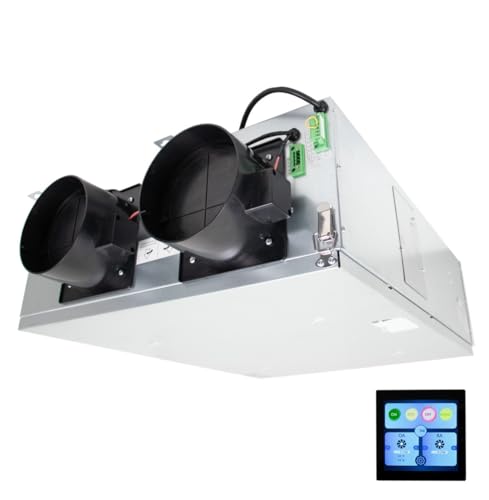
- Balanced airflow from 40 to 100 CFM
- Built-in humidity sensor and washable filter
- Continuous-duty EC motors with timed operation
Best For: Humidity-aware fresh-air exchange
Mid-Size Wireless Ventilation

- Up to 5,024 CFM for average homes
- Wireless control with 12-hour timer
- R5 damper box helps insulate the attic
Best For: Homes up to 2,510 square feet
Balanced Humidity Control
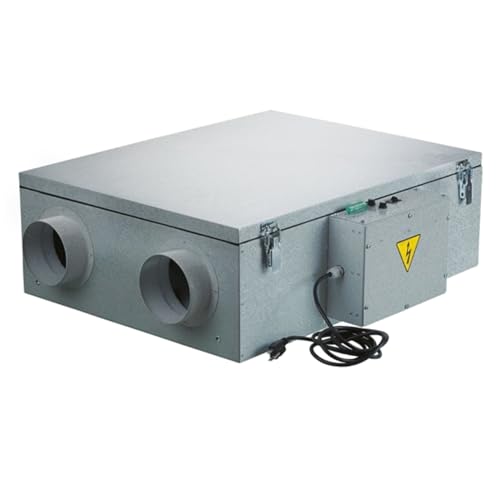
- 180 CFM balanced ventilation
- Enthalpy heat and moisture recovery
- Slim casing with washable MERV 6 filters
Best For: Whole-house ventilation with humidity recovery
High-Volume Whole-House Cooling

- Up to 4,415 CFM airflow
- Wireless control and 12-hour timer
- R5 insulated damper box included
Best For: Rapid cooling and ventilation in homes up to 2,210 square feet
Efficient Continuous Exchange

- Up to 162 CFM balanced exchange
- Heat and moisture recovery
- Low-speed operation as low as 19 watts
Best For: Continuous, energy-conscious whole-house ventilation
Best High-Capacity Pick – Marshal WD160 Whole-House Dehumidifier
For homeowners comparing whole house ventilation systems for humid climates, the Marshal WD160 is a strong moisture-control option when dehumidification is the priority. It removes up to 160 pints per day, provides 330 CFM of airflow, and includes a fresh-air function for broader whole-home support.
Best For: Large homes, basements, crawl spaces, and HVAC-integrated installations needing powerful humidity control.
Pros:
- High-capacity moisture removal with energy-efficient operation.
- Fresh-air intake function helps supplement indoor air quality.
- Adjustable outlet direction and ducting support flexible installation.
- Digital humidity control, two fan speeds, and cycle-timer operation.
Cons:
- Its primary function is dehumidification rather than balanced mechanical ventilation.
- The large commercial-style cabinet may require dedicated installation space.
The WD160 is best suited to humid properties where excess moisture, musty odors, and crawl-space or basement dampness are the main concerns. Its fresh-air feature adds versatility, but it is not a direct substitute for a dedicated ERV.
Best Year-Round Ventilation – ACiQ 150 CFM Energy Recovery Ventilator
ACiQ Energy Recovery Ventilator ERV 150 CFM, Any Climate | Low & High-Speed Ventilation System
Check Price On AmazonThe ACiQ 150 CFM ERV is a practical choice for homeowners seeking whole house ventilation systems for humid climates with year-round comfort in mind. It continuously exchanges stale indoor air while transferring heat and moisture, helping reduce the impact of outdoor conditions on indoor comfort.
Best For: Homes needing continuous fresh-air exchange across bedrooms, bathrooms, offices, and living areas.
Pros:
- Energy-recovery technology transfers heat and moisture for more efficient ventilation.
- 150 CFM capacity supports whole-home fresh-air exchange.
- Automatic exhaust defrost helps support all-climate operation.
- Can be installed as plug-in or hardwired, with two speed settings.
Cons:
- Ceiling mounting and a 50-pound weight may make installation more involved.
- Its two-speed push-button control is less feature-rich than app-controlled models.
With dedicated energy recovery and a larger 150 CFM rating, this ERV offers a balanced approach to ventilation in humid conditions. The included warranty is eight years when registered, or five years if unregistered.
Best Filtered Room Ventilator – VT501F WiFi HEPA Wall Vent
For targeted ventilation in a bedroom, office, attic, or other enclosed room, the VT501F offers a compact alternative to larger whole house ventilation systems for humid climates. Its through-wall design combines fresh-air intake, stale-air exhaust, and three-stage filtration in a quiet, app-enabled unit.
Best For: Individual rooms that need filtered fresh air, odor reduction, and simple through-wall installation.
Pros:
- Pre-filter, HEPA filter, and activated carbon filtration help reduce dust, pollen, and odors.
- Supports fresh-air intake, exhaust, and circulation modes.
- WiFi, remote, and button controls provide flexible operation.
- Quiet 30 dB EC-motor operation suits bedrooms and home offices.
Cons:
- Its 60 cubic meters-per-hour airflow is intended for room-level rather than whole-home coverage.
- Through-wall installation requires suitable exterior wall access.
- Filters require periodic cleaning or replacement.
This unit is a good supplement where a single room needs cleaner, quieter air exchange without complex ductwork. It should not be expected to provide the capacity of a central ERV or whole-home dehumidifier.
Best Compact Humidity-Focused ERV – Honeywell TrueFRESH 70 CFM ERV
The Honeywell TrueFRESH ERV is designed for homeowners evaluating whole house ventilation systems for humid climates where moisture control and a compact footprint matter. It exchanges stale indoor air, removes excess moisture from incoming air, and offers three-speed touch control.
Best For: Space-conscious installations needing fresh-air exchange with added humidity management.
Pros:
- Designed to remove excess moisture from incoming outdoor air.
- Automatically replaces stale indoor air with fresher air.
- Compact design simplifies installation where space is limited.
- Three speeds and a touch-control panel support straightforward operation.
Cons:
- Its 70 CFM airflow is lower than the 150 CFM ACiQ ERV.
- The listed noise level is 45 dB, so it may be more noticeable than ultra-quiet room ventilators.
- The supplied notes do not specify advanced smart-home or remote controls.
The TrueFRESH is a sensible fit for smaller or space-constrained ventilation projects, especially where incoming humidity is a concern. Its lower airflow makes it less suited to larger homes requiring high-volume air exchange.
High-Capacity Whole-House Cooling – QuietCool QC ES-7000 RF
For large homes seeking whole house ventilation systems for humid climates, the QuietCool QC ES-7000 RF offers high-volume airflow for rapid cooling and ventilation. Its wireless control, timer, and insulated damper box make it practical for scheduled operation and seasonal use.
Best For: Large homes up to 3,440 square feet that need powerful whole-house cooling and ventilation.
Pros:
- Moves up to 6,878 CFM on high and 4,304 CFM on low.
- Includes a wireless RF control kit with a glass switch and countdown timer up to 12 hours.
- ECM motor provides efficient operation, with 727 watts on high and 164 watts on low.
- R5 damper doors help insulate the home from the attic when the fan is off.
Cons:
- Designed for ceiling-mount installation, which may require professional preparation.
- Its high airflow capacity may be more than smaller homes need.
The QC ES-7000 RF is the strongest airflow option in this roundup and adds useful wireless scheduling. It is best suited to larger homes where rapid air exchange and efficient low-speed operation are priorities.
Balanced Moisture Management – Awoco 6-Inch ERV
The Awoco 6-inch ERV is a more targeted choice among whole house ventilation systems for humid climates because it exchanges stale indoor air while helping optimize interior moisture. Its balanced airflow, built-in humidity sensor, washable filter, and adjustable runtime support continuous ventilation.
Best For: Homes needing balanced fresh-air exchange and humidity-aware ventilation at up to 100 CFM.
Pros:
- Balances outside-air intake and stale-air exhaust from 40 to 100 CFM.
- Built-in humidity sensor helps maintain more comfortable indoor humidity.
- Includes washable replaceable filters, defrost and recirculation dampers, and low-temperature protection.
- EC motors are rated for continuous operation, with a timer adjustable from 5 to 60 minutes per hour.
Cons:
- Requires multiple 6-inch ducts, including insulated ducting for outside and exhaust air.
- Limited to 100 CFM, so it is intended for ventilation rather than whole-home rapid cooling.
- Has a 1-year limited warranty.
Unlike the high-CFM whole-house fans, this ERV is designed for controlled air exchange and moisture management. Its humidity sensor and balanced operation make it the most directly focused option for maintaining indoor air quality in humid conditions.
Mid-Size Wireless Ventilation – QuietCool QC CL-5400 RF
For average-size homes comparing whole house ventilation systems for humid climates, the QuietCool QC CL-5400 RF provides strong airflow with wireless control and a seasonal insulating damper. It is sized for homes up to 2,510 square feet and offers two operating speeds.
Best For: Average homes that need high-volume cooling and ventilation with remote scheduling.
Pros:
- Delivers up to 5,024 CFM on high and 4,406 CFM on low.
- Wireless RF control includes a glass wireless switch and countdown timer up to 12 hours.
- R5 damper doors help reduce attic air transfer when the system is not operating.
- Includes acoustical ducting, ceiling grille, window locks, and a 20-foot power cord.
Cons:
- Uses a PSC motor rather than the ECM motor found in the higher-capacity ES-7000.
- Ceiling-mount installation and window locks are required parts of the setup.
- It is less suitable for homes larger than its stated 2,510-square-foot range.
The QC CL-5400 RF is a practical middle-ground option: it offers substantial airflow without the larger ES-7000’s capacity. Choose it when your home fits the recommended size range and wireless control is important.
Balanced Humidity Control – Frigate ERV 150
For homeowners comparing whole house ventilation systems for humid climates, the VENTS-US Frigate ERV 150 offers balanced supply and exhaust airflow while its enthalpy core transfers heat and moisture. Its 180 CFM capacity, washable MERV 6 filters, and slim corrosion-resistant housing suit permanent ceiling installations.
Best For: Whole-house ventilation where balanced airflow and humidity recovery are priorities.
Pros:
- Recovers heat and moisture to help reduce cooling loss and stabilize indoor conditions.
- Provides up to 180 CFM of balanced ventilation at a listed 1.9 sones.
- Slim 9.6-inch-deep steel casing with corrosion-resistant aluminum-zinc coating.
- Includes washable MERV 6 filters, mounting brackets, and automatic frost protection.
Cons:
- Ceiling-mount installation is permanent and may require ductwork planning.
- Has one listed power level and uses a push-button control method.
The Frigate ERV 150 is a strong fit when you want continuous balanced ventilation without a condensate drain for the enthalpy core. Its 180 CFM output and compact casing make it a practical option for many whole-house installations.
High-Volume Whole-House Cooling – QuietCool QC CL-4700 RF
The QuietCool QC CL-4700 RF is a high-volume whole-house fan for homeowners considering whole house ventilation systems for humid climates primarily for rapid air exchange and cooling. It moves up to 4,415 CFM and includes wireless control, a timer, ducting, and an insulated R5 damper box.
Best For: Cooling and ventilating average homes up to 2,210 square feet when outdoor conditions are suitable.
Pros:
- Delivers 4,415 CFM on high and 3,402 CFM on low for rapid air movement.
- Includes a wireless RF control kit with glass switch and up to a 12-hour countdown timer.
- R5 damper doors help insulate the home from the attic when the fan is off.
- Includes acoustical ducting, ceiling grille, window locks, and a 20-foot power cord.
Cons:
- Unlike an ERV, the supplied specifications do not indicate heat or humidity recovery.
- It requires suitable window operation for whole-house cooling and ventilation.
- Its 551-watt high-speed rating is higher than the ERV models listed here.
This QuietCool model is best viewed as a powerful cooling and air-exchange fan rather than a humidity-recovery ventilator. Its wireless controls, two speeds, and included damper box add convenience for seasonal use.
Efficient Continuous Exchange – Frigate ERV 120S
For shoppers seeking whole house ventilation systems for humid climates, the VENTS-US Frigate ERV 120S combines balanced fresh-air supply and stale-air exhaust with an enthalpy core that transfers heat and moisture. It provides up to 162 CFM, supports three operating modes, and uses standard 5-inch duct connections.
Best For: Continuous, lower-power whole-house ventilation with humidity and heat recovery.
Pros:
- Enthalpy core transfers heat and moisture, with up to 65% apparent sensible effectiveness.
- Offers up to 162 CFM and can use as little as 19 watts on low speed.
- Three-key control provides low, medium, and standby modes for 24-hour operation.
- Includes washable MERV 6 filters, mounting brackets, and electronic anti-frost protection.
Cons:
- Its maximum airflow is lower than the 180 CFM Frigate ERV 150.
- Installation requires duct connections, with the unit designed for standard 5-inch ducts.
- Anti-frost operation may temporarily cycle the supply fan in freezing conditions.
The Frigate ERV 120S emphasizes efficient continuous operation and straightforward three-speed control. Its moisture recovery and low-speed power use make it a particularly practical choice when ventilation needs to run regularly.
How We Picked These Whole House Ventilation Systems for Humid Climates
We selected products across the main approaches to whole-home air management: energy recovery ventilation, high-volume whole-house fans, through-wall air exchange, and dedicated dehumidification with fresh-air functionality. We considered airflow capacity, humidity handling, filtration, controls, energy efficiency, installation flexibility, noise-related features, and whether each system is better suited to new construction, retrofit work, or targeted room ventilation.
Because product specifications and installation requirements vary, verify current airflow ratings, electrical needs, filter availability, duct compatibility, and local code requirements before purchasing.
Quick Comparison
| System type | Best suited for | Main advantage | Important limitation |
|---|---|---|---|
| ERV | Year-round balanced ventilation | Recovers energy while exchanging indoor and outdoor air | May still require separate dehumidification in very damp weather |
| Whole-house fan | Cool, dry evenings and shoulder seasons | Moves large volumes of air quickly | Can introduce humid outdoor air and is climate dependent |
| Through-wall ventilator | Retrofit rooms or smaller homes | Less invasive installation | Lower capacity and more localized coverage |
| Dehumidifier with fresh-air function | Moisture control in humid homes | Directly removes indoor humidity | May not provide balanced whole-home ventilation by itself |
Key Buying Factors
Humidity Control and Climate Fit
In humid climates, ventilation alone can raise indoor moisture levels. An ERV can moderate incoming air, but homes with persistent dampness may need a dedicated dehumidifier, especially during hot, rainy weather. Whole-house fans work best when outdoor air is cooler and reasonably dry.
Airflow, Home Size, and Duct Design
Compare rated CFM with your home’s floor area, occupancy, ceiling height, and air-sealing level. A higher number is not automatically better: excessive airflow can waste energy, create drafts, or overwhelm existing returns and exhaust paths. Professional sizing is worthwhile for a ducted system.
Filtration and Air Quality
Look for accessible filters and confirm the filter type and replacement cost. Dual filtration or HEPA-equipped ventilation can be valuable for dust, pollen, and fine particles, but filtration performance depends on proper sealing and regular maintenance.
Controls, Noise, and Installation
Wireless remotes, wall controls, timers, variable speeds, and humidity-based operation make daily use easier. Check sound ratings, access for cleaning, condensate handling, freeze protection, and whether installation requires dedicated ducts, exterior openings, or professional electrical work.
Who Should Buy Which Whole House Ventilation Systems for Humid Climates?
Choose an ERV for dependable, balanced fresh-air exchange throughout the year, particularly in a tightly sealed home. Choose a whole-house fan if your weather regularly provides cool, dry outdoor air and you want rapid nighttime cooling. A through-wall ventilator is more practical for a retrofit, apartment, addition, or individual problem room.
If indoor relative humidity remains high despite normal ventilation, prioritize a dehumidifier with fresh-air capability or pair dedicated dehumidification with an appropriately sized ERV. For allergy-sensitive households, focus on models with effective, replaceable filtration. No matter which category you choose, use a hygrometer to monitor conditions and aim for indoor humidity that discourages condensation and mold growth.