Cleaning large, exterior, or hard-to-reach windows is time-consuming and can involve serious ladder and fall risks. The latest window cleaning robots combine strong suction, automatic spray systems, smart navigation, and backup safety features to reduce hands-on work.
Our 2026 roundup compares 10 models across performance, coverage, controls, water delivery, and safety so you can choose the right robot for your glass surfaces and cleaning routine.
Best 10 Heavy-Duty Window Cleaning Robots Picks for 2026
Best Overall

- 10,000Pa suction with 10-stage safety protection
- Triple-spray wet wiping and edge-focused cleaning
- Six modes with smart path planning
Best For: Large, hard-to-reach, and floor-to-ceiling windows
Best Dual-Pad Design

- Round wet-lift and square dry-polish pads
- 6,500Pa suction with 55N constant pressure
- 80ml tank and 30-minute UPS protection
Best For: Streak-reduced polishing and close edge cleaning
Best for High Windows

- 6,400Pa variable suction and dual spray
- 30-minute UPS backup with heavy-duty safety cable
- Works on windows, mirrors, skylights, and tile walls
Best For: High, floor-to-ceiling, and other difficult-to-access surfaces
Best Value Features

- Four-nozzle dual spray system
- Six cleaning modes with remote control
- 25-minute backup and included accessories
Best For: Routine glass cleaning with flexible manual and automatic modes
Best Safety-Focused Pick

- 6500Pa suction with UPS backup and safety tether
- Edge detection supports framed and frameless glass
- Remote control and three cleaning paths
Best For: Multi-story homes and hard-to-reach windows
Best Premium Station System

- Automatic station washes mop pads
- WIN-SLAM 5.0 navigation with obstacle avoidance
- Triple spray and TruEdge edge cleaning
Best For: Highly automated cleaning of large indoor glass areas
Adaptive-Suction Value Pick
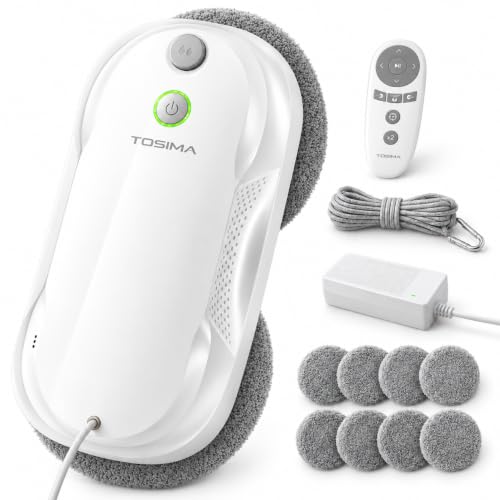
- Up to 6400Pa adaptive suction
- Dual spray and intelligent navigation
- Triple safety system with 25-minute backup
Best For: Smooth glass and safety-conscious users
Best Overall – ECOVACS WINBOT W2S PRO
The ECOVACS WINBOT W2S PRO is a strong all-around choice among heavy-duty window cleaning robots. Its 10,000Pa suction, triple-spray wet wiping, edge-focused design, and multiple cleaning modes make it well suited to large, hard-to-reach, or floor-to-ceiling glass.
Best For: Homeowners who want robust suction, automated route planning, and thorough cleaning options for difficult windows.
Pros:
- 10,000Pa suction plus a 10-stage safety system helps maintain a secure grip.
- Triple-spray wet wiping helps loosen fingerprints, pollen, water spots, and pet marks.
- TruEdge 2.0 and four edge brushes help clean close to frames and corners.
- Six cleaning modes accommodate fast, thorough, edge, heavy-duty, deep, and zone cleaning.
Cons:
- It is corded electric, so operation requires access to power.
- The water capacity is relatively compact at 4.1 fluid ounces.
- The safety tether and manual instructions must be followed during use.
With the highest listed suction in this roundup and strong edge-cleaning features, the W2S PRO is a particularly capable pick when dependable coverage matters more than minimal setup.
Best Dual-Pad Design – HUTT 10 Premium
The HUTT 10 Premium stands out among heavy-duty window cleaning robots for its round-and-square dual-pad approach. It combines wet lifting with dry polishing, while 6,500Pa suction and constant pressure support more aggressive cleaning of everyday dirt and fingerprints.
Best For: Users who prioritize edge reach, reduced streaking, and a wet-lift/dry-polish cleaning process.
Pros:
- Dual-pad design combines a round wet-cleaning pad with a square dry-polishing pad.
- 6,500Pa suction and 55N constant pressure help support stable, forceful cleaning.
- Dual ultrasonic spray and an 80ml tank provide broad moisture coverage.
- Includes a 220kg-rated safety rope and UPS adhesion protection for up to 30 minutes.
Cons:
- Purified water is recommended, and cleaning liquid is not included.
- Tracks and pads need to remain appropriately clean and dry to maintain traction.
- At 1.3kg and up to 65dB, it may not be the quietest or lightest-feeling option for every user.
The HUTT 10 Premium is a compelling choice for shoppers who want more than a single-pass wipe, especially when polishing and close edge cleaning are central priorities.
Best for High Windows – X6 Window Cleaning Robot
The X6 is designed for homeowners who need help with high, inside/outside, or hard-to-access glass. As one of the heavy-duty window cleaning robots with variable suction, dual spray, edge detection, and a 30-minute UPS function, it focuses on practical coverage and fall protection.
Best For: High windows, floor-to-ceiling glass, skylights, mirrors, and tile walls.
Pros:
- Variable 6,400Pa suction adjusts to help address dust, stains, and grime.
- UPS protection can maintain adhesion for up to 30 minutes during a power cut.
- A safety cable rated for at least 150 pounds and edge sensors add protection.
- Dual spray, smart navigation, and a slim round shape support broad surface use.
Cons:
- It is corded electric despite having a backup battery function.
- Very dirty windows may require two cleaning passes and pad changes.
- Using too much water can contribute to smears or reduced traction.
The X6 balances high-window versatility with straightforward remote operation. It is especially attractive when ladder reduction and backup adhesion are more important than premium edge-detail features.
Best Value Features – TOSIMA WA9C Pro
The TOSIMA WA9C Pro offers a feature-rich approach to heavy-duty window cleaning robots without relying on app control. Its four-nozzle spray system, remote operation, multiple path modes, and safety monitoring make it a practical option for routine glass cleaning.
Best For: Buyers who want remote-controlled cleaning modes, adjustable spray, and a complete accessory kit.
Pros:
- Four precision nozzles distribute water across the glass for deep cleaning.
- Six cleaning modes include N-, Z-, and manual paths for targeted coverage.
- Pressure monitoring, a drop sensor, and power-failure protection support safer operation.
- Includes four mops, replacement nozzles, an unclogging needle kit, and a water bottle.
Cons:
- Its listed 2,600–3,200Pa suction is lower than the other models here.
- Battery backup maintains adhesion for up to 25 minutes, shorter than some alternatives.
- The safety rope must be anchored securely for overhead work.
The WA9C Pro is a sensible pick when flexible remote control and included accessories matter most. Its lower suction rating makes it better suited to shoppers who value convenience and spray control over maximum grip.
Best Safety-Focused Pick – 6500Pa Window Cleaning Robot
For shoppers comparing heavy-duty window cleaning robots, this model emphasizes strong 6500Pa suction, dual safety protection, and remote operation. Its edge sensors, multiple cleaning paths, and 60ml dual-sided spray system make it suited to routine cleaning on windows, glass doors, and other smooth glass surfaces.
Best For: Multi-story homes and hard-to-reach windows where strong attachment and remote control are priorities.
Pros:
- 6500Pa suction, a 5-meter safety rope, and a 25-minute UPS backup support secure operation.
- Edge detection and obstacle awareness work with framed and frameless windows.
- Three selectable cleaning paths and dual-sided spray help accommodate different layouts.
- Includes 10 cleaning pads for ongoing maintenance.
Cons:
- The 60ml water tank is smaller than the tank on some competing models.
- Designed primarily for dust, fingerprints, and light marks; heavy buildup may require pre-cleaning.
- Pads need to be lightly dampened, properly wrung out, and washed after use.
This is a practical choice when safety features and broad surface compatibility matter most. Buyers should still plan for occasional manual preparation when windows have stubborn stains or heavy residue.
Best for Visible Water Control – Tosima X1 Window Cleaning Robot
The Tosima X1 is one of the more convenient heavy-duty window cleaning robots for shoppers who want to monitor water usage while cleaning. Its visible 85ml tank, dual ultrasonic spray nozzles, automatic S-shaped route, and remote control support routine cleaning across large and small glass surfaces.
Best For: Daily indoor window cleaning when tank visibility and flexible manual control are useful.
Pros:
- The 85ml viewing-window tank makes the remaining water easy to check.
- Dual nozzles atomize water in the direction of travel to help reduce smearing.
- Automatic top-to-bottom S-shaped cleaning works on surfaces from 30×30 cm and up.
- A backup battery keeps the robot attached for about 25 minutes during a power outage.
Cons:
- It is specified for indoor use and household temperatures from 0°C to 40°C.
- The listed noise level is 65 dB.
- Operation requires a corded electric power source and an attached safety tether.
Choose the X1 if a larger, easy-to-monitor water tank and straightforward remote adjustments are more valuable than a self-cleaning station. It offers useful flexibility for everyday indoor glass cleaning, including overhead sunroom windows.
Best Premium Station System – ECOVACS WINBOT W3 OMNI
The ECOVACS WINBOT W3 OMNI stands apart among heavy-duty window cleaning robots by pairing intelligent navigation with an automatic cleaning station. Its self-washing mop system, triple-nozzle spray, edge-focused TruEdge technology, and multiple cleaning modes are designed for routine maintenance of large windows, glass doors, and high-rise glass.
Best For: Buyers seeking a highly automated setup with self-cleaning pads and advanced navigation.
Pros:
- The station washes mop pads with 16 high-pressure nozzles in about one minute.
- WIN-SLAM 5.0 provides dynamic obstacle avoidance and 1mm navigation precision.
- TruEdge technology targets edges and corners while helping prevent cross-contamination.
- Fast, Intensive, and Zone modes provide control for different cleaning situations.
Cons:
- At 12.22kg, it is substantially heavier than the other listed robots.
- The system is specified for indoor use and uses app control rather than a traditional remote.
- Its large station and advanced features may be more than needed for occasional light cleaning.
The W3 OMNI is the strongest fit for convenience-focused buyers who want less pad handling and more automated maintenance. Its station and navigation package make it a premium option, particularly for larger or frequently cleaned glass areas.
Compact Everyday Pick – WINBOT MINI
For shoppers seeking heavy-duty window cleaning robots in a compact format, the ECOVACS WINBOT MINI is geared toward routine indoor glass care. Its lightweight design, app control, ultrasonic spray, and multiple safety protections make it practical for apartments, narrow windows, and quick touch-ups.
Best For: Small homes, apartments, narrow or hard-to-reach indoor windows, and light daily dirt.
Pros:
- Compact, lightweight body is easy to handle and store.
- Ultrasonic spray and three cleaning modes support routine glass cleaning.
- Strong suction and a nine-stage protection system help keep cleaning stable.
- Quiet operation is suitable for frequent home use.
Cons:
- Designed primarily for dust, fingerprints, and light stains rather than heavy buildup.
- Corded electric operation limits use where an outlet is unavailable.
- Heavily soiled windows may require multiple cycles or pad cleaning.
The WINBOT MINI makes the most sense when easy handling and everyday maintenance matter more than maximum coverage or deep-cleaning power. Its compact form is especially useful for smaller glass surfaces.
Adaptive-Suction Value Pick – Tosima W5
The Tosima W5 is a strong contender among heavy-duty window cleaning robots for shoppers who want adaptive suction and added backup protection. It combines up to 6400Pa of variable-frequency suction with dual spray, intelligent navigation, and remote control for smooth glass surfaces.
Best For: Apartments and homes with smooth glass, frameless windows, and users who value remote operation and safety redundancy.
Pros:
- Adaptive suction reaches up to 6400Pa and adjusts to the surface.
- Dual-spiral cleaning and dual-spray design help loosen dirt and fingerprints.
- Triple safety system includes a safety rope, edge-sensing air pressure sensor, and emergency battery backup.
- Remote control supports automatic modes and manual guidance.
Cons:
- At four pounds, it is less lightweight than a mini-format robot.
- Its listed use is focused on glass windows and other smooth surfaces.
- Cleaning width is listed as six inches, so larger areas may take time.
Choose the W5 if secure attachment and flexible control are priorities. Its backup battery and safety rope add reassurance for elevated cleaning, while replaceable parts can simplify ongoing maintenance.
Large-Area Premium Pick – WINBOT W2 PRO Omni
For larger or more demanding jobs, the ECOVACS WINBOT W2 PRO Omni stands out among heavy-duty window cleaning robots with battery operation, a multifunction station, and three-nozzle spraying. Intelligent path planning is designed to handle floor-to-ceiling, frameless, small, and tilting windows.
Best For: Large glass areas, difficult window layouts, and users who want portable operation with extended battery coverage.
Pros:
- Battery mode provides up to 110 minutes of cleaning and coverage for up to 55 square meters.
- Plugged-in mode supports continuous cleaning near an outlet.
- Three-nozzle wide-angle spraying works with a wet cloth to improve coverage.
- WIN-SLAM 4.0 path planning and 12-stage protection support efficient, safer cleaning.
Cons:
- The multifunction station and larger dimensions may require more storage space.
- Its feature set may be more than needed for occasional small-window touch-ups.
- Battery performance varies with cleaning conditions and usage.
The W2 PRO Omni is the most capable choice of these three for coverage and flexibility. Its combination of a portable station, dual power modes, wide-angle spray, and advanced navigation suits substantial window-cleaning sessions.
How We Picked the Best Heavy-Duty Window Cleaning Robots
We evaluated these models against the features that matter most for demanding window-cleaning jobs: maximum suction, pad or nozzle design, spray coverage, navigation intelligence, cable and battery safety, control options, and suitability for large or high windows. We also considered whether each robot is designed for interior glass only or can handle exterior surfaces under appropriate conditions.
Product specifications can vary by surface, glass condition, cleaning pad, and moisture level. Suction ratings are useful for comparison, but they should not replace checking the manufacturer’s surface requirements, tether instructions, and operating limits.
Quick Comparison
- Maximum suction: The listed options range from 6,400Pa to 10,000Pa, with higher ratings generally offering more holding power on suitable smooth glass.
- Best for advanced automation: The ECOVACS WINBOT W3 Omni and W2S PRO emphasize smart navigation and integrated cleaning features.
- Best for compact storage: The ECOVACS WINBOT Mini is built around a smaller footprint and dual-nozzle spraying.
- Best for visible water management: The Tosima X1 includes an 85 ml visible water tank.
- Best for flexible controls: Models with remotes, portable stations, or charging-while-working designs can be easier to manage across multiple windows.
Key Buying Factors for Heavy-Duty Window Cleaning Robots
Suction and Surface Compatibility
Choose a robot with suction appropriate for your window size and cleaning conditions, but confirm that it supports your glass type. Dust, grease, textured surfaces, frameless edges, and excessive water can affect grip and movement.
Safety and Backup Power
Prioritize anti-drop systems, safety tethers, UPS or backup power, overload protection, and clear status alerts. A strong tether attachment point and correct setup are essential when cleaning exterior or elevated windows.
Spray and Cleaning Coverage
Dual or multi-nozzle systems can distribute cleaning solution more evenly, while ultrasonic atomization may help control moisture. Check tank capacity, refill convenience, pad availability, and whether the robot can operate without leaving excessive water behind.
Navigation and Window Layout
Smart path planning is valuable on large panes because it can reduce missed areas and unnecessary passes. If your windows have narrow frames, divided sections, or unusual shapes, verify the robot’s supported dimensions and edge behavior.
Power, Controls, and Maintenance
Consider cord length, station portability, charging behavior, remote controls, app requirements, and noise. Reusable pads should be easy to remove and wash, and replacement supplies should be available before you commit to a model.
Who Should Buy Which Heavy-Duty Window Cleaning Robots?
Choose a high-suction model such as the ECOVACS WINBOT W2S PRO if maximum holding power is your main concern and your glass meets the manufacturer’s requirements. The W3 Omni or W2 PRO Omni may better suit shoppers who want a more complete station-based system and advanced automation.
For buyers focused on portability or smaller panes, the WINBOT Mini is a practical direction. The Tosima X1 is worth considering when monitoring water use matters, while the WA9C Pro and other multi-nozzle models appeal to shoppers who want broader spray coverage and multiple cleaning modes.
Whichever model you choose, treat these devices as assisted cleaning tools rather than unattended appliances. Secure the safety line, inspect the glass and pads, keep the robot within its operating limits, and follow the manufacturer’s instructions for every exterior cleaning session.