Excess humidity can damage instruments, electronics, finishes, artwork, and building materials long before moisture becomes visibly obvious. The right commercial-grade dehumidifier helps maintain a more stable studio environment while reducing condensation, mold risk, and cleanup.
We selected 10 high-capacity models with features suited to demanding spaces, including built-in pumps, continuous drainage, automatic defrost, large coverage ratings, and low-grain refrigerant technology. Use the guide below to narrow the choices by room size, moisture load, installation needs, and operating priorities.
Best 10 Commercial-Grade Studio Dehumidifiers Picks for 2026
Best Overall
Waykar 150 Pint Commercial Dehumidifier

- 150-pint capacity for spaces up to 7,000 square feet
- Built-in pump plus gravity-drain options
- Energy Star, auto-defrost, and adjustable humidity control
Best For: Large studios, basements, garages, and flexible drainage setups
Best Warranty
ALORAIR Galaxy 60 145-Pint Dehumidifier

- 145-pint moisture removal under saturated conditions
- Corrosion-resistant construction and automatic defrost
- ETL listed with a 6-year limited warranty
Best For: Contained commercial spaces, crawl spaces, and durability-focused buyers
Best Quiet Operation

- 150-pint capacity with coverage up to 7,500 square feet
- Front humidity display and display-off sleep mode
- Auto-defrost, memory restart, and continuous-drain option
Best For: Large studios and overnight operation with easy humidity monitoring
Best Heavy-Duty Choice
Moiswell VP250 250-Pint Dehumidifier

- Up to 250 pints daily and 442 CFM airflow
- Built-in pump with up to 16.4-foot vertical discharge
- Designed for commercial, industrial, and restoration work
Best For: Large-scale drying, warehouses, workshops, and water-damage restoration
Restoration Power Pick

- LGR unit with Panasonic compressor
- Built-in pump with 15-foot lift head
- Stackable design with memory restart
Best For: Water-damage restoration and construction drying
Low-Clearance Specialist
Airecoler GT-X5 Commercial Dehumidifier
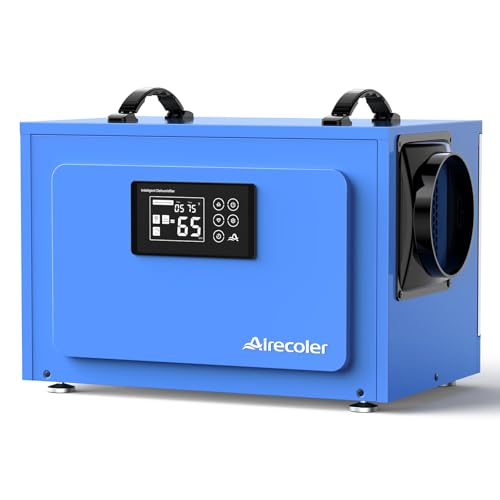
- Compact design for crawl spaces
- Auto drain, defrost, timer, and restart
- Five-year coverage with added system protection
Best For: Low-clearance crawl spaces and basements
Large-Area Efficiency Choice
Airzentti 155-Pint Dehumidifier

- Coverage listed up to 7,500 square feet
- Built-in pump with 16.4-foot lift
- Energy Star certified with auto-protection features
Best For: Large commercial, industrial, attic, and basement spaces
Compact Crawlspace Pick

- 53 PPD AHAM dehumidification capacity
- Automatic drainage and auto-defrost
- Compact metal-bodied design for up to 1,200 sq. ft.
Best For: Crawlspaces, basements, and smaller commercial areas
Restoration-Ready Workhorse
180 Pint LGR Commercial Dehumidifier

- Up to 180 pints per day and 3,000 sq. ft. coverage
- Built-in pump with 15-foot lift and drain hose
- Digital monitoring with auto-restart
Best For: Water-damage restoration and construction drying
Maximum-Capacity Industrial Choice
Moiswell VP320 305 Pint Dehumidifier

- Up to 305 pints per day and 8,500 sq. ft. coverage
- 412 CFM airflow with a built-in 16.4-foot pump
- Casters and multiple handles for job-site transport
Best For: Large industrial spaces and time-sensitive drying projects
Best Overall – Waykar 150 Pint Commercial Dehumidifier
For buyers comparing commercial-grade studio dehumidifiers, the Waykar 150-pint model is a versatile option for large indoor areas. It is rated for spaces up to 7,000 square feet and combines adjustable humidity control with multiple drainage methods, including a built-in pump.
Best For: Basements, garages, wine cellars, large studios, and other spaces needing flexible drainage.
Pros:
- Removes up to 150 pints of moisture per day under stated test conditions.
- Includes pump drainage, gravity drainage, and a 1.85-gallon removable tank.
- Offers auto-defrost, self-drying, automatic restart, and adjustable 30%–80% humidity control.
- Energy Star certified and equipped with casters, a handle, and swing airflow.
Cons:
- The stated 7,000-square-foot coverage depends on operating conditions.
- The included gravity drain hose is only 3.3 feet long.
- Pump operation must be reset after unplugging following a normal shutdown.
The Waykar stands out as a balanced choice when portability, pump drainage, and broad coverage matter more than specialized industrial construction. Its controls and self-drying features also make it practical for regular unattended operation.
Best Warranty – ALORAIR Galaxy 60 145-Pint Dehumidifier
Among commercial-grade studio dehumidifiers, the ALORAIR Galaxy 60 emphasizes durability and long-term support. Its corrosion-resistant design, low-temperature operation, and professional construction suit demanding moisture-control environments up to 1,800 square feet.
Best For: Crawl spaces, basements, storage areas, garages, and commercial locations where durability and warranty coverage are priorities.
Pros:
- Removes up to 145 pints per day under saturated conditions.
- Corrosion-resistant technology helps protect coils and refrigerant performance.
- Automatic defrost supports operation in colder environments.
- ETL listed and backed by a 6-year limited warranty.
Cons:
- Coverage is listed for up to 1,800 square feet, less than several competing models here.
- The supplied notes do not indicate a built-in pump.
- Its commercial-oriented design may be more than needed for smaller residential spaces.
The Galaxy 60 is a compelling pick for buyers who value corrosion protection, cold-weather functionality, and extended warranty coverage. Its smaller stated coverage area makes it better suited to contained spaces than very large studios.
Best Quiet Operation – Kesnos 150 Pint Dehumidifier
The Kesnos 150-pint unit is a practical contender among commercial-grade studio dehumidifiers for buyers who want high capacity with convenient day-to-day controls. It covers spaces up to 7,500 square feet and adds a front humidity display plus a sleep mode that turns off the display while the unit continues running.
Best For: Large studios, basements, offices, stockrooms, and spaces where visibility and quieter overnight operation are useful.
Pros:
- Rated to remove up to 150 pints per day and cover up to 7,500 square feet.
- Front humidity display provides at-a-glance readings.
- MIRAGE Sleep Mode turns off the display during operation.
- Includes auto-defrost, memory restart, safety lock, washable filter, and two fan speeds.
Cons:
- The continuous-drain setup uses a 3.3-foot hose and requires a compatible 3/4-inch garden hose for some installations.
- The unit has a 2.12-gallon tank, so tank-based operation may require frequent emptying in humid conditions.
- The supplied coverage and capacity figures are based on stated test conditions.
Kesnos is a strong fit when convenient monitoring and sleep-friendly operation matter. It offers broad rated coverage and useful protection features, though buyers planning continuous drainage should confirm hose and outlet compatibility.
Best Heavy-Duty Choice – Moiswell VP250 250-Pint Dehumidifier
For severe moisture problems, this Moiswell unit is the most heavy-duty option among these commercial-grade studio dehumidifiers. It combines a stated 250-pint daily extraction rate with 442 CFM airflow, a built-in pump, and coverage claims up to 8,500 square feet.
Best For: Warehouses, workshops, factories, grow rooms, greenhouses, and water-damage restoration work.
Pros:
- Provides up to 250 pints of daily moisture removal, with 110 pints at AHAM conditions.
- 442 CFM airflow is designed to speed drying in large spaces.
- Built-in pump can discharge condensate vertically up to 16.4 feet.
- Uses an R32 system and includes a 24-hour automatic on/off timer.
Cons:
- Its heavy-duty capacity may be excessive for smaller studios or moderate humidity.
- The supplied notes list a 500-square-foot floor-area detail that conflicts with the broader 8,500-square-foot coverage claim.
- The notes do not specify a warranty or humidity-range control.
The VP250 is the clear capacity and airflow leader for demanding drying jobs. Because the supplied specifications contain differing area figures, buyers should verify the intended coverage and installation requirements before purchase.
Restoration Power Pick – Panasonic LGR Dehumidifier
For demanding water-damage restoration and construction jobs, this commercial-grade studio dehumidifiers option combines LGR performance with a Panasonic compressor. Its 150-pint saturation rating, 350 CFM airflow, and built-in pump make it suited to large, wet spaces where dependable moisture removal matters.
Best For: Water-damage restoration, construction drying, basements, warehouses, and other commercial spaces up to 2,500 square feet.
Pros:
- LGR design and Panasonic compressor support rapid moisture removal.
- Built-in pump offers a 15-foot lift head for flexible drainage.
- Memory restart resumes operation after a power interruption.
- Compact, stackable housing and included 25-foot power cord aid transport and setup.
Cons:
- At 65 pounds, it is substantial to move between job sites.
- The listed one-speed operation provides less airflow customization.
- The 150-pint figure is measured at saturation; the AHAM rating is 80 pints per day.
This is a strong choice when restoration-focused features, portable stacking, and automatic pumping take priority. Its compact footprint is practical for crews that need commercial drying capacity without a larger cabinet-style unit.
Low-Clearance Specialist – Airecoler GT-X5 Commercial Dehumidifier
Among commercial-grade studio dehumidifiers, the Airecoler GT-X5 stands out for fitting into cramped areas. Its compact 19.2-by-12.2-by-13.4-inch body, continuous-drain setup, and automatic controls make it practical for crawl spaces, basements, and other locations where access is limited.
Best For: Crawl spaces, low-clearance basements, garages, warehouses, and commercial or industrial areas up to 6,000 square feet.
Pros:
- Removes up to 125 pints per day at maximum conditions and 60 pints at AHAM.
- Compact form factor supports freestanding, countertop, or floor-joist placement.
- Includes auto defrost, continuous draining, timer, and automatic restart features.
- Five-year coverage includes two years for the full unit and three additional years for the dehumidification system.
Cons:
- Its 6.56-foot drain hose may limit placement when the drain is farther away.
- Airflow is rated at 265 CFM, lower than some larger restoration-focused models.
- The maximum capacity rating is based on nearly saturated conditions rather than AHAM conditions.
The GT-X5 is a sensible fit when installation flexibility and low-clearance access matter more than a built-in pump. Its automatic operating modes help support set-and-forget moisture control in hard-to-reach spaces.
Large-Area Efficiency Choice – Airzentti 155-Pint Dehumidifier
For broad coverage, this commercial-grade studio dehumidifiers model pairs a 155-pint maximum capacity with Energy Star certification and a built-in pump. Its humidity controls, duct collar, and continuous-drain options support extended operation across commercial, industrial, attic, and basement applications.
Best For: Large spaces up to 7,500 square feet, including warehouses, commercial offices, attics, basements, crawl spaces, and water-damage restoration sites.
Pros:
- Rated for up to 155 pints per day at saturation and 70 PPD under AHAM conditions.
- Built-in pump drains water up to 16.4 feet, with gravity-drain capability also included.
- Energy Star certified and TUV compliant for efficiency and stated compliance.
- Auto defrost, auto drain, screen lock, and timer support extended unattended operation.
Cons:
- The 220 CFM airflow rating is lower than the first model’s 350 CFM rating.
- Its 59-pound weight and larger 24.3-inch width may make transport and placement less convenient.
- The 155-pint headline capacity is measured under nearly saturated conditions.
This model is compelling when coverage area, pumping height, and energy-conscious operation are key selection factors. The duct collar and multiple drainage modes add flexibility for permanent or semi-permanent installations.
Compact Crawlspace Pick – ALORAIR Sentinel HD55
The ALORAIR Sentinel HD55 is a compact option among commercial-grade studio dehumidifiers, with a rugged metal casing, automatic drainage, and low-temperature operation. It removes up to 53 pints per day at AHAM conditions and is rated for spaces up to 1,200 square feet.
Best For: Crawlspaces, basements, storage areas, offices, and smaller commercial spaces where compact sizing and continuous drainage matter.
Pros:
- Continuous drainage eliminates the need for frequent tank emptying.
- Automatic defrost supports operation in cooler environments.
- Compact 41.7-pound design includes a rugged handle for easier transport.
- Metal casing and cETL listing are suited to demanding work areas.
Cons:
- Its 1,200-square-foot coverage is limited compared with larger industrial units.
- The included MERV-1 filter is a basic component-protection filter rather than a high-filtration option.
Choose the HD55 when you need dependable moisture control in a relatively compact footprint. Its automatic drainage and auto-defrost system make it practical for crawlspaces and other locations that are difficult to service frequently.
Restoration-Ready Workhorse – 180 Pint LGR Commercial Dehumidifier
This 180-pint LGR unit is built for high-moisture jobs, combining 350 CFM airflow with a Panasonic compressor, copper coil tubing, and coverage up to 3,000 square feet. It is a strong choice among commercial-grade studio dehumidifiers when continuous drainage and restoration-focused controls are priorities.
Best For: Water-damage restoration, construction sites, basements, garages, storage areas, and other commercial indoor applications.
Pros:
- Removes up to 180 pints per day under 95°F and 90% RH conditions.
- Built-in pump provides a 15-foot lift and includes a drain hose.
- Digital controls display temperature, relative humidity, and grain depression.
- Auto-restart helps resume operation after power interruptions.
Cons:
- At 95 pounds, it is substantially heavier than compact dehumidifiers.
- Its 20-by-22-by-35-inch footprint requires more storage and transport space.
For demanding drying work, this model offers the capacity and monitoring features professionals typically need. The integrated pump and auto-restart function reduce hands-on attention during extended restoration or construction projects.
Maximum-Capacity Industrial Choice – Moiswell VP320 305 Pint Dehumidifier
The Moiswell VP320 delivers the highest stated capacity in this group, removing up to 305 pints per day and moving 412 CFM of air. For large commercial spaces, it stands out among commercial-grade studio dehumidifiers with an integrated pump, automatic controls, and a claimed coverage area of up to 8,500 square feet.
Best For: Warehouses, factories, workshops, greenhouses, data centers, and fast-drying restoration or painting projects.
Pros:
- Up to 305 pints per day, with 130 PPD listed at AHAM conditions.
- Built-in pump supports drainage up to 16.4 feet vertically or horizontally.
- 412 CFM airflow helps circulate air across large spaces.
- Casters, a heavy-duty handle, and recessed side handles improve job-site mobility.
Cons:
- Its 106.4-pound weight makes it less convenient to move than compact units.
- The NEMA 5-20 plug requires a 20-amp receptacle.
- Its 1,700-watt draw may require more electrical capacity than smaller models.
The VP320 is the logical fit when moisture loads and room sizes exceed the practical range of smaller commercial machines. Verify the required 20-amp electrical connection before purchase, then use its pump, auto-defrost, and restart features for largely unattended drying.
How We Picked the Best Commercial-Grade Studio Dehumidifiers
We focused on the specifications that matter most in studios and other demanding indoor spaces: rated moisture-removal capacity, coverage claims, drainage design, pump availability, defrost operation, portability, and controls. We also considered whether each unit is better suited to a moderately damp studio, a persistently wet basement, a crawlspace, or a large commercial area.
Capacity ratings are useful for comparison, but they are not directly interchangeable across every test condition. Actual performance depends on temperature, relative humidity, room leakage, insulation, and how consistently the unit can discharge collected water.
Quick Comparison
The selected models range from roughly 113 to 305 pints per day, giving shoppers options for both concentrated moisture problems and very large spaces. Units with built-in pumps are convenient when a floor drain is unavailable or sits above the machine’s outlet. Models with gravity-drain hoses can be simpler and quieter when a nearby drain is properly positioned.
- Moderate commercial spaces: Consider the 113- to 155-pint models when the studio is enclosed and moisture levels are manageable.
- Persistent dampness: A 150- to 180-pint unit may provide more headroom for basements, wet work areas, or frequently opened spaces.
- Large or severe moisture loads: The 250- and 305-pint options are designed for substantially larger areas and heavier conditions.
- Cool environments: Automatic defrost is especially useful in basements, crawlspaces, and studios that remain chilly.
Key Buying Factors for Commercial-Grade Studio Dehumidifiers
Capacity and Room Conditions
Match the unit to the actual moisture load rather than relying only on advertised square footage. A poorly sealed studio, drying room, basement, or space with wet materials may need considerably more capacity than a finished, climate-controlled room of the same size.
Drainage and Pump Setup
Continuous drainage is usually preferable for unattended operation. Check hose compatibility, outlet height, pump lift, and whether the included hose reaches your drain. A built-in pump adds installation flexibility, while gravity drainage may reduce complexity.
Low-Temperature Operation
Automatic defrost helps prevent frost buildup on the coils when the surrounding air is cool. This feature is valuable for crawlspaces, garages, storage areas, and unheated studios, where standard residential units may lose efficiency.
Portability, Controls, and Maintenance
Look for sturdy casters, handles, clear humidity controls, washable filters, and accessible service areas. Commercial equipment is often moved between rooms, so practical portability can matter as much as raw capacity. Leave adequate airflow around the unit and clean the filter regularly.
Who Should Buy Which Commercial-Grade Studio Dehumidifiers?
Choose a lower-capacity model when you need steady humidity control in a contained studio with a manageable moisture source. Select a pump-equipped unit if the machine will run unattended or the drain is elevated. LGR models are worth considering for restoration work, drying materials, or unusually wet environments where lower humidity is the priority. For expansive basements, warehouses, or multiple connected areas, the 250- and 305-pint models offer greater reserve capacity, provided the electrical supply and drainage arrangement can support them.