Private well water can look clear while still carrying sediment, iron, manganese, metals, or microorganisms that affect taste, fixtures, and household water use. The right whole-house system depends on your test results, flow needs, and installation budget.
We compared 10 budget well water filtration systems across filtration stages, media, capacity, maintenance, and well-water suitability. Use the guide below to narrow the options before choosing a system.
Best 10 Budget Well Water Filtration Systems Picks for 2026
Best Budget Starter

- Three-stage sediment, carbon, and odor filtration
- Includes nine cartridges for 1.5–2 years
- Built-in valves simplify maintenance
Best For: Families wanting an affordable whole-house starter system
Best High-Capacity Pick
iSpring 2-Stage Whole House Filter
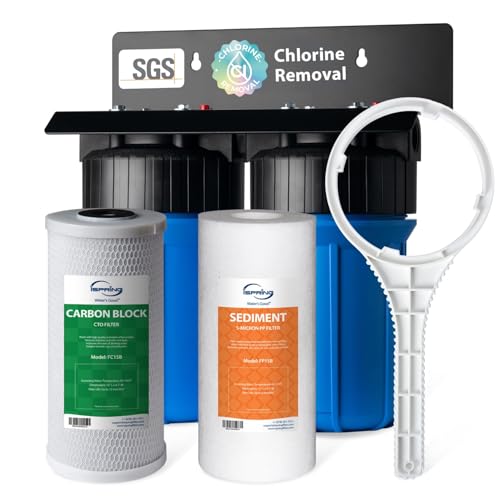
- 50,000-gallon rated capacity
- 15-GPM flow with 1-inch ports
- Pre-assembled bracket and pressure-release valve
Best For: Homes needing long-lasting filtration and strong flow
Best UV Option
24 GPM Whole-House UV Purifier

- 110W UV treatment at up to 24 GPM
- Includes two extra replacement bulbs
- Stainless steel chamber for well or city water
Best For: High-flow UV purification in homes, RVs, or light commercial settings
Best for Heavy Metals
WF3 3-Stage Whole House Filter

- Three-stage filtration with GAC+KDF media
- Targets listed heavy metals, chlorine, sediment, and VOCs
- Gauges and timers simplify maintenance planning
Best For: Well-water users seeking broader contaminant reduction and monitoring
Best for Iron and Manganese

- Targets iron up to 3.0 ppm and manganese up to 1.0 ppm
- Three-stage whole-house filtration with 15 GPM flow
- Up to 100,000-gallon capacity and DIY maintenance
Best For: Well-water homes focused on iron and manganese reduction
Best Budget Starter Kit
3-Stage Whole House Water Filter
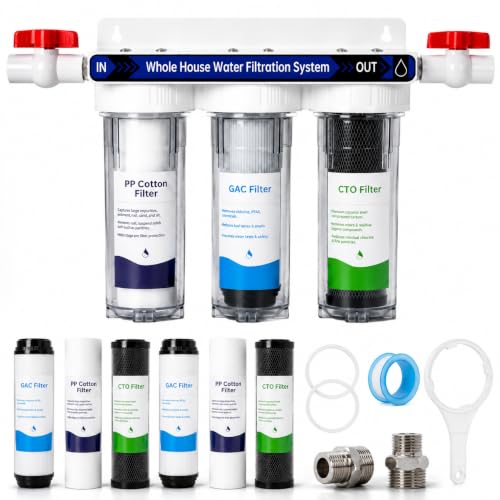
- Includes nine cartridges across three complete filter sets
- 15 GPM flow with 3/4-inch brass ports
- Clear housings and included shutoff valves simplify maintenance
Best For: Small to medium homes seeking general filtration and spare filters
Best Commercial-Grade Carbon Filtration

- Reduces up to 99% of chlorine and common aesthetic contaminants
- Three-stage filtration with 1-inch ports and 15 GPM flow
- 100,000-gallon capacity with DIY installation support
Best For: High-flow whole-house carbon filtration and chlorine reduction
Best Budget Iron & Manganese Filter

- Reduces iron, manganese, chlorine, rust, and sediment
- 15 GPM flow with 1-inch ports
- Up to 50,000 gallons or six months of filtration
Best For: Affordable whole-house iron and manganese reduction
Best Heavy-Duty Protection

- Targets heavy metals, chlorine, and scale
- 17 GPM maximum flow rate
- Includes stainless-steel frame and pressure gauges
Best For: Larger homes needing monitored, anti-scale filtration
Best 3-Stage Well Water Option

- Targets iron, manganese, odor, chlorine, rust, and sediment
- SGS-tested iron and manganese reduction
- 15 GPM flow with six- to 12-month cartridge intervals
Best For: Well-water homes needing broader three-stage filtration
Best Budget Starter – 3-Stage Well Water Filter
For shoppers comparing budget well water filtration systems, this compact three-stage option is designed to improve water throughout the home without removing naturally occurring minerals. It targets sediment, chlorine, and odors, and includes three complete sets of cartridges for an estimated 1.5–2 years of supply.
Best For: Families seeking an affordable, low-maintenance whole-house filter with replacement cartridges included.
Pros:
- Three-stage filtration addresses sediment, chlorine, and odors.
- Includes nine cartridges, providing an estimated 1.5–2 years of replacements.
- Built-in shut-off valves and a bypass valve simplify filter changes.
- Supports flow rates up to 15 GPM and fits standard 3/4-inch plumbing.
Cons:
- Does not reduce TDS or remove dissolved minerals.
- Filter cartridges are listed with a six-month life cycle, so regular maintenance is required.
- The supplied details describe sediment, chlorine, and odor reduction rather than heavy-metal or UV treatment.
This is a practical value pick when upfront convenience and included replacement filters matter most. Confirm that its filtration scope matches your well-water test results before buying.
Best High-Capacity Pick – iSpring 2-Stage Whole House Filter
The iSpring WGB21B is a strong contender among budget well water filtration systems for homes that want high capacity and straightforward whole-house installation. Its two-stage design uses a 5-micron sediment filter and a CTO carbon filter, with capacity rated up to 50,000 gallons.
Best For: Households prioritizing long cartridge life, strong flow, and a pre-assembled installation setup.
Pros:
- Rated for up to 50,000 gallons or approximately one year for a family of four.
- 1-inch inlet and outlet ports support fast flow with less pressure loss.
- Reduces dirt, sand, rust, scale particles, chlorine, tastes, odors, and some VOCs.
- Includes a mounting bracket, pressure-release valve, and filter wrench.
Cons:
- Two filtration stages provide less treatment variety than some three-stage systems.
- Does not reduce TDS or remove dissolved minerals.
- The system is intended for point-of-entry installation and may require plumbing work at the main supply.
With its high stated capacity and 15-GPM maximum flow, this iSpring model offers a balanced blend of operating economy and performance. Its warranty and manufacturer support add reassurance for DIY buyers.
Best UV Option – 24 GPM Whole-House UV Purifier
Among budget well water filtration systems, this UV purifier stands out for households looking for high-flow ultraviolet treatment rather than a cartridge-based sediment and carbon setup. Two 55W lamps deliver a stated 24-GPM flow, and two extra bulbs are included for extended service.
Best For: Homes, RVs, or light commercial setups seeking high-flow UV purification for well or city water.
Pros:
- Two lamps provide a combined 110W UV system with a rated 24-GPM flow.
- Includes two replacement bulbs, plus quartz sleeves, brackets, and power adapters.
- Stainless steel chamber is designed for corrosion resistance and leak-resistant installation.
- Threaded connections support flexible residential, under-sink, and RV use.
Cons:
- UV treatment does not replace sediment or carbon filtration described for the other systems.
- Requires electrical power and ongoing bulb replacement; each bulb is rated for up to 1,500 hours.
- The supplied specifications list a 24-gallon capacity, so capacity details should be clarified before purchase.
This is best viewed as a specialized UV purification component or standalone treatment choice, not a complete solution for every well-water contaminant. Consider pairing it with appropriate prefiltration when sediment or taste and odor issues are concerns.
Best for Heavy Metals – WF3 3-Stage Whole House Filter
This WF3 system is a more feature-rich choice among budget well water filtration systems, especially for shoppers concerned about heavy metals as well as sediment, chlorine, odors, and VOCs. Its three 20-by-5.5-inch cartridges are supported by pressure gauges, filter-life timers, and maintenance-friendly valves.
Best For: Well-water households seeking broader contaminant reduction and more visibility into filter condition.
Pros:
- Three-stage setup includes sediment, carbon block, and GAC+KDF filtration.
- Supplied notes identify reduction of lead, mercury, arsenic, cadmium, chromium, chlorine, VOCs, and suspended solids.
- Pressure gauges and 180-day timers help track clogging and replacement timing.
- Includes relief and drain valves, a housing brush, adapters, and a maintenance record card.
Cons:
- At 44 pounds and up to 31 inches high, it requires more installation space than compact systems.
- The listed maximum supported TDS is 500 ppm, lower than some alternatives.
- Replacement cartridges and maintenance are still required on the listed 180-day schedule.
The WF3 makes the most sense when monitoring and broader treatment are worth the larger footprint. Because well-water conditions vary, test your water first and verify the system’s stated reduction claims for your specific contaminants.
Best for Iron and Manganese – iSpring WGB32BM
For homeowners comparing budget well water filtration systems, the iSpring WGB32BM is a practical whole-house option when iron and manganese are key concerns. Its three-stage design also addresses sediment, chlorine, rust, tastes, odors, herbicides, and industrial solvents while supporting flow rates up to 15 GPM.
Best For: Homes using well water with iron and manganese levels within the system’s stated limits.
Pros:
- Specifically reduces iron up to 3.0 ppm and manganese up to 1.0 ppm.
- Three-stage filtration includes sediment and coconut-shell carbon filtration.
- Supports up to 15 GPM and up to 100,000 gallons of capacity.
- Includes DIY installation guidance, a wrench, one-year warranty, and lifetime free technical support.
Cons:
- Does not reduce total dissolved solids.
- Requires cartridge replacement, generally up to once per year depending on water conditions.
- Installation requires a permanent connection to the main water supply line.
The WGB32BM stands out among budget well water filtration systems for its dedicated iron and manganese cartridge. Test your water first to confirm that its stated reduction limits match your needs.
Best Budget Starter Kit – 3-Stage Whole House Water Filter
This three-stage system is worth considering when shopping for budget well water filtration systems and you want replacement cartridges included. It uses PP, GAC, and CTO filters to reduce sediment, rust, chlorine, odors, and unpleasant tastes throughout the home without electricity or wastewater.
Best For: Small to medium households wanting an affordable system with spare filter sets and visible housings.
Pros:
- Includes three complete filter sets, or nine cartridges total.
- Supports flow rates up to 15 GPM through reinforced 3/4-inch NPT brass ports.
- Clear housings make sediment buildup and filter condition easier to monitor.
- Includes shutoff valves, connectors, plumber’s tape, a wrench, and a manual.
Cons:
- Does not reduce total dissolved solids.
- Actual cartridge life varies with water quality and household usage.
- The supplied notes do not specify iron or manganese reduction performance.
Its included replacement sets improve the upfront value, making this a budget-friendly choice for general water-quality improvement. However, households with significant iron or manganese should verify treatment needs before choosing it.
Best Commercial-Grade Carbon Filtration – iSpring WGB32B
The iSpring WGB32B is a strong candidate among budget well water filtration systems for homeowners prioritizing chlorine, sediment, taste, and odor reduction. Its commercial-grade three-stage cartridge setup supports up to 15 GPM and is designed for whole-house installation with minimal routine maintenance.
Best For: Households needing high-flow whole-house carbon filtration while retaining naturally occurring minerals.
Pros:
- Reduces up to 99% of chlorine along with sediment, rust, tastes, odors, and more.
- Uses a 5-micron sediment stage and two coconut-shell CTO carbon block stages.
- Offers 1-inch NPT connections, up to 15 GPM flow, and 100,000-gallon capacity.
- Includes a filter wrench, user manual, DIY guidance, and lifetime technical support after registration.
Cons:
- Does not remove total dissolved solids.
- The supplied notes do not identify dedicated iron or manganese reduction.
- Cartridges need periodic replacement, with a stated cycle of about one year.
The WGB32B balances large-capacity filtration and strong flow performance without an RO system’s TDS reduction. It is best suited to general whole-house treatment rather than a specialized solution for iron-heavy well water.
Best Budget Iron & Manganese Filter – Waterdrop WHF21-FG
For shoppers comparing budget well water filtration systems, the Waterdrop WHF21-FG is a practical two-stage option focused on iron, manganese, chlorine, rust, and sediment. Its 15 GPM flow rate and standard 1-inch connections make it suitable for whole-home installation, while the included bracket and pre-installed cartridges help simplify setup.
Best For: Homes needing an affordable whole-house filter with targeted iron and manganese reduction.
Pros:
- Third-party tested to reduce up to 96.4% of iron and 98.2% of manganese.
- Also helps reduce chlorine, rust, sediment, and particles larger than 5 microns.
- Offers up to 15 GPM flow and filtration capacity of up to 50,000 gallons.
- Includes a mounting bracket, wrench, pre-installed filters, and a 1-year warranty.
Cons:
- Filter life is listed at up to six months and varies with water quality and usage.
- It is a two-stage system, so it may provide less comprehensive treatment than a three-stage setup.
The WHF21-FG stands out when iron and manganese are the main concerns and you want steady whole-house flow without a more elaborate system. Test your well water first to confirm that its stated treatment focus matches your needs.
Best Heavy-Duty Protection – Express Water 3-Stage System
The Express Water Ultimate Protection system is a substantial choice among budget well water filtration systems for households that want multiple treatment stages. Its activated carbon, KDF, and polyphosphate media target chlorine, heavy metals, and scale, while the freestanding stainless-steel frame and gauges make monitoring more convenient.
Best For: Larger homes seeking heavy-duty whole-house filtration with pressure monitoring and anti-scale protection.
Pros:
- Three-stage filtration targets chlorine, lead, arsenic, chromium, mercury, cadmium, and other heavy metals.
- Polyphosphate media helps address scale buildup in pipes and appliances.
- Provides up to 17 GPM flow and a stated capacity of up to 100,000 gallons.
- Includes a stainless-steel stand, three pressure gauges, and pressure-release buttons.
Cons:
- At 63 pounds and approximately 29 by 8.5 by 30 inches, it requires considerable installation space.
- Replacement filters are listed on a six-month cycle, depending on water conditions and use.
- The supplied notes do not identify the system as NSF-certified for contaminant reduction.
This system is more equipment-heavy than compact alternatives, but its higher flow rating, monitoring features, and anti-scale stage may justify the added footprint. Verify available space and water pressure before purchasing.
Best 3-Stage Well Water Option – Waterdrop WHF3T-FG
Designed specifically for well water, the Waterdrop WHF3T-FG is one of the more targeted budget well water filtration systems in this roundup. Its three-stage, seven-stage filtration design uses iron and manganese reduction cartridges plus carbon filtration to address odors, chlorine, sediment, rust, sand, and other larger particles throughout the home.
Best For: Well-water households that want broader filtration and dedicated iron and manganese treatment.
Pros:
- SGS-tested to reduce up to 95.9% of iron and 99.7% of manganese.
- Seven-stage filtration addresses iron, manganese, chlorine, odors, sediment, rust, sand, and other large particles.
- Maintains a stated 15 GPM flow rate and uses 1-inch inlet and outlet connections.
- Iron and manganese cartridges are expected to last six to 12 months, while the GAC filter is listed for up to 12 months.
Cons:
- The system supports a maximum listed TDS level of 300 ppm, which may not suit every well.
- Filter replacement timing depends on source-water quality and household usage.
- Its approximately 22.9 by 8.46 by 26.1-inch form factor needs dedicated installation space.
The WHF3T-FG is a strong fit when well-water problems extend beyond a single contaminant, particularly if iron, manganese, odor, rust, and sediment occur together. A water test remains important before relying on any whole-house filter as the complete treatment solution.
How We Picked These Budget Well Water Filtration Systems
We focused on whole-house systems designed for common residential plumbing setups and compared the filtration problems each model is intended to address. Key considerations included stage count, sediment and carbon filtration, iron or manganese reduction, heavy-metal claims, flow rate, replacement-filter availability, included extras, and compatibility with typical 3/4-inch or 1-inch connections.
Because well chemistry varies substantially, no filter should be selected from the product name alone. A current laboratory water test is the best starting point, especially if your water has staining, odor, unusual taste, or suspected bacterial contamination.
Quick Comparison
| Need | Look For | Best-Matched Options |
|---|---|---|
| Basic sediment and taste improvement | Two- or three-stage sediment and carbon filtration | iSpring WGB21B, Waterdrop WHF21-FG |
| Iron and manganese concerns | Dedicated iron/manganese media and suitable pretreatment | iSpring WGB32BM, Waterdrop WHF3T-FG |
| Heavy-metal reduction | Clearly specified reduction claims and verified media | WF3-01, Express Water Ultimate Protection |
| Microbial treatment | UV disinfection sized for your flow and water quality | 110W whole-house UV system |
| Lower maintenance cost | Longer-rated capacity or replacement filters sold in multipacks | 2-year-supply system, iSpring WGB21B |
Key Buying Factors for Budget Well Water Filtration Systems
Test the Water First
Test for sediment, hardness, pH, iron, manganese, sulfur, nitrate, lead, arsenic, and coliform bacteria when applicable. A standard sediment-and-carbon unit cannot reliably solve every well-water problem.
Match the Media to the Contaminant
Polypropylene filters target particles, while carbon helps with chlorine and some taste- and odor-producing compounds. Iron and manganese often require specialized media or oxidation. UV systems address microorganisms, not sediment, dissolved metals, or most chemical contaminants.
Check Flow Rate and Connection Size
Compare the system’s rated gallons per minute with simultaneous showers, appliances, and outdoor use. Undersized filtration can reduce pressure. Verify inlet and outlet fittings, available installation space, and whether a bypass valve or pressure gauge is included.
Budget for Ownership
Purchase price is only part of the cost. Check replacement-filter prices, expected service intervals, bulb replacement for UV units, filter-housing access, and whether prefiltration is needed to prevent rapid clogging.
Who Should Buy Which Budget Well Water Filtration Systems?
Choose a basic two-stage system if your test shows mainly sediment and taste issues and your household has moderate flow demands. Choose a three-stage unit when you want finer sediment control, multiple carbon stages, or broader treatment coverage. For visible orange or black staining, prioritize a system specifically designed for iron and manganese rather than relying on standard carbon cartridges.
Consider UV only when microbial treatment is part of the plan and the water is already clear enough for effective UV exposure. Buyers concerned about arsenic, lead, or other regulated contaminants should verify independent performance data and may need specialized treatment beyond these whole-house cartridges. When in doubt, have a qualified water-treatment professional interpret the test results before installation.