A damp garage can damage tools, encourage rust, and create musty odors long before visible mold appears. The right dehumidifier helps control excess moisture without forcing you to overspend on capacity you do not need.
We compared 10 budget-friendly garage dehumidifiers across room coverage, pint ratings, drainage options, operating noise, energy efficiency, and cold-weather performance so you can choose a practical fit for your space.
Best 10 Budget Garage Dehumidifiers Picks for 2026
Best Budget Pick
GoGuess 21-Pint Compressor Dehumidifier

- Covers spaces up to 1,600 square feet
- Three modes and 30%–80% humidity control
- Tank or included-hose continuous drainage
Best For: Medium garages, basements, and laundry areas
Best Large-Space Value
34-Pint 2,500-Square-Foot Dehumidifier

- Rated for spaces up to 2,500 square feet
- DEHU, DRY, and continuous operating modes
- Casters, drain hose, and power-failure memory
Best For: Large garages and basements needing hands-free drainage
Best for Cold Garages
AEOCKY X1-Pro Rotary Desiccant Dehumidifier

- Designed for cold operation from 34°F to 95°F
- Up to 10 pints per day under stated lab conditions
- Sleep mode operates at a stated 25 dB
Best For: Cold garages, cabins, RVs, and small basements
Best Overall Value

- 34-pint capacity for spaces up to 2,500 sq. ft.
- Includes drain hose and adjustable 30%–80% humidity control
- Quiet 38 dB operation with sleep mode and auto defrost
Best For: Large garages, basements, and storage areas
Best Compact Pick
Small Garage Dehumidifier with Auto Shutoff

- Compact, portable design with built-in carry handle
- Quiet operation at 40 dB or less
- Auto shutoff and up to 34 oz. daily moisture removal
Best For: Small garages, closets, RVs, and localized damp areas
Best for Large Garages

- Rated for spaces up to 5,500 sq. ft.
- Up to 80 pints per day with a 1.45-gallon tank
- Includes a 6.56-foot hose and 30%–80% humidity control
Best For: Large, heavily damp garages and basements
Best Large-Area Value
DryTank Max 100-Pint Dehumidifier

- Up to 100 pints per day
- Coverage listed up to 5,000 sq. ft.
- Drain hose and auto restart included
Best For: Large garages and other high-humidity areas
Best Heavy-Duty Build
Gasbye DryPrime 115-Pint Dehumidifier
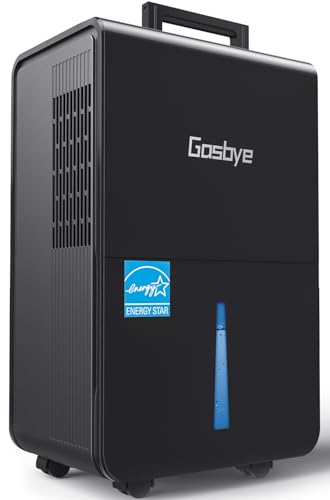
- Up to 115 pints per day under stated conditions
- Three drainage options
- Energy Star 2026 certified
Best For: Large garages needing continuous drainage
Best Quiet Option

- 35 dB listed operating noise
- 80-pint capacity with 5,000 sq. ft. coverage
- Timer, child lock, and dual drainage
Best For: Quieter garages and mixed-use living spaces
Best Budget Pick – GoGuess 21-Pint Compressor Dehumidifier
For shoppers comparing budget garage dehumidifiers, the GoGuess offers practical moisture control for spaces up to 1,600 square feet. Its compressor removes up to 21 pints per day under stated test conditions, while adjustable humidity control, sleep operation, and dual drainage add everyday convenience.
Best For: Garages, basements, laundry areas, and other medium-sized spaces needing affordable, adjustable humidity control.
Pros:
- Rated for areas up to 1,600 square feet with up to 21 pints of daily extraction.
- Offers DEHU, TURBO, and SLEEP modes, plus adjustable humidity from 30% to 80%.
- Supports both tank collection and continuous drainage with the included hose.
- Includes automatic shutoff, auto-defrost, child lock, washable filter, and automatic restart.
Cons:
- The 2.3-liter tank may require frequent emptying during very humid conditions.
- The 21-pint rating is based on 95°F and 90% relative humidity test conditions.
This is a well-rounded budget option when you want compressor performance, simple controls, and flexible drainage without stepping up to a larger-capacity unit.
Best Energy-Efficient Option – Waykar 34-Pint Energy Star Dehumidifier
The Waykar is a strong candidate among budget garage dehumidifiers for larger or consistently damp spaces. It is rated for up to 2,000 square feet, removes up to 34 pints per day under stated conditions, and carries ENERGY STAR certification for more efficient operation.
Best For: Large garages, basements, whole-home areas, and users who expect extended operation.
Pros:
- 34-pint capacity and coverage rated up to 2,000 square feet.
- ENERGY STAR certification is designed to help limit unnecessary energy use.
- Wide 30%–80% humidity range, 90-degree airflow adjustment, and two fan speeds.
- Offers a 2.5-liter tank, continuous drainage, 24-hour timer, defrost, and overload protection.
Cons:
- The manual 90-degree airflow adjustment may be less convenient than automatic directional airflow.
- The tank still needs emptying when continuous drainage is not installed.
Choose this model when capacity and operating efficiency matter more than the smallest footprint. Its drainage flexibility also suits garages that need unattended moisture control.
Best Large-Space Value – 34-Pint 2,500-Square-Foot Dehumidifier
For larger garages and basement zones, this 34-pint unit provides broad coverage at a value-oriented price point. It is rated for up to 2,500 square feet and combines continuous operation, a drain hose, portability, and a low-speed noise rating of 40 dB or less.
Best For: Large garages, basements, and other residential spaces where coverage and hands-free drainage are priorities.
Pros:
- Rated for up to 2,500 square feet with up to 34 pints of daily dehumidification.
- DEHU, DRY, and CONT modes support routine control, clothes drying, and nonstop operation.
- Includes a 0.53-gallon tank, drain hose, automatic shutoff, and power-failure memory.
- Casters, a recessed handle, washable filter, timer, and LED touchscreen improve usability.
Cons:
- The two-fan-speed design offers fewer speed choices than some competing models.
- The listed 2-liter tank is relatively small for a unit intended for high-humidity areas.
This model makes sense when you want generous stated coverage and continuous drainage in a mobile package. Its controls and memory feature are particularly useful for a garage that is checked less often.
Best for Cold Garages – AEOCKY X1-Pro Rotary Desiccant Dehumidifier
The AEOCKY X1-Pro stands apart from typical budget garage dehumidifiers because its rotary desiccant design is intended for cold conditions. It uses a zeolite molecular-sieve core rather than refrigerated coils, helping it avoid coil icing in rooms from 34°F to 95°F while delivering up to 10 pints per day in stated laboratory conditions.
Best For: Cold garages, winter-use basements, cabins, RVs, closets, and laundry rooms where compressor icing is a concern.
Pros:
- Desiccant technology is designed to keep extracting moisture in cold rooms without coil icing.
- Rated for up to 10 pints per day in laboratory conditions and 5 pints per day in stated real-world conditions.
- Sleep mode reaches 25 dB, with maximum-output testing listed at 39 dB at three feet.
- Compact design is intended for small spaces and small basements.
Cons:
- Its stated capacity is lower than the 21- to 34-pint compressor models in this roundup.
- The 340-watt heat-based system can warm the surrounding area.
- A slight warmth or scent may occur during first use or after long storage, according to the supplied guidance.
This is the specialized choice for a chilly garage where a conventional compressor may struggle. For larger, warmer spaces, a higher-capacity compressor model may be more practical.
Best Overall Value – 34-Pint Garage Dehumidifier
For shoppers comparing budget garage dehumidifiers, this 34-pint model offers a practical balance of moisture removal, control, and drainage support. It is rated for spaces up to 2,500 square feet and includes a drain hose for less frequent tank emptying.
Best For: Large garages, basements, storage areas, and homeowners who want quiet operation with adjustable humidity settings.
Pros:
- Removes up to 34 pints of moisture per day under stated test conditions.
- Includes a 3.28-foot drain hose for continuous drainage and has a 0.6-gallon tank with full-tank alerts.
- Offers 30%–80% humidity adjustment, 38 dB operation, sleep mode, auto defrost, and a 1–24-hour timer.
Cons:
- The included drain hose is relatively short at 3.28 feet.
- Its 0.6-gallon tank may require regular emptying when continuous drainage is unavailable.
This is a well-rounded choice when you need meaningful garage moisture control without giving up portability or quieter nighttime operation.
Best Compact Pick – Small Garage Dehumidifier with Auto Shutoff
If you need one of the more compact budget garage dehumidifiers, this semiconductor-based unit is easy to move and simple to operate. Its small footprint suits limited spaces, though its moisture-removal capacity is better matched to localized dampness than a large, persistently humid garage.
Best For: Small garages, closets, bathrooms, RVs, dorms, and other compact areas needing quiet supplemental moisture control.
Pros:
- Compact design with a built-in carry handle for easy relocation.
- Runs at no more than 40 dB and automatically shuts off when the tank is full or incorrectly installed.
- Removes up to 34 ounces of moisture per day under the stated test conditions and includes seven adjustable ambient light colors.
Cons:
- Its 34-ounce-per-day extraction rate is substantially lower than compressor-style options in this roundup.
- The notes list a 95-ounce tank but do not specify a continuous-drain hose.
- It is best suited to smaller areas rather than broad, heavily damp garage spaces.
This model makes sense when portability and low noise matter more than maximum extraction power, especially for a small garage corner or enclosed storage area.
Best for Large Garages – KNKA 80-Pint Dehumidifier
For very large or especially damp garages, this KNKA unit provides the highest stated capacity among these budget garage dehumidifiers. It is rated for up to 5,500 square feet, supports continuous drainage, and offers several operating modes for changing humidity conditions.
Best For: Large garages, basements, laundry rooms, and expansive residential areas with substantial moisture loads.
Pros:
- Removes up to 80 pints per day in the stated high-humidity test and 56 pints under typical basement conditions.
- Includes a 1.45-gallon tank and a 6.56-foot drain hose for continuous drainage.
- Provides Auto, Dry, and Setting modes, 30%–80% humidity control, 40–45 dB operation, casters, a washable filter, and a child lock.
Cons:
- The optional 2.64-gallon external tank is sold separately.
- The unit should remain upright for 24 hours before first use.
- Its larger capacity and footprint may be more than needed for a small garage.
This is the strongest fit for buyers prioritizing coverage and drainage capacity, provided the garage has enough room for its larger 11.14-by-14.17-by-20.87-inch body.
Best Large-Area Value – DryTank Max 100-Pint Dehumidifier
For shoppers comparing budget garage dehumidifiers, the DryTank Max offers a high stated capacity and coverage for large, damp areas. It is designed for spaces up to 5,000 square feet and includes humidity control, auto defrost, auto restart, and a drain hose.
Best For: Large garages, basements, laundry rooms, bathrooms, and storage areas where substantial moisture removal is needed.
Pros:
- Removes up to 100 pints of moisture per day under the stated test conditions.
- Adjustable humidity control supports automatic operation.
- Includes a drain hose, auto defrost, and auto restart.
Cons:
- The supplied dimensions appear unusually small for a high-capacity floor unit, so verify the listing measurements before purchase.
- Only a 1.45-gallon tank is specified, which may require frequent emptying when using manual drainage.
This model is a compelling budget-oriented choice when maximum stated capacity and included drainage accessories matter most. Confirm the physical size and drainage setup to ensure it fits your garage.
Best Heavy-Duty Build – Gasbye DryPrime 115-Pint Dehumidifier
Among budget garage dehumidifiers, the Gasbye DryPrime stands out for its solid 43-pound construction, flexible drainage, and high stated moisture-removal capacity. Its Energy Star 2026 certification and smart humidity control are useful for extended operation in large spaces.
Best For: Large garages, basements, and other spaces where continuous drainage, durability-focused construction, and lower operating costs are priorities.
Pros:
- Rated up to 115 pints per day at 86°F and 80% relative humidity.
- Offers a 1.7-gallon tank, included drain hose, and garden-hose connection.
- Energy Star 2026 certified, with smart humidity control, auto restart, and a washable filter.
- Listed operating noise is around 45 dB.
Cons:
- At 43 pounds and 24 inches tall, it is less convenient to move than compact models.
- The product listing gives different capacity figures under different conditions, so real-world output will vary with temperature and humidity.
The DryPrime is the strongest fit here for a garage needing dependable, long-duration moisture control. Its larger footprint and weight are reasonable tradeoffs for the drainage flexibility and heavy-duty design.
Best Quiet Option – Ludatido 80-Pint Dehumidifier
The Ludatido is a practical pick for shoppers seeking budget garage dehumidifiers with quieter operation and a smaller footprint. It combines 80-pint-per-day dehumidification with Energy Star certification, multiple modes, a timer, and continuous-drain capability.
Best For: Garages, basements, apartments, and other areas where quiet operation, portability, and flexible daily controls are important.
Pros:
- Rated for up to 80 pints per day and coverage up to 5,000 square feet.
- Listed at 35 dB, making it the quietest option in this group by the supplied specifications.
- Includes Sleep, Fan, and Dry modes, plus a 24-hour timer and child lock.
- Supports both manual tank emptying and continuous drainage.
Cons:
- Its 1.32-gallon tank is smaller than the tank on the Gasbye model.
- The supplied specifications list a 13.5 kg weight, so it may not be as lightweight as its compact dimensions suggest.
Choose the Ludatido when low noise and everyday convenience matter more than the highest stated capacity. Its controls and dual-drain design make it well suited to garages that also connect to living areas.
How We Picked the Best Budget Garage Dehumidifiers
We focused on the features that matter most in a garage: realistic coverage, moisture-removal capacity, automatic operation, tank and hose drainage, energy use, and performance in cooler conditions. We also included several capacity levels, from compact units for smaller garages to high-output models intended for large or persistently damp spaces.
Product claims such as square-foot coverage and pint-per-day capacity are useful for comparison, but actual results depend on temperature, humidity, insulation, air circulation, and how often doors are opened. A larger rating is not automatically better if it increases cost and energy use without solving a real moisture problem.
Quick Comparison
| Best For | Typical Capacity | Features to Prioritize |
|---|---|---|
| Small or partially enclosed garage | 20–35 pints per day | Compact design, auto shutoff, simple controls |
| Average two-car garage | 34–50 pints per day | Continuous drainage, humidistat, washable filter |
| Large or very damp garage | 80–115 pints per day | High airflow, hose drainage, durable operation |
| Cold winter garage | Desiccant or low-temperature-rated unit | Frost resistance and reliable cold-weather performance |
Key Buying Factors for Budget Garage Dehumidifiers
Coverage and Moisture-Removal Rate
Match the unit to the garage’s size and moisture level rather than relying on the largest advertised number. A moderately damp attached garage may need far less capacity than an uninsulated space with water intrusion or frequent vehicle storage.
Drainage and Maintenance
A built-in tank is convenient but requires regular emptying. For unattended operation, choose a model with a drain hose connection and place the unit near a suitable floor drain or condensate pump. Clean the filter regularly and leave adequate clearance around the air intake and exhaust.
Cold-Weather Operation
Compressor dehumidifiers can lose efficiency or develop frost in cold garages. If temperatures regularly fall near or below typical basement conditions, look for low-temperature protection or consider a desiccant model. Check the manufacturer’s operating range before buying.
Noise, Controls, and Energy Use
For garages near living areas, a quieter model with a humidistat, timer, and automatic restart is worth prioritizing. Energy Star certification can help reduce operating costs, but compare the rated capacity and expected runtime as well as the label.
Who Should Buy Which Budget Garage Dehumidifiers?
Choose a compact 20- to 35-pint model for a smaller garage, light condensation, or occasional use. An efficient 34- to 50-pint unit is the most versatile choice for many average two-car garages, especially when continuous drainage is available. Large 80- to 115-pint models make more sense for oversized spaces, serious humidity, or garages with frequent water exposure. For unheated winter garages, favor a desiccant or specifically cold-weather-capable design.
Before purchasing, measure the space, identify a safe drainage route, and check the lowest expected temperature. A correctly sized unit with convenient drainage will usually outperform a much larger dehumidifier that is difficult to maintain or cannot operate effectively in your garage’s conditions.