Heat, humidity, and trapped air can raise attic temperatures and contribute to moisture problems. The right roof ventilation fan helps move stale air out while complementing your intake vents.
We compared 10 options across airflow, power source, controls, coverage, installation style, and intended use so you can choose a fan that fits your roof, attic, garage, or outbuilding.
Best 10 Roof Ventilation Fans Picks for 2026
High-Capacity Pick
Master Flow ERV6BL Powered Roof Fan

- 1,500 CFM airflow
- Covers up to 2,800 sq. ft.
- Thermostat included
Best For: Large attics needing powerful electric ventilation
Automatic Control Pick
Air Vent 53832 Power Attic Ventilator

- 1,320 CFM airflow
- Automatic thermostat and humidistat
- 10-year limited warranty
Best For: Attics needing temperature and humidity control
Solar Hybrid Pick
iLiving 14-Inch Solar Attic Fan
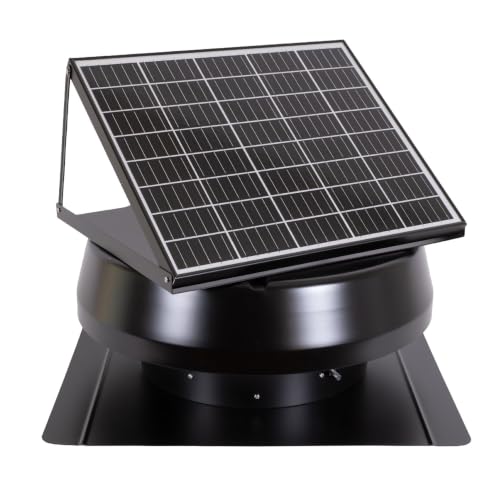
- 1,150 CFM solar airflow
- Adjustable panel angle
- 15-year limited warranty
Best For: Solar-powered ventilation for large attics
Maximum Airflow Pick

- 2,339 CFM airflow
- Covers up to 3,400 sq. ft.
- Adjustable thermostat
Best For: Large attics requiring maximum exhaust capacity
Best Eco-Friendly Pick

- Solar-powered, electricity-free operation
- Up to 240 CFM in strong sunlight
- 8-inch removable vent with protective mesh
Best For: Sunny garages, sheds, shops, and smaller attic spaces
Best Smart High-Capacity Pick
QuietCool AFR SMT PRO-2.0 Roof Fan

- Up to 1,922 CFM of attic airflow
- App, thermostat, and humidistat control
- Two speeds with a 20-foot power cord
Best For: Attics needing automated, high-volume electric ventilation
Best High-Airflow Solar Pick

- Up to 2,000 CFM of solar-powered airflow
- Controller-free sunrise-to-dusk operation
- Heavy-duty metal housing and copper motor
Best For: Larger attics, garages, greenhouses, sheds, and barns
Best for Traditional Roof-Mounted Attic Ventilation
Master Flow 1000 CFM Power Roof Vent

- 1,000 CFM airflow for attics up to 1,600 sq. ft.
- Thermostat-controlled, hard-wired roof-mount design
- Galvanized steel housing with animal-resistant screen
Best For: Conventional attic ventilation on compatible non-tile roofs
Best for High-Airflow Multi-Space Ventilation
2500 CFM Roof Exhaust Attic Fan
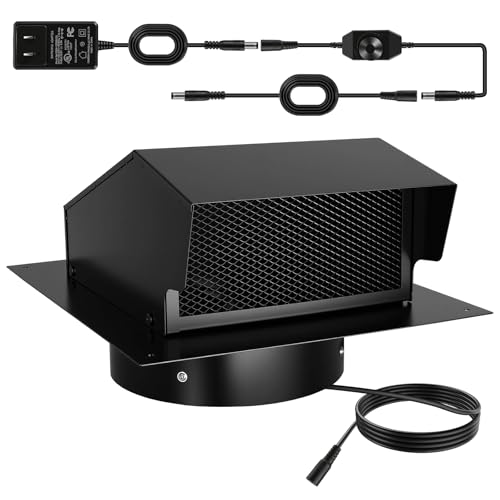
- Up to 2,500 CFM with adjustable speed control
- Water-resistant motor and weather-resistant metal housing
- Includes cords, adapter, and installation accessories
Best For: Attics, garages, sheds, and other utility spaces needing strong airflow
Best for Solar-Assisted 24/7 Operation
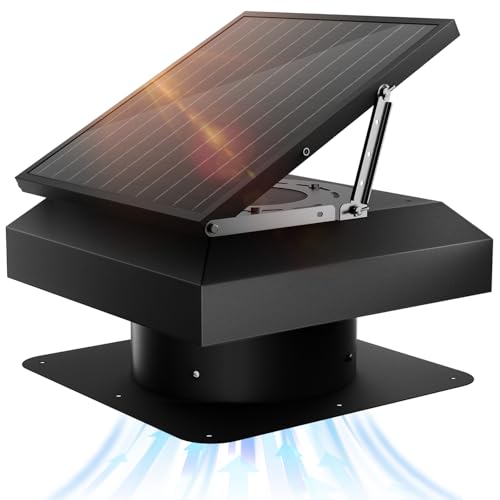
- 2,000 CFM airflow for spaces up to 2,500 sq. ft.
- Solar power with AC/DC auto-switching
- Four speeds and adjustable thermostat control
Best For: Attics and utility spaces needing solar-assisted, continuous ventilation
High-Capacity Pick – Master Flow ERV6BL Powered Roof Fan
If you need powerful roof ventilation fans for a sizable attic, the Master Flow ERV6BL combines 1,500 CFM of airflow with coverage for spaces up to 2,800 square feet. Its galvanized-steel construction, built-in screen, and thermostat controller make it a practical electric roof-mount option.
Best For: Homeowners seeking high airflow and thermostat-controlled ventilation for a large attic.
Pros:
- Moves up to 1,500 CFM and is rated for attics up to 2,800 square feet.
- Galvanized-steel construction and built-in screen support durability and protection.
- Includes a thermostat controller for automatic operation.
Cons:
- Requires hardwired 120-volt electrical installation.
- Not compatible with tile roofing systems.
This is a strong choice when airflow capacity and durable construction matter most. Confirm roof compatibility and plan for electrical installation before buying.
Automatic Control Pick – Air Vent 53832 Power Attic Ventilator
The Air Vent 53832 is one of the more feature-focused roof ventilation fans, pairing 1,320 CFM airflow with both an automatic thermostat and humidistat. Its roof-mounted design and long limited warranty make it worth considering for homeowners who want automated attic exhaust.
Best For: Attics where temperature and humidity-based automatic control are priorities.
Pros:
- Provides airflow rated at 1,320 CFM.
- Includes both an automatic thermostat and humidistat.
- Backed by a 10-year limited warranty with five-year replacement-plus protection.
Cons:
- Uses a 100-watt AC power source and requires roof-mounted installation.
- The supplied specifications list plastic blades and a brushed motor.
Its thermostat-and-humidistat combination gives it a useful advantage for more responsive attic ventilation. Check the mounting requirements and included installation details for your roof.
Solar Hybrid Pick – iLiving 14-Inch Solar Attic Fan
The iLiving ILG8SF301 offers solar-powered roof ventilation with a 40-watt adjustable panel and airflow up to 1,150 CFM. It is designed to cool up to 2,900 square feet and adds a waterproof brushless motor plus smart thermostat control for flexible attic use.
Best For: Homeowners who want solar-powered attic ventilation with adjustable panel positioning.
Pros:
- Solar-powered design delivers up to 1,150 CFM and covers up to 2,900 square feet.
- Adjustable solar panel angle supports positioning at 0, 15, 30, or 45 degrees.
- Includes a smart thermostat and waterproof brushless motor with a 15-year limited warranty.
Cons:
- The AC/DC adapter kit is sold separately.
- Its listed noise level is 65 dB.
This model is a compelling fit when reducing dependence on standard electrical power is important. Its solar output depends on sunlight, while the optional adapter adds flexibility for non-solar operation.
Maximum Airflow Pick – iLiving ILG8G14-12T Gable Fan
For buyers prioritizing raw airflow, the iLiving ILG8G14-12T stands out among roof ventilation fans and attic exhaust options with a rated 2,339 CFM capacity. Its gable-mount design, adjustable thermostat, galvanized-steel housing, and coverage up to 3,400 square feet suit large attic spaces.
Best For: Large attics needing very high airflow from a gable-mounted ventilator.
Pros:
- Moves up to 2,339 CFM and is rated to cool up to 3,400 square feet.
- Includes an adjustable built-in thermostat for automatic operation.
- Galvanized-steel housing and included mounting brackets support installation.
Cons:
- Single-speed operation provides less adjustment than a variable-speed model.
- At 230 watts and 2.85 amps, it requires hardwired 120-volt power.
- Its one-year limited component warranty is shorter than some alternatives.
This fan is the airflow leader in the group, making it appropriate for expansive attic spaces. Because it mounts at a gable rather than directly on the roof, verify that your attic layout supports that installation style.
Best Eco-Friendly Pick – 25W Solar Roof Vent Fan
If you want roof ventilation fans without adding to your electricity bill, this 25W solar model is a practical option for smaller attic, garage, shop, or warehouse spaces. Its 8-inch vent reaches up to 240 CFM in strong sunlight, while the galvanized-steel cover and bird-blocking aluminum mesh add useful protection. Keep in mind that output drops substantially in cloudy conditions or shade.
Best For: Sunny locations needing low-cost ventilation for an attic, garage, shed, shop, or similar space.
Pros:
- Solar-powered operation avoids regular electricity use.
- IP68 waterproof brushless motor and corrosion-resistant galvanized-steel cover.
- Removable 8-inch vent with a pipe extension for flexible-duct connections.
- Solar panel uses tempered glass and an aluminum frame.
Cons:
- Performance is greatly reduced by clouds or shadows.
- It cannot store electricity and may stop when sunlight is insufficient.
- Its stated airflow is up to 240 CFM, lower than larger electric models.
This is one of the simpler roof ventilation fans to consider when solar operation and easy installation matter more than maximum airflow. Plan the installation around unobstructed sunlight for the best results.
Best Smart High-Capacity Pick – QuietCool AFR SMT PRO-2.0 Roof Fan
Among roof ventilation fans, the QuietCool AFR SMT PRO-2.0 stands out for homeowners who want high airflow and automated control. This AC-powered roof-mount fan delivers up to 1,922 CFM, offers two speeds, and works with smart app control plus a built-in thermostat and humidistat. It plugs into a standard 120V outlet using the included 20-foot power cord.
Best For: Attics where powerful electric ventilation, app-based operation, and automatic temperature or humidity control are priorities.
Pros:
- Up to 1,922 CFM on high speed.
- Smart app control with thermostat and humidistat functionality.
- Two-speed PSC motor can use as little as 208 watts on low.
- Includes a 20-foot power cord and built-in fire-safety shutoff.
Cons:
- Requires an AC electrical outlet rather than solar power.
- Compatible flashings for multiple roof types are sold separately.
- At 50 dB, it is not the quietest option listed.
This model is a strong fit for buyers comfortable with a powered roof installation and looking for more control than a basic exhaust fan provides. Confirm the required flashing and roof compatibility before installation.
Best High-Airflow Solar Pick – 40W 12-Inch Solar Attic Fan
For buyers comparing roof ventilation fans by airflow, this 40W solar attic fan offers a notably powerful solar setup. Its 12-inch metal blades are rated for 1,800–2,000 CFM, and the controller-free design starts at sunrise and shuts down at dusk. The pre-connected panel and fan support a straightforward DIY installation for attics, garages, greenhouses, sheds, or barns.
Best For: Larger spaces that need substantial daytime airflow without electrical wiring or a separate controller.
Pros:
- Delivers up to 2,000 CFM from a 40W solar panel.
- Controller-free automatic operation from sunrise to dusk.
- Heavy-duty metal housing, copper motor, and IP65 weather-resistant design.
- Pre-connected components simplify setup.
Cons:
- Solar operation means airflow depends on available daylight.
- The 25.4-pound unit is heavier than the smaller solar model.
- It does not provide nighttime ventilation or stored power.
This is a compelling solar choice when maximum daytime airflow is more important than compact size or all-weather, around-the-clock operation. Its larger footprint and weight should be checked against the planned roof location before purchase.
Best for Traditional Roof-Mounted Attic Ventilation – Master Flow 1000 CFM Power Roof Vent
For homeowners seeking dependable roof ventilation fans for a conventional attic, the Master Flow GAF ERV4 combines 1,000 CFM airflow with a built-in thermostat. It is designed for attic spaces up to 1,600 square feet and uses up to 55% less electricity than typical competing vents, according to the supplied product information.
Best For: Standard asphalt-shingle roof installations requiring hard-wired, thermostat-controlled attic exhaust.
Pros:
- Moves up to 1,000 CFM and is rated for attic spaces up to 1,600 square feet.
- Galvanized steel construction and a heavy-duty internal screen help support durability and animal protection.
- Suitable for roof slopes from 3:12 to 12:12 and carries several listed or approved ratings.
- Thermostat control can help automate ventilation while supporting lower cooling loads.
Cons:
- Requires hard-wired electrical installation.
- Not compatible with tile roofing systems.
- Its fixed 1,000 CFM capacity may be less suitable for unusually large attic areas.
This is a focused choice for a standard roof-mounted attic project where durable metal construction, thermostat operation, and straightforward exhaust performance matter more than solar operation or portability.
Best for High-Airflow Multi-Space Ventilation – 2500 CFM Roof Exhaust Attic Fan
This 10-inch roof exhaust fan is a flexible option among roof ventilation fans, delivering up to 2,500 CFM with a speed controller and plug-and-play power setup. Its wall-mount design and broad application list make it suitable for attics as well as garages, sheds, workshops, greenhouses, and other enclosed spaces.
Best For: Buyers who need adjustable, high-volume ventilation for multiple utility or outbuilding spaces.
Pros:
- Provides up to 2,500 CFM of airflow for spaces listed from 200 to 3,000 square feet.
- Includes a speed control switch, power cord, adapter, and extension cord for flexible setup.
- Galvanized steel and aluminum construction, an IP68 waterproof motor, and a mesh guard support outdoor use.
- Designed for quiet operation, with supplied specifications listing noise as low as 40–45 dB.
Cons:
- The supplied details identify it as a wall-mount model, so roof-specific installation may require careful planning.
- Listed voltage is 230 volts; verify electrical compatibility before purchase.
- Sealant is needed after installation to help prevent water leakage.
With unusually high airflow and adjustable output, this fan is appealing for large or varied ventilation jobs. Confirm the mounting approach, voltage, and weather-sealing requirements before using it as a roof vent.
Best for Solar-Assisted 24/7 Operation – 40W Solar 2000 CFM Attic Fan
For shoppers comparing roof ventilation fans with lower grid dependence, this 40W solar attic fan pairs a 2,000 CFM exhaust fan with an adjustable solar panel, thermostat, and AC/DC backup adapter. Its dual-power switching is designed to maintain operation during cloudy conditions and at night when the adapter is connected.
Best For: Attic, garage, or workshop ventilation where solar assistance, automatic temperature control, and continuous operation are priorities.
Pros:
- Delivers up to 2,000 CFM and is designed to cool spaces up to 2,500 square feet.
- Adjustable solar panel angle from 0–70 degrees helps optimize sun exposure.
- Offers four speeds, thermostat control from 68–113°F, and solar/AC auto-switching.
- Includes an MPPT controller, temperature probe, AC/DC adapter, mounting bracket, and screw kit.
Cons:
- There is no battery backup, so nighttime or cloudy-day operation depends on the AC adapter.
- Mode 2 performance control requires the AC/DC adapter.
- The supplied specifications identify it as wall-mounted, so installation planning is important for roof applications.
This model stands out for buyers who want solar-assisted ventilation without giving up continuous operation when connected to household power. Its thermostat and multi-speed controls add flexibility, while the lack of battery backup is worth noting.
How We Picked These Roof Ventilation Fans
We evaluated the selected models by looking at published airflow ratings, power requirements, control options, construction, installation format, and stated coverage. The list includes powered roof-mount fans, solar units, smart models, gable-mounted ventilators, and smaller exhaust fans for garages or outbuildings.
CFM ratings were treated as a comparison point rather than a guarantee of whole-attic performance. Actual results depend on attic size, insulation, intake ventilation, duct or roof layout, weather, and installation quality.
Quick Comparison
| Type | Best For | Main Advantage | Trade-Off |
|---|---|---|---|
| Powered roof mount | Homes with accessible electrical power | Consistent airflow and thermostat control | Requires wiring and roof installation |
| Solar roof fan | Energy-conscious installations | Low operating cost and simple daily operation | Performance varies with sunlight |
| Smart attic fan | Monitoring and automatic control | App access plus temperature or humidity settings | Higher cost and setup complexity |
| Gable mount | Attics with suitable gable openings | Avoids cutting a new roof opening | Needs a compatible gable location |
| Small exhaust fan | Sheds, garages, barns, and workshops | Flexible placement and speed control | Usually not intended for large residential attics |
Key Buying Factors for Roof Ventilation Fans
Airflow and Attic Size
Compare the fan’s CFM rating with the manufacturer’s coverage guidance, but do not select solely by the largest number. A high-output fan cannot compensate for inadequate intake vents, blocked soffits, or poor air sealing. Oversized ventilation may also be unnecessary for a small space.
Power Source and Controls
Electric fans provide predictable operation when wired correctly. Solar models reduce electrical use and often work well where roof exposure is favorable, but output can drop in cloudy conditions or shade. Thermostats start the fan when temperatures rise; humidistats and smart controls can provide more targeted operation.
Mounting and Installation
Roof-mount fans require careful flashing and weatherproofing. Gable models can be easier when an existing opening provides a suitable mounting location. Check roof pitch, opening dimensions, power-cord length, and whether electrical work or professional installation is required before buying.
Noise, Durability, and Weather Resistance
Review construction materials, motor design, warranty terms, and published noise information where available. Galvanized or coated metal housings can be useful in exposed locations. A fan installed near living spaces should receive extra attention to vibration and sound.
Who Should Buy Which Roof Ventilation Fans?
Choose a powered roof-mount model if you want dependable, thermostat-controlled airflow and already have—or can add—the required electrical connection. Solar models are a strong fit for sunny roofs, detached structures, and buyers prioritizing lower operating costs. A smart fan is worthwhile when app control, humidity monitoring, or more precise scheduling matters.
Select a gable-mounted ventilator when your attic has a compatible gable opening and you want to avoid creating a new roof penetration. For sheds, garages, greenhouses, barns, or other small structures, a compact wall or roof exhaust fan with adjustable speed may be more practical than a high-capacity residential attic unit. Whichever model you choose, confirm adequate intake ventilation and follow local building and electrical requirements.