
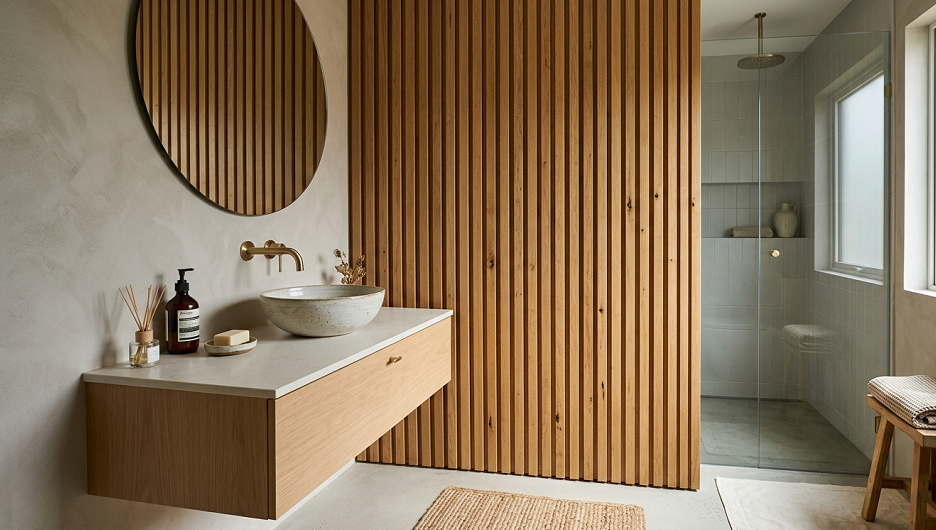
Let’s be honest: most of our bathrooms are high-stress zones. Between the mismatched plastic bottles, the grout that never stays white, and that one drawer filled with half-used lotions from 2019, it’s hard to find “zen.” I remember my first attempt at a bathroom “refresh.” I went full-on “modern” with cold gray tiles and chrome fixtures. I ended up with a room that felt more like a hospital surgical suite than a sanctuary. I’d walk in there and my blood pressure would actually go up.
That’s where Japandi comes in. It’s the marriage of Japanese minimalism and Scandinavian functionality. It’s not just about looking clean; it’s about feeling warm. If you’ve been staring at your outdated vanity wondering why your house feels chaotic, these Japandi bathroom design ideas are going to be your roadmap to a space that actually lets you breathe.
1. Swap That Cold Vanity for Light Oak Wood
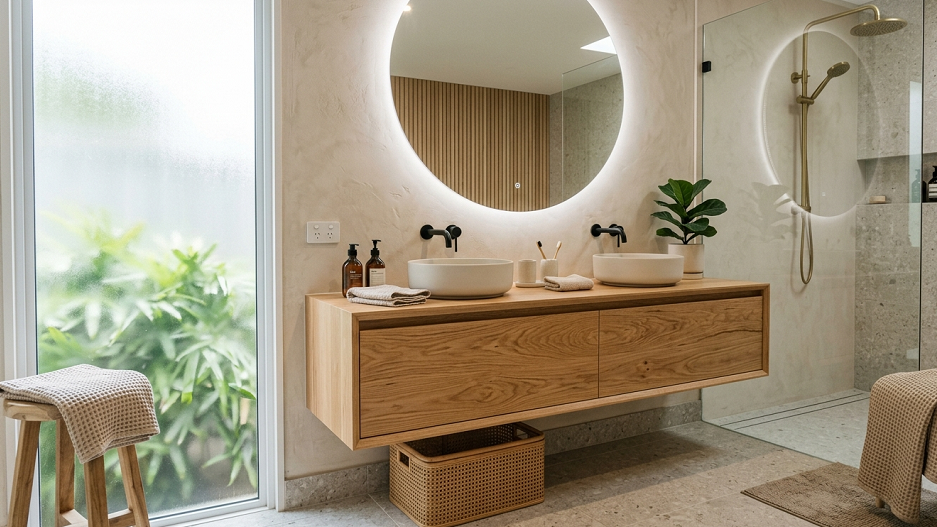
I used to think dark espresso cabinets were the height of luxury. I was wrong. Dark wood in a bathroom shows every single water spot and speck of dust. In the Japandi world, we lean heavily into light, unfinished, or honey-toned woods like oak or bamboo. This is the “Scandi” side of the equation bringing in that organic warmth.
When you’re looking for a new vanity, skip the high-gloss finishes. You want something with a visible grain. I once installed a cheap MDF vanity that claimed to be “moisture resistant,” and within six months, the edges were peeling like a sunburn. Save yourself the heartbreak and invest in solid wood or high-quality veneers.
A floating vanity is a pro move here. By keeping the floor visible underneath, you trick your brain into thinking the room is bigger than it is. It also makes cleaning a breeze—no more awkward corners where dust bunnies go to retire. Just make sure your plumbing is tucked away neatly, or the “minimalist” vibe will be ruined by a mess of silver pipes.
Side note: If you aren’t ready to rip out your cabinets, you can sand down your existing wooden vanity and apply a clear matte sealer. It’s a weekend project that costs about $40 but looks like a $2,000 upgrade.
2. Use Stone-Effect Tiles for a Grounded Feel
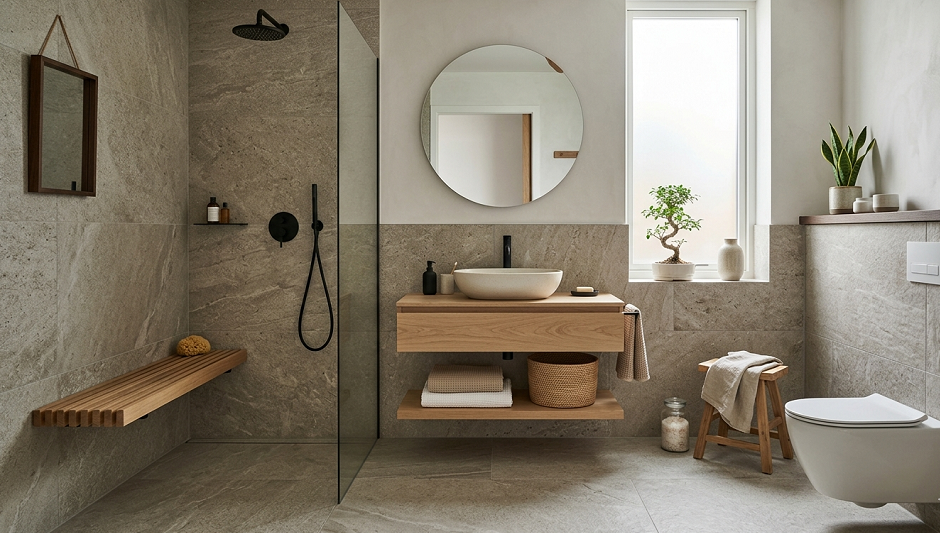
The Japanese side of Japandi is all about “Wabi-sabi,” which is a fancy way of saying we appreciate things that are perfectly imperfect. Standard 12×12 ceramic tiles are boring and feel mass-produced. Instead, look for large-format porcelain tiles that look like slate, limestone, or concrete.
I once spent three days laying tiny mosaic tiles in a shower, thinking it would look “artisan.” It looked like a grid-paper nightmare, and cleaning the grout was a full-time job. With Japandi, bigger is better. Fewer grout lines mean a calmer visual field. It also means you spend less time scrubbing on your hands and knees.
Go for a matte finish. Shiny floors in a bathroom are a death trap when wet, and they show every water stain. A textured, stone-look tile provides grip and hides the fact that you haven’t mopped in a week. It’s practical, and it looks like it belongs in a high-end Kyoto bathhouse.
If you’re worried about the room feeling too “heavy” with stone, keep the tile on the floor and maybe one feature wall. Leave the other walls a soft, warm white. This balance keeps the space from feeling like a cave while still giving you that grounded, earthy energy.
3. The Power of an Oval Vessel Sink
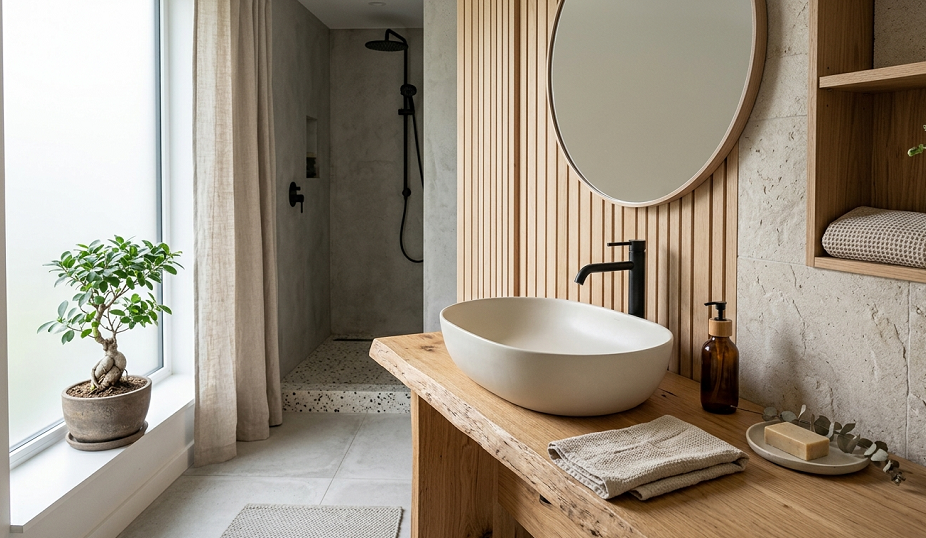
If there is one thing I’ve learned about DIY, it’s that sharp corners are the enemy of relaxation. My old square sink was a literal pain—I hit my elbow on it more times than I can count. Japandi design loves soft, organic curves. An oval vessel sink sitting on top of a wooden counter is the ultimate “peaceful” look.
Vessel sinks get a bad rap for being “trendy,” but in a Japandi context, they mimic the look of a traditional washing bowl. Choose one in a matte ceramic or even a stone material. Avoid the glass ones; they look dated the second you install them and are a nightmare to keep streak-free.
One thing people forget: when you buy a vessel sink, you need a “tall” faucet or a wall-mounted one. I made the mistake of buying a standard faucet for my first vessel sink and realized I couldn’t even fit my hands under the water stream. Don’t be like me. Measure twice, buy once.
The ritual of washing your hands in a beautiful bowl rather than a standard “hole in the counter” changes the vibe of your morning routine. It turns a chore into a moment of mindfulness. Plus, it’s a huge selling point if you ever decide to move.
4. Invest in Slatted Wood Wall Panels
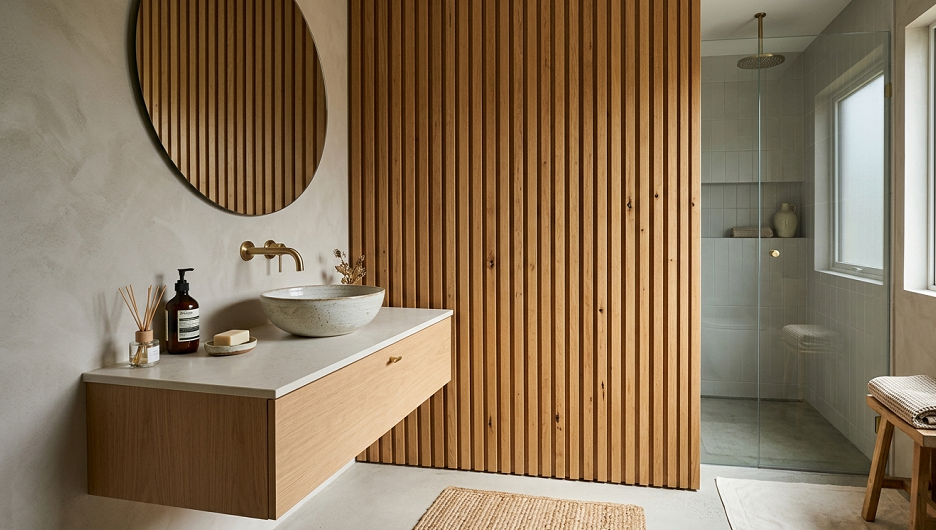
You’ve probably seen these all over your feed, and for once, the trend is actually worth the hype. Slatted wood (often called “tambour”) adds incredible texture without adding “clutter.” In a Japandi bathroom, these panels act as the bridge between the clean lines of the North and the natural materials of the East.
I installed these behind my toilet to hide some wonky drywall, and it completely transformed the room. It went from “basic bathroom” to “boutique hotel” in two hours. You can buy pre-made panels, or if you’re feeling brave, you can rip down some pine boards and DIY it. Just make sure you seal them properly—bathrooms are humid, and unsealed wood will warp faster than you can say “Scandi-chic.”
The vertical lines of the slats also draw the eye upward, making short ceilings feel much taller. It’s a classic design trick that works every time. I’ve found that using oak or teak slats works best for that authentic Japandi look. Avoid dark stains like mahogany; they’re too heavy for this style.
Quick side note: Don’t put these inside the actual shower zone. I’ve seen people try it, and it’s a mold disaster waiting to happen. Keep them on the “dry” side of the room to act as a backdrop for your vanity or a focal wall.
5. Switch to Matte Black or Brushed Gold Fixtures
Chrome is the default for most builders because it’s cheap, but it’s the least “Japandi” thing on the planet. It’s cold and reflective. For a truly minimalist home, you want fixtures that have a “quiet” presence. Matte black provides a sharp, Japanese-inspired contrast against light wood, while brushed gold adds a Scandi-style warmth.
I switched my shower head to a matte black rain-shower model last year. Not only does it look incredible against my stone tiles, but it also doesn’t show fingerprints. Chrome fixtures are like mirrors for every smudge and soap splash. Who has time for that?
When choosing your hardware—towel racks, TP holders, faucets—keep the shapes simple. No ornate carvings or “vintage” levers. You want sleek, circular, or gently curved lines. It’s about creating a cohesive look where nothing “shouts” for attention.
One warning: black fixtures can sometimes show calcium buildup if you have hard water. If your water is “crunchy,” go with brushed nickel or gold instead. They’re much more forgiving and still fit the aesthetic perfectly.
6. Embrace the “Spa-Like” Wet Room Layout
If you’re doing a full remodel, this is the gold standard. A wet room is where the shower and the tub are in the same glass-enclosed area. It’s incredibly popular in Japanese homes because it’s efficient and feels incredibly luxurious.
I tried to DIY a “partial” wet room in my guest bath, and let me tell you, waterproofing is no joke. If you aren’t 100% confident in your tanking skills, hire a pro for the floor prep. But once it’s done? It’s a game changer. No more clunky shower curbs to trip over, and the whole room feels twice as big because the floor is continuous.
The Japandi wet room usually features a deep soaking tub. In Japan, these are called “Ofuro” tubs. They’re shorter and deeper than Western tubs, meant for sitting and reflecting rather than lying down and scrolling on your phone. Even if you just get a standard freestanding tub, placing it inside the shower zone creates a high-end “destination” feel.
Use a single sheet of frameless glass to separate the wet zone from the rest of the room. This keeps the sightlines open. Nothing kills a minimalist vibe faster than a bulky, framed shower door with a million metal tracks that collect gunk.
7. Natural Light and “Hidden” LED Strips
Lighting is usually an afterthought in bathroom design, which is a tragedy. Most people stick a “vanity bar” over the mirror and call it a day. That harsh light makes everyone look like they haven’t slept in a decade. In a Japandi space, we want soft, diffused light that mimics a foggy morning in a forest.
If you have a window, don’t block it with heavy blinds. Use frosted glass or a simple linen Roman shade. If you don’t have a window (like my basement bath), you have to get creative. I installed LED strips behind my mirror and under my floating vanity. This creates a “glow” rather than a “beam.”
This is called layered lighting. You want your “task” lighting (for shaving or makeup) to be functional, but your “ambient” lighting should be for relaxing. Putting your lights on a dimmer switch is the single best $20 investment you will ever make. Being able to dim the lights for a late-night bath is the ultimate luxury.
Avoid those “cool white” bulbs that look blue. They make the wood in your Japandi bathroom look sickly. Stick to “warm white” or “soft white” (around 2700K to 3000K). It brings out the honey tones in the oak and makes the stone feel inviting rather than cold.
8. Neutral Palettes: Think Beyond “White”
People hear “minimalist” and think “white walls.” But a pure white bathroom can feel sterile and boring. The Japandi palette is built on “greige,” oatmeal, sand, and muted terracotta. These are colors you’d find in a handful of pebbles at the beach.
I once painted a small bathroom “stark white” thinking it would make it look bigger. It just made it look like an unfinished basement. I repainted it a soft, warm beige with gray undertones, and suddenly the room felt expensive. The color provides a backdrop that allows your wooden vanity and green plants to pop.
Don’t be afraid of dark accents, though. A charcoal gray wall can provide a beautiful “Japanese” contrast. The key is to keep it matte. Avoid glossy paint at all costs—it reflects light in a way that feels cheap and frantic. Matte or “eggshell” finishes absorb light and feel much more sophisticated.
If you’re stuck on a color, go to the paint store and look for the “historical” or “nature” collections. Anything that sounds like a type of dirt or a species of tree is probably a safe bet for a Japandi home.
9. Bring in Living Greenery (The Right Way)
You can’t have a Japandi bathroom without plants. It’s the “life” in the design. But please, I beg you, skip the fake plastic vines from the craft store. They collect dust and look sad. You want real, humidity-loving plants that thrive in a bathroom environment.
Snake plants are my go-to. They are virtually impossible to kill (trust me, I’ve tried) and their architectural shape fits the Japanese aesthetic perfectly. If you have a bit more light, a Peace Lily or a Monstera can work. The green against the light wood and stone is the quintessential “peaceful” look.
I once overdid it and turned my bathroom into a literal jungle. I couldn’t even reach the toilet paper without moving a fern. Keep it intentional. One large plant in a concrete pot or a couple of small ones on a wooden shelf is plenty.
If your bathroom is pitch black with no windows, even a “low light” plant will eventually die. In that case, use high-quality dried branches like Eucalyptus or Willow in a tall ceramic vase. It gives you that organic feel without the slow death of a living thing.
10. Minimalist Storage: The “One-Touch” Rule
Clutter is the death of Japandi. If your counter is covered in toothpaste tubes and hair ties, no amount of oak slats will save you. The goal is “hidden but accessible” storage.
I’m a big fan of recessed medicine cabinets. They look like a regular mirror but hide all the ugly stuff. If you can’t cut into your walls, use beautiful wooden trays or ceramic bowls to “corral” your daily items. If it’s on a tray, it looks like a “styled choice” rather than a “mess.”
I used to have a massive cabinet filled with “just in case” toiletries. When I cleared it out, I realized I had three bottles of expired sunscreen and a rusted razor. Be ruthless. Only keep what you use every day in the bathroom. Everything else goes in a linen closet or under the sink in organized bins.
Try to decant your soap and shampoo into matching amber glass or ceramic bottles. It sounds “extra,” but getting rid of the loud, brightly colored plastic labels immediately lowers the visual noise of the room. It’s a small change that makes a massive impact.
11. Textural Comfort with Waffle-Weave Linens
Scandi design is big on “Hygge,” which is all about coziness. In a bathroom, that means your towels shouldn’t be those thin, scratchy things you’ve had since college. Japandi bathrooms favor waffle-weave towels in neutral tones like flax, charcoal, or sage green.
Waffle-weave is great because it dries quickly—which is practical—and it has a beautiful, honeycomb texture that looks great hanging on a wooden hook. I switched to these a few years ago and I’ll never go back to fluffy terry cloth. They take up less space in the laundry and they feel like a spa treatment every time you use them.
Don’t forget the bath mat. Skip the shaggy, “noodle” mats that stay wet for three days. Go for a wooden teak mat or a low-pile organic cotton rug. A teak mat allows water to drain and gives you that “sauna” feel under your feet.
Quick side note: If you’re hanging towels, use simple wooden pegs or a sleek matte black bar. Avoid those “fancy” double-towel racks that stick out a foot from the wall. They’re bulky and always seem to get knocked loose.
12. Focus on “Artistic” Minimalism
You don’t need a lot of decor in a Japandi bathroom, but what you do have should be meaningful. Instead of a gallery wall, choose one single piece of art. Maybe a simple black-and-white ink wash painting or a framed botanical print.
I once tried to decorate with a bunch of “beach-themed” knick-knacks—seashells, a tiny lighthouse, the whole deal. It felt cluttered and childish. In Japandi design, we let the materials be the art. A beautiful piece of driftwood or a single, perfectly shaped stone on a shelf is more powerful than a dozen “decor” items from a big-box store.
The mirror itself can be the focal point. A large, circular mirror with a thin wooden frame or even a frameless “pebble-shaped” mirror adds a lot of character without feeling “busy.” It breaks up all the straight lines of the tiles and vanity.
Think of your bathroom as a gallery for your life. Every item should either be very useful or very beautiful. If it’s neither, it doesn’t belong in your sanctuary.
13. The Bonus: Don’t Forget the Scent
This isn’t exactly a “design” idea, but it’s a crucial part of the Japandi experience. A bathroom that looks like a spa but smells like damp towels isn’t a success. Use scents that lean toward the “earthy” side—think Hinoki wood, sandalwood, eucalyptus, or cedar.
I avoid those “ocean breeze” or “linen” candles; they smell like chemicals to me. A simple reed diffuser with high-quality essential oils provides a constant, subtle background scent. Or, hang a bundle of fresh eucalyptus in your shower. When the steam hits it, it smells incredible and helps clear your sinuses.
This is the final layer of the “peaceful” home. It engages all your senses. When you walk into your Japandi bathroom, it should be a signal to your brain that the day’s stress is over and it’s time to reset.
The Real Talk: What’s Not Worth Your Time
Look, I’m all for DIY, but there are some things you should just avoid in a Japandi bathroom. First: avoid high-maintenance finishes. Unsealed marble looks great for about five minutes until you spill a drop of mouthwash on it, and then it’s stained forever. Stick to high-quality porcelain that looks like marble.
Second: don’t go too cheap on the “minimalism.” True minimalism relies on high-quality materials because there is nowhere to hide flaws. If you buy a cheap, flimsy wooden shelf, it’s going to look cheap and flimsy. It’s better to have one expensive, beautiful item than five cheap ones.
Third: skip the “smart” toilets unless you really want one. I know they’re big in Japan, but they are a nightmare to repair and the electronics can be finicky in a humid room. Unless you have a big budget for a plumber who specializes in tech-toilets, a high-quality, sleek, standard one-piece toilet is a much better investment.
Finally: don’t ignore your lighting. I’ve seen people spend $10k on tiles and then leave a $20 “boob light” on the ceiling. It ruins everything. Lighting is the “glue” that holds the design together.
Parting Wisdom
Creating a Japandi bathroom isn’t about following a set of strict rules; it’s about finding a balance between the “clean” and the “cozy.” It’s about building a space that serves you, rather than a space you have to constantly serve (by cleaning and organizing). Start small—maybe just change your towels and add a plant—and see how it feels. You don’t have to do it all at once.
What’s the one thing in your bathroom that stresses you out the most right now? Is it the clutter, the lighting, or just those 1990s tiles? Let me know in the comments below, and let’s brainstorm how to fix it!