

Look, I’ve spent fifteen years staring into the porcelain abyss so you don’t have to. I’ve been sprayed by more “mystery water” than I’d care to admit, and I’ve seen enough DIY disasters to fill a library.
The biggest debate I hear lately—usually while I’m squeezed behind a pedestal sink with a flashlight in my mouth—is whether you should go for a dual-flush toilet or stick with the classic single-flush. Most people think they’re saving the planet with those two buttons, but let me tell you, your wallet and your sanity might have a different opinion.
Key Benefits of Dual Flush Toilets
The main reason anyone buys a dual-flush is to save water. It’s got two buttons: one for “liquid waste” (usually about 0.8 gallons) and one for “solid waste” (the full 1.6 gallons).
- Lower Water Bills: If you’ve got a house full of kids who use the bathroom like it’s their hobby, those half-flushes add up. Over a year, you’re looking at saving thousands of gallons.
- Environmental Karma: If you live somewhere like Arizona or California where water is basically liquid gold, these are almost mandatory.
- Modern Aesthetics: Let’s be real, those top-mounted buttons look way sleeker than the old-school chrome lever that jiggles every time you touch it.
I installed one for my sister-in-law back in ’19. She loved it for three months until she realized her kids couldn’t figure out which button did what, and they ended up just pushing both at the same time anyway.

Downsides of Dual Flush Systems
Here’s where I get opinionated. I’ve found that dual-flush toilets are a total headache to repair, even if they look pretty on Pinterest.
- The “Double Flush” Irony: Often, the low-volume flush isn’t strong enough to actually clear the bowl. So what do you do? You flush it again. Now you’ve used more water than a single-flush would have used in the first place.
- Proprietary Parts: With a single-flush, I can walk into any hardware store and buy a $5 flapper. With a dual-flush, you’re usually looking at a specialized tower valve that costs $40 and has to be ordered from the manufacturer.
- Cleaning the Buttons: Those top-mounted buttons are germ magnets. Water and grime get into the cracks, and eventually, the buttons start sticking. There’s nothing like a toilet that runs all night because a little bit of soap scum got stuck in the “flush” button.
Potential Challenges with Installation and Maintenance
If you’re planning on DIY-ing this, listen up. I once tried to rush a dual-flush install during a Super Bowl halftime show—bad move. I ended up with a slow leak that warped the subfloor because the tank-to-bowl gasket on those things can be finicky.
1. Tank-to-Bowl Alignment
Dual-flush valves are bulky. They take up a lot of room inside the tank. If you don’t get the seal perfectly centered, it’s going to weep. And a weeping toilet is just a slow-motion disaster for your flooring.
2. Button Calibration
You have to trim the plastic rods that connect the buttons to the valve. If you cut them too short, the toilet won’t flush. If you leave them too long, the valve stays slightly open and your water bill skyrockets. It’s a “measure twice, cut once” situation that most people mess up on the first try.
3. Hard Water Issues
If you have “crunchy” water (high mineral content), dual-flush valves hate you. The seals on those canisters are much more sensitive to calcium buildup than a rubber flapper. I’ve seen them start leaking within six months in houses with well water.
Advantages of Single Flush Toilets
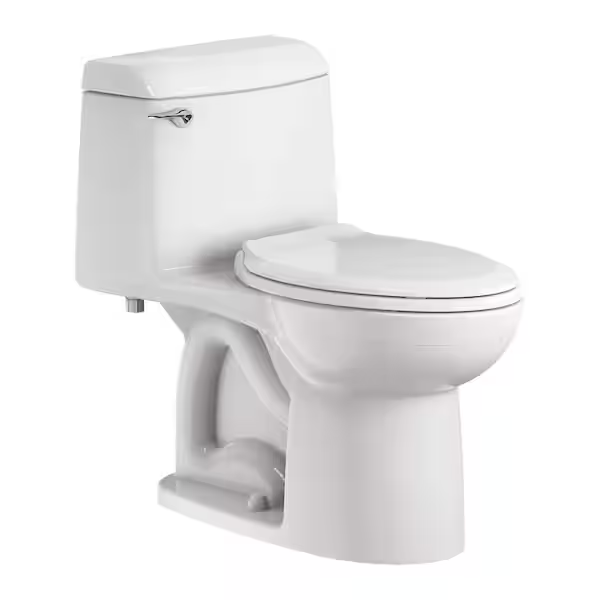
Call me old-fashioned, but I love a single-flush. They are the “work trucks” of the bathroom world. They aren’t fancy, but they get the job done every single time.
- Simplicity: It’s a lever and a chain. If it breaks, you can fix it with a paperclip and a prayer until you get to the store.
- Siphon Action: Single-flush toilets usually rely on a strong siphoning action. They pull everything down in one go. You don’t get that “lingering debris” problem as often.
- Cheaper Upfront: You’ll generally save $50 to $100 on the unit itself.
Quick side note: If you’re worried about water, just buy a “High-Efficiency” (HET) single-flush. They use 1.28 gallons for every flush, which is a great middle ground without the complexity of the two-button system.
Real Talk: What’s Not Worth the Effort
I’m going to be blunt: Don’t buy a cheap dual-flush toilet from a big-box store “bargain bin.” If you’re going dual-flush, you have to go high-end (think TOTO or Kohler). The cheap ones have weak flushing rim jets, and you’ll be scrubbing the bowl twice as often.
Also, skip the “dual-flush conversion kits.” They’re garbage. I’ve spent more time removing those “As Seen on TV” kits from tanks than I have actually installing them. They never seal right, and they make the flush feel wimpy.
Pro Tip: If your current toilet is leaking, don’t just assume you need a new one. Replace the flapper first. It’s a $6 fix that saves most people from a $300 bill.
The Final Verdict
Look, if you want to feel good about your carbon footprint and you don’t mind a slightly more technical repair down the road, go for the dual-flush. But if you want a toilet that “just works” and won’t require a specialized degree to fix on a Sunday night, stick with a high-quality single-flush.
The best toilet is the one you don’t have to think about.
What’s the biggest nightmare you’ve ever dealt with under your bathroom sink? Drop your horror stories or questions in the comments below, and I’ll see if I can help you out!


