Managing ventilation across a large home takes more than a basic on/off switch. The right controller can coordinate fans, monitor temperature or humidity, automate fresh-air exchange, and make comfort easier to manage from anywhere.
These six options cover several approaches, from dedicated ventilation controls and smart fan switches to wireless thermostats, sensor-based modules, and infrared controllers. Use the guide below to match the control method, wiring, compatibility, and automation features to your home.
Best 6 Smart Home Ventilation Controllers for Large Homes Picks for 2026
Best Smart Ceiling Fan Controller
Leviton Decora Smart Fan Speed Controller

- Four-speed Wi-Fi ceiling fan control
- Voice control and scheduling support
- Requires neutral wire; ceiling-fan use only
Best For: Compatible pull-chain ceiling fans in connected homes
Best HVAC-Integrated Ventilation Control
Honeywell Fresh Air Ventilation Control

- Synchronizes ventilation with heating and cooling
- Adjustable installation input dials
- Designed with ventilation standards in mind
Best For: Split-system HVAC installations in larger homes
Best Sensor-Based Climate Module
MOES WiFi Temperature and Humidity Controller
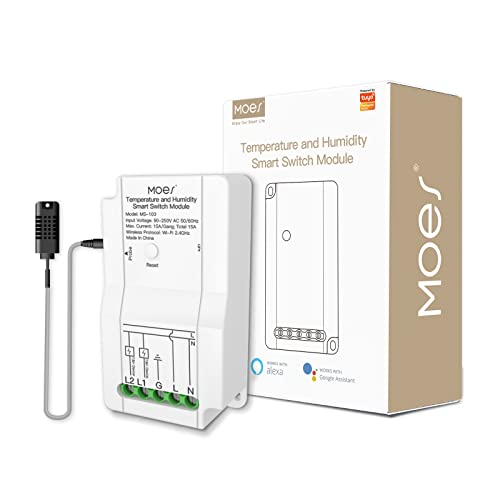
- Monitors temperature and humidity in real time
- Dual relays support connected equipment
- Smart Life, Alexa, and Google Assistant control
Best For: Targeted climate control in rooms or specialty spaces
Whole-Room Airflow
Aubric Smart WiFi Fan Controller

- Adds Wi-Fi control to compatible ceiling fans
- Offers three fan speeds and light on/off
- Supports schedules, Alexa, and Google Home
Best For: Smart control of ceiling-fan airflow
Climate Automation
WiFi Smart IR Remote Control C1
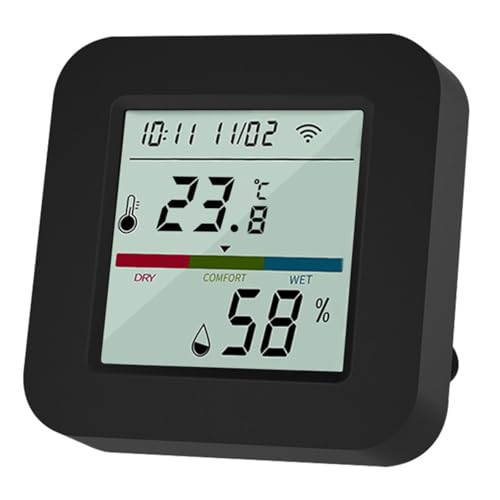
- Monitors temperature and humidity
- Automates ACs, fans, heaters, and humidifiers
- Uses Smart Life, Tuya, Alexa, and Google Home
Best For: Targeted room climate automation
Best Smart Ceiling Fan Controller – Leviton Decora Smart Fan Speed Controller
For large homes that need more convenient airflow management, the Leviton Decora Smart Fan Speed Controller adds Wi-Fi control to a compatible pull-chain ceiling fan. It provides four speeds, scheduling, timers, LED speed indicators, and voice control without requiring a hub.
Best For: Homeowners who want smart control of compatible overhead ceiling fans in multiple rooms.
Pros:
- Offers quiet four-speed control with low, medium, high, and maximum settings.
- Supports Alexa, Google Assistant, Apple Siri, SmartThings, and Sonos.
- Includes scheduling, auto-shutoff timers, LED speed indication, and a slim wall-mounted design.
Cons:
- Requires a neutral wire for installation.
- Not designed for exhaust fans, lighting loads, or combined ceiling fan light kits.
- Only supports compatible overhead ceiling fans rated up to 1.5A.
This is a strong choice when your ventilation strategy relies on circulating air with ceiling fans rather than mechanically bringing in outside air. Check fan compatibility and wiring before buying, especially in a larger installation.
Best HVAC-Integrated Ventilation Control – Honeywell Fresh Air Ventilation Control
The Honeywell Fresh Air Ventilation Control is designed for larger residential HVAC setups where ventilation should work alongside heating and cooling. Its Smart Control synchronizes ventilation calls with the HVAC system, while adjustable input dials help tailor operation to the installation.
Best For: Large-home split-system installations needing HVAC-synchronized fresh-air control.
Pros:
- Designed to help meet ventilation codes and standards, including ASHRAE 62.2-2010.
- Coordinates air delivery with heating and cooling calls.
- Uses easy-to-adjust input dials for customized installation settings.
Cons:
- Requires integration with a compatible split-system HVAC installation.
- Uses physical dials rather than app-based or voice control.
- The supplied details do not specify compatibility with every HVAC configuration.
For a large home with a suitable split system, this controller is more directly focused on fresh-air ventilation than a ceiling-fan switch. Confirm system compatibility and local installation requirements before choosing it.
Best Sensor-Based Climate Module – MOES WiFi Temperature and Humidity Controller
The MOES WiFi module offers temperature- and humidity-based switching for targeted equipment in a larger home. Its external probe provides real-time readings, while dual relays can control heating and refrigeration equipment simultaneously through the Smart Life or Tuya ecosystem.
Best For: Room-specific humidity or temperature control for specialized spaces and equipment.
Pros:
- Provides real-time temperature and humidity monitoring with an included probe.
- Dual relay outputs can connect heating and refrigeration equipment at the same time.
- Supports manual and automatic modes, timing, Smart Life app control, Alexa, and Google Assistant.
Cons:
- Requires a neutral wire and 2.4GHz Wi-Fi; 5GHz Wi-Fi is not supported.
- The sensor probe is not waterproof and has a cable length of about 19.68 inches.
- It is a module for connected equipment, not a complete whole-home ventilation system.
This controller can complement a larger-home ventilation plan by automating climate-related equipment in specific zones. Its relay and sensor limitations make careful electrical and application matching essential.
Room-by-Room Control – Flair Puck Wireless Smart Thermostat
For large homes exploring smart home ventilation controllers for large homes, the Flair Puck is a flexible option for room-level temperature management. It works with Flair Smart Vents on central HVAC systems and can also control compatible mini splits, window units, and portable ACs through infrared signals.
Best For: Homes needing room-by-room control, smart vent temperature sensing, or wireless mini-split management.
Pros:
- Supports Flair Smart Vents for balancing temperatures across multiple rooms.
- Works with more than 200 mini-split, window-unit, and portable-AC brands via IR.
- Can run on included AAA batteries or the included USB cable and adapter.
- Offers Wi-Fi, voice-control, Alexa, Google Assistant, and iOS/Android compatibility.
Cons:
- Central-HVAC room control requires Flair Smart Vents and a temperature sensor in each room.
- One Puck is required for every mini-split head unit.
- Advanced Flair Smart Vent functionality may require the Flair Bridge.
The Flair Puck is best suited to larger homes where uneven room temperatures are the main issue. Its wireless design and dual use with smart vents or mini splits make it more versatile than a basic thermostat, provided you are prepared to build out the necessary Flair components.
Whole-Room Airflow – Aubric Smart WiFi Fan Controller
For shoppers comparing smart home ventilation controllers for large homes, this Aubric controller upgrades a compatible ceiling fan with Wi-Fi and remote operation. It controls fan speed and the connected light through a phone app, RF remote, Alexa, or Google Home.
Best For: Homes using compatible ceiling fans to circulate air in individual rooms or larger living areas.
Pros:
- Provides low, medium, and high fan-speed control.
- Supports smartphone control through Smart Life and voice control with Alexa or Google Home.
- Includes scheduling and multiple-user sharing features.
- Works with many popular ceiling-fan brands and can be installed over pull-chain or wall-switch setups.
Cons:
- Controls one fan device and does not provide HVAC temperature regulation.
- The light function supports on/off control but not dimming.
- The 4.5-by-2-by-1-inch receiver needs sufficient space inside the fan canopy.
This is a practical choice when ventilation means ceiling-fan circulation rather than ducted HVAC control. Check the receiver dimensions and fan compatibility before installation, especially in a large home with several different fan models.
Climate Automation – WiFi Smart IR Remote Control C1
For large households seeking smart home ventilation controllers for large homes, the WiFi Smart IR Remote Control C1 combines temperature and humidity monitoring with infrared appliance control. It can automate compatible ACs, heaters, fans, and humidifiers through the Smart Life or Tuya apps.
Best For: Rooms where temperature and humidity automation matter, including basements, garages, greenhouses, wine cellars, and pet areas.
Pros:
- Measures temperature and humidity and displays readings on its LCD screen.
- Creates rules that trigger IR appliances when temperature thresholds are reached.
- Supports remote app operation and voice commands through Alexa and Google Home.
- Can learn signals from an existing IR remote for customization with unlisted brands.
Cons:
- Controls appliances through IR rather than directly managing ductwork or vents.
- Requires 2.4GHz Wi-Fi and continuous USB Type-C power.
- Temperature-reading accuracy is listed as plus or minus 1°C.
The C1 is a strong fit for targeted climate automation rather than whole-home ventilation balancing. Its humidity sensing, programmable rules, and broad IR appliance support make it useful for specialized rooms, but larger installations may require multiple units with clear IR access to each appliance.
How We Picked the Best Smart Home Ventilation Controllers for Large Homes
We focused on the features that matter when controlling ventilation across multiple rooms or larger floor plans: remote access, automation potential, sensor support, installation requirements, device compatibility, and the ability to control fans, fresh-air equipment, thermostats, or mini-splits. Because these products use different control methods, we considered them by intended role rather than treating every model as a direct substitute.
We also looked for practical differences between professionally wired controls and flexible retrofit devices. A dedicated ventilation controller may be better for an air exchanger, while a smart fan switch or IR controller may suit an existing ceiling fan, portable unit, or mini-split.
Quick Comparison
| Controller type | Best suited to | Key consideration |
|---|---|---|
| Smart fan speed controller | Compatible wired fans | Requires suitable wiring and load compatibility |
| Fresh-air ventilation control | Whole-home ventilation equipment | Best when matched to the HVAC system |
| Temperature and humidity module | Custom automation projects | Requires careful setup and sensor placement |
| Wireless thermostat or puck | Zoned comfort and smart vents | Works within its supported ecosystem |
| Wi-Fi fan remote kit | Ceiling fans and lights | Check receiver, wiring, and motor compatibility |
| Wi-Fi IR controller | IR-controlled AC or heat pumps | Needs a clear infrared path and device support |
Key Buying Factors for Smart Home Ventilation Controllers for Large Homes
Compatibility and Installation
First identify what you are controlling: an HRV or ERV, bathroom exhaust fan, ceiling fan, mini-split, or central HVAC accessory. Verify voltage, motor type, load rating, neutral-wire requirements, and whether professional installation is recommended. A controller designed for one equipment category may not safely operate another.
Coverage, Placement, and Networking
Large homes can expose weak Wi-Fi coverage and uneven sensor readings. Check whether the controller needs a hub, relies on 2.4 GHz Wi-Fi, or communicates through a proprietary ecosystem. Place temperature and humidity sensors away from vents, windows, kitchens, and direct sunlight for more useful readings.
Automation and Controls
Look for schedules, humidity thresholds, temperature triggers, remote access, voice-assistant support, and integrations with your existing platform. A simple timer may be enough for exhaust ventilation, while a large home may benefit from zone-based routines and alerts.
Safety and Serviceability
Confirm electrical ratings and installation instructions before purchase. For permanently wired equipment or whole-home ventilation systems, an HVAC technician or licensed electrician can verify safe integration and airflow settings.
Who Should Buy Which Smart Home Ventilation Controllers for Large Homes?
Choose a dedicated fresh-air controller for an HRV, ERV, or other whole-home ventilation system. Choose a smart fan controller or retrofit kit for compatible ceiling or exhaust fans. A temperature-and-humidity module is better for technically confident buyers who want custom rules. Select a wireless thermostat or puck when your home already uses the matching smart-vent, mini-split, or zoning ecosystem. An IR controller is the most flexible retrofit choice for compatible air conditioners and heat pumps, provided the signal path is reliable.