Hot, poorly ventilated attics can increase indoor temperatures, strain air-conditioning systems, and contribute to moisture problems. The right roof ventilation fan helps move trapped heat and humid air outside while using less electricity than many conventional exhaust options.
This roundup compares 10 energy-efficient roof ventilation fans, including solar, hybrid, and low-wattage electric models. Use the guide below to match airflow, controls, coverage, and installation requirements to your home or outbuilding.
Best 10 Energy-Efficient Roof Ventilation Fans Picks for 2026
Solar Hybrid Pick
iLIVING 14-Inch Smart Thermostat Roof Fan
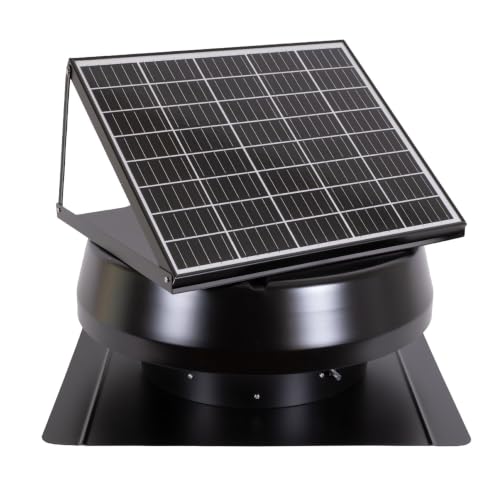
- 40W solar panel with 1,150 CFM airflow
- Adjustable thermostat and panel angle
- IP68 motor with 15-year limited warranty
Best For: Solar-powered attic ventilation with optional AC backup
Quiet High-Airflow Pick

- 35W EC motor moves 1,400 CFM
- Eight speeds with remote and timer
- Gravity shutters and 55 dB operation
Best For: Adjustable garage, workshop, shed, or greenhouse ventilation
24/7 Solar Backup Pick
55W Hybrid Thermostat Attic Fan

- 55W solar panel with AC backup
- 1,300 CFM airflow and automatic thermostat
- Remote control with 45 dB operation
Best For: Roof-mounted attic ventilation with day-and-night backup
Lowest-Wattage Pick
Amico 10-Inch Thermostat Shutter Fan

- 13W brushless DC motor
- 1,073 CFM with eight speeds
- 45 dB operation and automatic shutters
Best For: Low-energy garage, shed, greenhouse, or workshop ventilation
Efficient Electric Pick
Master Flow ERV5 1250 CFM Attic Fan

- High-efficiency PSC motor design
- Ventilates attics up to 2,800 sq. ft.
- Galvanized steel with internal screen
Best For: Energy-conscious electric attic ventilation
Solar Savings Choice
25W Solar 8-Inch Roof Vent Fan

- Runs from a 25W solar panel
- Up to 240 CFM in sunny conditions
- Galvanized cover with bird-resistant mesh
Best For: Sunny off-grid ventilation in utility spaces
High-Airflow Thermostat Pick
Master Flow ERV6BL 1500 CFM Attic Fan

- Up to 1,500 CFM airflow
- Built-in thermostat controller
- Galvanized steel body and screen
Best For: Large attics needing automated electric ventilation
Solar High-Airflow Pick

- Up to 2,000 CFM from a 40W solar panel
- Controller-free, pre-connected plug-and-play setup
- Metal, weather-resistant construction for multiple spaces
Best For: Solar ventilation for attics, garages, sheds, and greenhouses
Efficient Electric Value

- Ventilates attics up to 1,600 square feet
- Thermostat-controlled, hard-wired electric operation
- Galvanized steel housing with internal animal screen
Best For: Attics needing thermostat-controlled electric ventilation
Large-Attic Controller Pick

- Rated for attics up to 2,800 square feet
- Combines thermostat and humidistat control
- High-efficiency brushless motor and galvanized steel housing
Best For: Large attics needing temperature and humidity-based ventilation
Solar Hybrid Pick – iLIVING 14-Inch Smart Thermostat Roof Fan
For shoppers comparing energy-efficient roof ventilation fans, this iLIVING model combines solar operation with hybrid-ready capability. Its 40-watt solar panel, 1,150 CFM airflow, adjustable panel angle, and thermostat control make it a practical option for ventilating larger attics.
Best For: Solar-powered attic ventilation with thermostat-based operation.
Pros:
- Solar-powered 40-watt design delivers up to 1,150 CFM.
- Smart thermostat can be enabled or disabled across a 50–122°F range.
- Waterproof IP68 brushless motor and adjustable panel angle.
- 15-year limited manufacturer warranty.
Cons:
- AC/DC adapter kit for non-stop day-and-night operation is sold separately.
- At 65 dB, it is louder than the quieter models in this roundup.
- Roof-mount installation and 32-pound weight may require more planning.
The iLIVING is a strong fit when solar operation and broad attic coverage matter most. Plan for the separate adapter if continuous backup operation is important.
Quiet High-Airflow Pick – addlon 14-Inch EC Shutter Fan
This addlon shutter fan is among the more flexible energy-efficient roof ventilation fans for garages, workshops, sheds, and similar spaces. Its 35-watt EC motor produces 1,400 CFM, while eight speeds, a timer, and remote control make it easy to tailor ventilation.
Best For: Wall-mounted ventilation where high airflow, adjustable speeds, and simple plug-in setup are priorities.
Pros:
- High-efficiency 35-watt EC motor provides 1,400 CFM.
- Eight speeds, a 1–8 hour timer, LED display, and remote control.
- 55 dB operation with aerodynamic aluminum blades.
- Gravity shutters help block drafts, wind, and insects when off.
Cons:
- It is a wall-mount fan rather than a dedicated roof-mount unit.
- Its 7.9-pound construction and plug-in setup may not suit every installation.
- The notes do not specify a warranty.
Choose the addlon when controllability and airflow are more important than solar operation. The included cord and hole-cutting template also make it appealing for DIY installations.
24/7 Solar Backup Pick – 55W Hybrid Thermostat Attic Fan
For buyers seeking energy-efficient roof ventilation fans with dependable backup power, this 12-inch hybrid model pairs a 55-watt monocrystalline solar panel with AC support. A thermostat, three power levels, remote control, and 1,300 CFM airflow provide convenient automatic attic ventilation.
Best For: Roof-mounted attic ventilation that can continue operating when sunlight is limited.
Pros:
- Solar and AC power support continuous ventilation day or night.
- Smart thermostat starts at 77°F and shuts off at 68°F.
- 1,300 CFM airflow with a remote reaching up to 65 feet.
- Waterproof, UV-protected aluminum housing and brushless motor.
Cons:
- Its 55-watt solar panel requires suitable roof exposure for best solar operation.
- Three power levels offer less adjustment than the eight-speed shutter fans.
- Roof installation still requires attention to flashing and placement.
This is a well-rounded choice for homeowners who want solar savings without giving up AC backup. Its 45 dB operating noise is also comparatively quiet for an attic exhaust fan.
Lowest-Wattage Pick – Amico 10-Inch Thermostat Shutter Fan
The Amico is a compelling low-consumption option among energy-efficient roof ventilation fans, using a 13-watt brushless DC motor to deliver 1,073 CFM. Its thermostat sensor, eight speeds, quiet 45 dB operation, and automatic shutters suit garages, sheds, greenhouses, and other utility spaces.
Best For: Energy-conscious wall-mounted ventilation with automatic temperature control.
Pros:
- 13-watt DC motor is designed to reduce energy use.
- 1,073 CFM airflow covers spaces up to 1,400 square feet according to the supplied notes.
- Eight speeds, thermostat sensing, and power-off memory.
- 45 dB operation with gravity shutters that help block drafts and insects.
Cons:
- It is a 10-inch wall-mount fan, not a roof-mounted solar ventilator.
- Airflow is lower than the 1,300–1,400 CFM options listed here.
- The supplied notes specify a 3-year warranty, shorter than the iLIVING warranty.
The Amico stands out when minimizing electrical consumption and operating noise is the priority. Its thermostat and eight-speed control add useful flexibility for everyday garage or utility-space ventilation.
Efficient Electric Pick – Master Flow ERV5 1250 CFM Attic Fan
For homeowners comparing energy-efficient roof ventilation fans, the Master Flow ERV5 combines a 1,250 CFM output with a high-efficiency PSC motor designed to use less electricity than typical competitive motors. Its galvanized steel housing and broad roof-slope compatibility make it a practical powered attic-ventilation option.
Best For: Attics up to 2,800 square feet where dependable electric ventilation and durable construction are priorities.
Pros:
- High-efficiency PSC motor design helps reduce electricity use.
- Galvanized steel construction supports durability.
- UL Listed and approved for applicable Miami-Dade, Florida, and Texas requirements.
- Heavy-duty internal screen helps limit entry by small outdoor intrusions.
Cons:
- Requires a 120-volt corded-electric connection.
- Its 1,250 CFM capacity is lower than the 1,500 CFM ERV6.
The ERV5 is a well-rounded choice when energy-conscious electric operation matters more than maximum listed airflow. Confirm the roof slope, electrical setup, and local installation requirements before purchase.
Solar Savings Choice – 25W Solar 8-Inch Roof Vent Fan
This 25W solar model is one of the energy-efficient roof ventilation fans suited to locations with strong, direct sunlight. Its brushless DC motor can deliver up to 240 CFM in sunny conditions, while the galvanized-steel cover and included 8-inch vent support practical installation in several utility spaces.
Best For: Sun-exposed attics, garages, sheds, sunrooms, warehouses, and similar spaces where avoiding grid electricity is important.
Pros:
- Uses a 25W solar panel instead of household electricity.
- IP68 waterproof brushless DC motor is designed for efficient operation.
- Galvanized steel cover, corrosion-resistant coating, and aluminum mesh add protection.
- Vent extension can connect to flexible ducting, and the panel mounts to the cover.
Cons:
- Does not store electricity and may slow or stop in clouds or shade.
- Maximum listed airflow is up to 240 CFM in sunny conditions.
- Solar-panel placement is important for consistent performance.
This fan can reduce operating-cost concerns by drawing power directly from sunlight, but its output depends heavily on weather and panel exposure. It is best viewed as a solar-dependent ventilation solution rather than a constant-speed replacement for a high-CFM electric fan.
High-Airflow Thermostat Pick – Master Flow ERV6BL 1500 CFM Attic Fan
For larger attic spaces, the Master Flow ERV6BL stands out among energy-efficient roof ventilation fans with up to 1,500 CFM of airflow and a built-in thermostat controller. It is designed to ventilate attics up to 2,800 square feet while helping maintain a cooler, drier environment.
Best For: Homeowners who want high-capacity electric attic ventilation with automatic thermostat control.
Pros:
- Moves up to 1,500 CFM of air.
- Includes a thermostat controller for automatic operation.
- Durable galvanized steel construction with a built-in screen.
- Designed for attic spaces up to 2,800 square feet.
Cons:
- Requires a hard-wired 120-volt electrical connection.
- Not compatible with tile roofing systems.
- Its higher airflow does not eliminate the need to verify proper installation and attic ventilation layout.
The ERV6BL is the stronger fit when airflow capacity and thermostat control are more important than solar operation. Check roof compatibility and electrical requirements carefully, especially if your roof uses tile or lacks an appropriate hard-wired connection.
Solar High-Airflow Pick – 40W 2000 CFM Solar Attic Fan
For shoppers comparing energy-efficient roof ventilation fans, this solar-powered model offers high airflow without a hard-wired electrical connection. Its 40W panel drives up to 2,000 CFM, while the controller-free design automatically runs during daylight hours.
Best For: Attics, garages, sheds, greenhouses, and other spaces needing solar-powered ventilation.
Pros:
- Delivers up to 2,000 CFM from a 40W solar panel.
- Pre-connected, plug-and-play setup avoids complex wiring and controllers.
- Metal housing, copper motor, and IP65 weather-resistant design support outdoor use.
- Can also ventilate garages, sheds, greenhouses, and barns.
Cons:
- Solar operation means performance is tied to available daylight.
- At 25.4 pounds, it is heavier than some electric roof fans.
- It is not a fully automatic thermostat-controlled system.
This is a strong choice when minimizing electrical use and installation complexity matters most. Its high airflow and broad application range make it especially practical for detached or off-grid spaces, while the lack of a thermostat limits temperature-based control.
Efficient Electric Value – Master Flow 1000 CFM Roof Fan
This Master Flow roof-mounted fan is a practical option among energy-efficient roof ventilation fans for attics up to 1,600 square feet. Its 1,000 CFM electric motor uses up to 55% less electricity than typical competitor vents and includes a thermostat for temperature-based operation.
Best For: Hard-wired attic ventilation in homes with roof slopes from 3:12 to 12:12 and compatible non-tile roofing.
Pros:
- Moves up to 1,000 CFM for attic spaces up to 1,600 square feet.
- Uses up to 55% less electricity than typical competitor vents, according to the supplied product information.
- Includes a thermostat controller for automated operation.
- Galvanized steel construction and an internal screen support durability and animal protection.
Cons:
- Requires hard-wired electrical installation.
- Not compatible with tile roofing systems.
- Its airflow rating is lower than the larger 1,500 and 2,000 CFM options in this roundup.
Choose this model if you want a conventional roof-mounted electric fan with thermostat control and a stated focus on reduced electricity use. Confirm roofing compatibility and plan for hard-wired installation before buying.
Large-Attic Controller Pick – Master Flow 1500 CFM Roof Fan
For larger attics, this Master Flow model stands out among energy-efficient roof ventilation fans with 1,500 CFM airflow and a combined humidistat and thermostat controller. The high-efficiency motor adjusts ventilation based on temperature needs, while its stated coverage extends to spaces up to 2,800 square feet.
Best For: Larger, compatible non-tile roofing systems that need hard-wired temperature- and humidity-responsive ventilation.
Pros:
- Provides up to 1,500 CFM for attics up to 2,800 square feet.
- Includes an HT1 humidistat and thermostat controller.
- Uses a high-efficiency brushless motor designed to help optimize energy use.
- Galvanized steel construction and a built-in screen add durability and animal protection.
Cons:
- Requires hard-wired installation.
- Not compatible with tile roofing systems.
- At 125 watts, it has a higher listed wattage than the 1,000 CFM model.
This is the more capable electric choice when attic size and humidity control are priorities. The humidistat and thermostat provide more responsive management than a basic fan, but installation requires compatible roofing and electrical wiring.
How We Picked These Energy-Efficient Roof Ventilation Fans
We focused on models that combine practical airflow with relatively low power consumption, useful ventilation controls, and roof or attic applications. The selection includes solar and hybrid fans for reduced grid usage, as well as efficient AC or DC models for installations where dependable electrical operation matters more than renewable power.
We also considered stated airflow, motor wattage, thermostat or humidistat functionality, coverage claims, construction materials, and installation flexibility. Because real-world performance depends on roof design, insulation, climate, and intake ventilation, treat manufacturer coverage figures as estimates rather than guarantees.
Quick Comparison
- Lowest stated power use: The 13W Amico and 25W solar model suit buyers prioritizing minimal energy demand.
- Solar-focused choices: The 40W and 55W solar fans reduce reliance on household electricity, but output depends on sunlight and installation orientation.
- Hybrid flexibility: The iLIVING model is designed to combine solar operation with thermostat-based control and backup power readiness.
- Higher airflow: Several 1,400- to 2,000-CFM models are aimed at larger or especially heat-prone attic spaces.
- Traditional roof-mount options: Master Flow models provide established powered ventilation with galvanized-steel construction and thermostat or humidistat controls.
Key Buying Factors
Airflow and Attic Size
Compare CFM with the manufacturer’s recommended coverage, but do not size a fan by CFM alone. A fan needs adequate soffit, ridge, gable, or other intake ventilation; otherwise it may struggle to exchange air or pull conditioned air from the home. Larger attics, dark roofing, and hot climates may justify higher airflow or multiple properly balanced fans.
Power Source and Operating Cost
Solar fans can lower operating costs and simplify wiring, but they produce less airflow in cloudy conditions and may not run overnight unless paired with battery or hybrid functionality. Electric models offer more predictable operation, while low-wattage DC and EC motors can limit ongoing energy use.
Controls and Moisture Management
A thermostat starts ventilation when attic temperatures rise, avoiding unnecessary runtime. A humidistat can be valuable in damp climates or homes with moisture concerns. Adjustable speed settings provide more control, but they can add complexity and should be evaluated alongside warranty and controller reliability.
Installation and Durability
Check roof type, opening dimensions, flashing requirements, wiring access, and local building rules before buying. Galvanized steel and waterproof construction can improve longevity, while removable vents or controller-free designs may simplify particular installations. Professional installation is advisable when cutting roofing or connecting household electrical circuits.
Who Should Buy Which Energy-Efficient Roof Ventilation Fans?
Choose a solar model if reducing grid electricity and avoiding new attic wiring are top priorities, and your roof receives dependable sunlight. Choose a hybrid fan if you want solar savings with a backup-ready approach and more consistent control.
Choose a low-wattage electric or DC fan for predictable daily ventilation with modest energy use. Choose a higher-CFM model for a larger, hotter attic, provided intake ventilation is sufficient. Choose a thermostat-and-humidistat model if both heat and moisture management matter, particularly in humid regions.
Before purchasing, confirm the fan’s coverage rating, roof compatibility, electrical requirements, noise expectations, and warranty. The most efficient fan is one that is correctly sized, properly installed, and paired with balanced intake ventilation.