The best energy-efficient kitchen exhaust systems remove smoke, grease, heat, and cooking odors without wasting electricity or making your kitchen uncomfortably loud. This roundup includes compact under-cabinet hoods, wall-mounted range hoods, and high-airflow exhaust fans for different layouts and ventilation needs.
Use the comparison and buying guide below to match airflow, ducting, controls, and installation requirements to the way you cook.
Best 10 Energy-Efficient Kitchen Exhaust Systems Picks for 2026
Best Quiet Energy-Efficient Pick
Broan-NuTone Glacier 24-Inch Range Hood

- ENERGY STAR certified with LED lighting
- 300 CFM airflow and dishwasher-safe filters
- Quiet 1.5-sones normal operation
Best For: Compact kitchens needing quiet under-cabinet ventilation
Best High-Airflow Wall Fan

- 735 CFM airflow for demanding ventilation
- Brushless motor helps reduce friction and electricity use
- Metal housing with overheating protection
Best For: Utility kitchens and spaces needing powerful wall ventilation
Best Smart Ventilation Upgrade
Glacier 36-Inch Stainless Range Hood

- SmartSense adjusts fan speed based on heat
- 490 CFM maximum airflow with code-ready settings
- ENERGY STAR certified and Title 24 compliant
Best For: Large cooktops needing automatic, adjustable ventilation
Compact Efficiency Pick
30-Inch Under-Cabinet Range Hood

- 280 CFM airflow with two speeds
- Low-power 2W LED lighting
- Ducted or ductless installation
Best For: Space-conscious kitchens needing flexible ventilation
High-Capacity DC Pick
12-Inch Thermostatic Shutter Exhaust Fan

- Up to 1,282 CFM airflow
- 25W brushless DC motor
- Thermostat and eight speed settings
Best For: Large utility spaces needing automatic exhaust
Versatile Wall-Mount Pick
30-Inch Convertible Range Hood

- 380 CFM airflow across three speeds
- Two efficient 1.5W LED lights
- Ducted or ductless conversion
Best For: Wall-mount kitchens needing flexible, adjustable ventilation
Quiet Inline Pick
AMG Maverick 260 CFM Radon Fan

- 260 CFM airflow with up to 66–70W power use
- DIY-friendly wiring and five-year warranty
- Single-speed, 4-inch inline design
Best For: Inline ventilation projects prioritizing low power use
High-Airflow Value
6-Inch 358 CFM Wall Exhaust Fan
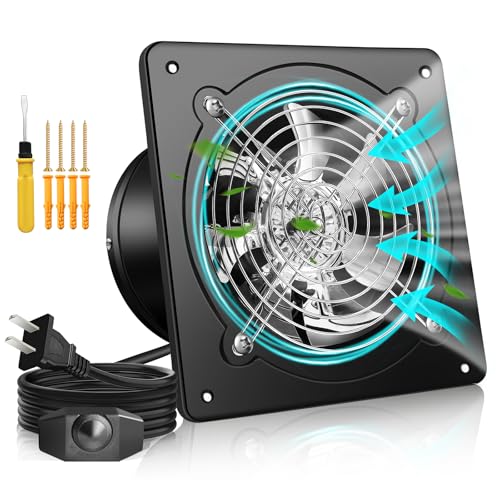
- 358 CFM airflow at 40W consumption
- Adjustable speed controller and brushless motor
- Automatic damper with standard 6-inch fit
Best For: High-airflow ventilation with adjustable operation
Best Quiet Energy-Efficient Pick – Broan-NuTone Glacier 24-Inch Range Hood
For compact kitchens, this ENERGY STAR-certified under-cabinet hood is a practical choice among energy-efficient kitchen exhaust systems. Its 300 CFM blower, Captur filtration system, and smooth-flow design target cooking smoke and odors while keeping normal operation to 1.5 sones.
Best For: Small or medium kitchens needing a quiet, space-saving under-cabinet range hood.
Pros:
- ENERGY STAR certified with integrated LED lighting.
- 300 CFM airflow and filtration designed to remove smoke and odors.
- Quiet 1.5-sones operation at normal speed.
- Dishwasher-safe mesh filters and EZ1 installation system simplify ownership.
Cons:
- At 24 inches wide, it may not suit larger cooktops.
- Only two fan speeds are provided.
This model balances moderate ventilation power, low operating noise, and easier installation. Its convertible ventilation design adds flexibility, while the ENERGY STAR certification and LED lighting support an efficiency-focused kitchen upgrade.
Best High-Airflow Wall Fan – 8-Inch 735 CFM Exhaust Fan
This wall-mounted fan offers substantial airflow for kitchens and other spaces that need regular ventilation. Its brushless double-ball-bearing motor is designed to reduce friction and electricity use, making it a candidate for energy-efficient kitchen exhaust systems where high-capacity extraction is the priority.
Best For: Utility kitchens, workshops, garages, or other areas requiring powerful wall or ceiling ventilation.
Pros:
- Rated at 735 CFM for strong air movement.
- Brushless motor is designed for efficient, quiet operation and longer service life.
- Metal construction includes an automatic closing valve and overheating protection.
- Can support ventilation, odor removal, dust removal, and humidity control.
Cons:
- Produces a listed 62 dB noise level.
- Manual wiring is required, and a switch is not included.
- Its single power level offers less control than a multi-speed hood.
With its high airflow rating and motor-efficiency features, this fan is better suited to dedicated exhaust applications than decorative range-hood duty. Plan the electrical connection and installation carefully before choosing it for a kitchen.
Best Smart Ventilation Upgrade – Glacier 36-Inch Stainless Range Hood
This 36-inch Glacier hood combines ENERGY STAR certification with automated ventilation. Its SmartSense infrared sensor detects heat from the range and adjusts fan speed, while Code Ready Technology can reduce airflow from the 490 CFM maximum to 300 or 400 CFM for local-code or make-up-air requirements.
Best For: Larger cooktops and homeowners who want automatic, code-conscious ventilation with low operating noise.
Pros:
- 490 CFM maximum airflow with SmartSense automatic fan adjustment.
- ENERGY STAR certified and Title 24 compliant.
- Code Ready Technology supports 300 or 400 CFM airflow limits.
- Includes LED lighting, baffle filtration, and EZ1 one-person installation brackets.
Cons:
- The 36-inch width requires adequate cabinet and cooktop space.
- Airflow may need to be reduced to meet local code or make-up-air requirements.
- The supplied specifications list conflicting noise figures, so buyers should verify the current rating.
This is the most feature-rich option in the group for larger cooking surfaces. Automatic sensing can prevent unnecessary full-power operation, while adjustable airflow makes it easier to work within installation requirements.
Best Efficient Budget Wall Fan – HG Power 8-Inch 567 CFM Exhaust Fan
The HG Power 8-inch fan delivers 567 CFM while drawing a listed 53.5 watts, making it a straightforward option among energy-efficient kitchen exhaust systems. Its metal construction, included switch, and wall- or ceiling-mount design support flexible installation in kitchens and utility areas.
Best For: Kitchens, garages, basements, sheds, and other spaces needing efficient single-speed exhaust.
Pros:
- 567 CFM airflow at a listed 53.5 watts.
- Metal-steel construction is designed for durability.
- Supports wall or ceiling installation.
- Includes a push-button control and water-resistant design.
Cons:
- Single-speed operation limits airflow adjustment.
- It is a general exhaust fan rather than a dedicated range hood with integrated lighting or filtration.
- Its compact design may require separate planning for ducting and grease management.
This fan is a practical pick when efficient high-volume air exchange matters more than range-hood features. It can handle smoke, humidity, and odors, but kitchen installations should account for the lack of dedicated hood filtration.
Compact Efficiency Pick – 30-Inch Under-Cabinet Range Hood
For kitchens that need practical, energy-efficient kitchen exhaust systems without sacrificing cabinet space, this 30-inch stainless steel hood offers 280 CFM suction, two fan speeds, and a low-power LED light. Its convertible design supports either ducted or ductless installation.
Best For: Smaller kitchens and under-cabinet installations that need flexible ventilation.
Pros:
- Slim 29.9-inch under-cabinet design helps conserve space.
- 280 CFM airflow removes cooking smoke and odors across two speeds.
- Includes a 2W LED light and a composite aluminum mesh/carbon filter.
- Supports both ducted and ductless installation.
Cons:
- Hardwire installation is required, and the junction box is not included.
- Only two fan speeds are available.
- The replacement filter is recommended every three to four months.
This is a straightforward choice when space, simple controls, and modest energy use matter most. The 2W LED adds efficiency, while the convertible ventilation design accommodates more kitchen layouts.
High-Capacity DC Pick – 12-Inch Thermostatic Shutter Exhaust Fan
Although designed for garages, sheds, greenhouses, and similar spaces rather than over a cooktop, this fan is a high-capacity option among energy-efficient kitchen exhaust systems for large utility or adjacent ventilation areas. Its 25W brushless DC motor delivers up to 1,282 CFM with automatic thermostat control.
Best For: Large garages, workshops, greenhouses, sheds, or other spaces needing powerful automatic exhaust.
Pros:
- Provides up to 1,282 CFM of airflow for areas up to about 1,600 square feet.
- 25W brushless DC motor is designed to use less energy than traditional AC fans.
- Thermostat activation and eight speed settings allow hands-off airflow control.
- Automatic shutters help block drafts, rain, and insects when the fan is off.
Cons:
- It is a wall- or window-mounted utility exhaust fan, not a conventional range hood.
- Its high airflow may be excessive for a typical residential kitchen.
- Installation may require cutting a wall or window opening.
Choose this model for large-volume ventilation rather than direct cooktop capture. The efficient DC motor, thermostat, and programmable speed range make it especially useful where heat and moisture build up over time.
Versatile Wall-Mount Pick – 30-Inch Convertible Range Hood
This Hermitlux wall-mounted hood combines 380 CFM airflow with energy-efficient kitchen exhaust systems features, including two 1.5W LED lights and a convertible ducted or ductless setup. Its three fan speeds provide more adjustment than basic two-speed under-cabinet models.
Best For: Kitchens needing a wall-mounted hood with stronger airflow, flexible venting, and efficient task lighting.
Pros:
- 380 CFM three-speed fan removes cooking smells and odors.
- Two 1.5W LED lights illuminate the cooking area while limiting lighting power use.
- Can be installed as ducted or ductless with two charcoal filters included.
- Includes a ventilation duct, installation kit, and one-year warranty.
Cons:
- Wall-mounted design requires more installation space than an under-cabinet hood.
- At 73W, its listed power draw is higher than the smaller hood’s 2W lighting feature alone.
- Ductless operation requires periodic charcoal-filter replacement.
This is a well-rounded option for cooks who want stronger, adjustable ventilation without committing to a single venting configuration. The included duct and charcoal filters simplify setup for different kitchen layouts.
Quiet Inline Pick – AMG Maverick 260 CFM Radon Fan
The Festa AMG Maverick is an inline exhaust fan to consider when planning energy-efficient kitchen exhaust systems or other continuous ventilation setups. It delivers 260 CFM using up to 66–70 watts, with a compact 4-inch duct connection and indoor/outdoor suitability.
Best For: DIY inline ventilation projects where low power use, a brushless motor, and a five-year warranty are priorities.
Pros:
- Energy-efficient operation at up to 66–70 watts.
- Provides 260 CFM airflow through a 4-inch duct.
- DIY-friendly one-click wiring and a five-year manufacturer warranty.
- Water-resistant design suitable for indoor or outdoor use.
Cons:
- Single-speed operation offers less airflow control.
- Its 50–60 dB noise range may be noticeable in quiet spaces.
- Not intended for use in unattended areas.
This fan is a specialized inline ventilation option rather than a complete range hood. Confirm that its 4-inch duct size and 260 CFM capacity match your kitchen layout before installation.
Compact Range Hood Pick – 24-Inch 280 CFM Under-Cabinet Hood
This 24-inch stainless steel hood is a practical choice for energy-efficient kitchen exhaust systems in compact cooking areas. Its 280 CFM fan has three speeds, while a 2W LED light adds task illumination with modest energy use.
Best For: Small kitchens needing a slim under-cabinet hood that can work with either ducted or ductless ventilation.
Pros:
- Three fan speeds provide more control than a single-speed exhaust fan.
- 280 CFM capacity helps remove cooking smoke and odors.
- Convertible ducted/ductless design includes a charcoal filter.
- Energy-efficient 2W LED cooking light.
Cons:
- Carbon filters should be replaced every three to four months in ductless use.
- At 55 dB, the fan may be audible during operation.
- The 24-inch width may not cover larger cooktops.
With its slim profile, push-button controls, grease filters, and flexible venting options, this hood suits space-conscious installations. Check the dimensions and duct arrangement before mounting.
High-Airflow Value – 6-Inch 358 CFM Wall Exhaust Fan
This 6-inch wall-mount exhaust fan combines 358 CFM airflow with 40W power consumption, making it a strong candidate for energy-efficient kitchen exhaust systems and broader utility ventilation. A brushless motor and adjustable speed controller let you tailor airflow to the task.
Best For: Kitchens, workshops, garages, and other spaces needing high airflow with adjustable operation and a standard 6-inch opening.
Pros:
- Moves up to 358 CFM while using 40 watts.
- Brushless, double-ball-bearing motor is designed for efficient operation and durability.
- Adjustable speed controller supports customized airflow.
- Automatic closing damper helps block insects and outside objects.
Cons:
- Wall-mount installation requires a suitable 6-inch opening or duct.
- The supplied details list one power level despite the included adjustable controller.
- Its multi-purpose design may require additional planning for a finished kitchen installation.
The combination of 358 CFM output and 40W consumption is appealing when ventilation performance matters. Verify clearances, duct compatibility, and the controller setup before installing it as a kitchen exhaust solution.
How We Picked the Best Energy-Efficient Kitchen Exhaust Systems
We focused on products that balance useful ventilation with sensible energy use, practical installation, and manageable noise. The selection includes range hoods for cooktops and dedicated exhaust fans for kitchens or larger ventilated spaces. We compared stated airflow, sound ratings where available, motor design, controls, ducted or ductless flexibility, construction, and installation format.
Because advertised CFM and energy performance can vary with duct length, bends, filters, and installation quality, treat published specifications as a starting point rather than a guarantee of real-world performance.
Quick Comparison
| Best for | Recommended type | What to prioritize |
|---|---|---|
| Small apartment kitchen | 24-inch under-cabinet hood | Compact fit, low noise, simple controls |
| Standard 30-inch cooktop | 30-inch range hood | Coverage, duct size, filter access |
| Large cooktop or frequent frying | 36-inch higher-CFM hood | Capture area, airflow, effective ducting |
| Remote or utility ventilation | Wall-mounted exhaust fan | Damper, speed control, weather protection |
| Specialized inline ventilation | Inline duct fan | Duct compatibility, static pressure, motor efficiency |
Key Buying Factors for Energy-Efficient Kitchen Exhaust Systems
Airflow and Capture Area
Choose a hood at least as wide as the cooking surface, and consider a wider model when burners sit near the edges. Higher CFM helps with heavy cooking, but excessive capacity can waste energy and pull conditioned air from the home. A properly sized duct and smooth, short exhaust path are essential.
Noise and Daily Comfort
Look for a low sones rating if the hood will run often. Variable-speed controls let you use a quiet lower setting for simmering and reserve maximum airflow for frying, grilling, or high-heat cooking.
Ducted Versus Ductless Operation
Ducted ventilation generally removes moisture, heat, and pollutants more effectively. Ductless models recirculate filtered air, making them easier to install but less effective at removing humidity and combustion byproducts. Confirm whether the chosen product includes the required filters, adapter, and ducting.
Controls, Filters, and Maintenance
Simple rocker or push-button controls can be reliable, while electronic controls may offer more precise speed settings. Washable metal filters reduce recurring replacement costs, but they still need regular cleaning to preserve airflow and efficiency.
Electrical and Installation Requirements
Verify cabinet width, mounting clearance, outlet or hardwire requirements, duct diameter, and wall or ceiling access before buying. Exhaust fans may also require a backdraft damper, exterior grille, or weatherproofing. Professional installation is advisable when modifying electrical wiring or exterior walls.
Who Should Buy Which Energy-Efficient Kitchen Exhaust Systems?
Choose a Compact Under-Cabinet Hood If…
You have a smaller kitchen, a 24-inch cooktop, or limited cabinet space. A slim 24-inch model is usually the easiest fit and can provide efficient everyday ventilation without excessive airflow.
Choose a 30- or 36-Inch Range Hood If…
You cook frequently, use multiple burners, or need broader coverage over a standard or wide cooktop. Select the 36-inch option for larger surfaces or high-heat cooking, provided your ductwork can support its airflow.
Choose a Wall-Mounted Exhaust Fan If…
You need general ventilation for a kitchen, workshop-style cooking area, greenhouse, or utility space rather than focused capture over a stove. Models with speed control, dampers, and efficient motors offer more flexible operation.
Choose an Inline Fan Only If…
Your installation uses compatible ductwork and requires the fan to be positioned away from the occupied space. Confirm that the fan is intended for the application and can overcome the system’s static pressure.