Energy-efficient indoor infrared saunas can deliver relaxing heat and wellness-focused features without the footprint or installation demands of a traditional sauna. The best choice depends on more than heater wattage: interior capacity, electrical requirements, low-EMF design, controls, and added red-light or Bluetooth features all affect everyday usability.
We compared 10 indoor models and portable sauna options across different sizes and price-oriented feature sets. Use the guide below to narrow your choices based on available space, household needs, and how often you expect to use the sauna.
Best 10 Energy-Efficient Indoor Infrared Saunas Picks for 2026
Best Overall

- 1200W low-EMF carbon heating system
- Chromotherapy, speakers, and foot heating
- Seven-year after-sales service
Best For: Feature-focused buyers wanting a compact wooden sauna
Best Premium Cabin

- Pacific clear cedar cabin construction
- Ultra-low-EMF carbon heating panels
- Red light therapy and Bluetooth audio
Best For: Users wanting an easy-assembly cedar sauna with wellness features
Best Portable
SereneLife Foldable Infrared Sauna

- Lightweight foldable sit-in design
- Three carbon panels heat to 140°F
- Heated foot pad and included chair
Best For: Small spaces and users who need easy storage
Best Low-Wattage Cabin

- 905W far-infrared heating system
- European Aspen wood construction
- Bluetooth audio and red light therapy
Best For: Compact spaces where lower power use matters
Best for Shared Home Heat
3-Person Ceramic Infrared Sauna

- Three-person capacity with 1,950W heating
- Carbon panels plus ceramic heating tubes
- Lighting and Bluetooth speakers included
Best For: Households wanting a spacious sauna for shared use
Best Portable Value
Red Light Infrared Steam Sauna Box

- Portable 1,200W steam system
- 660nm and 850nm light panels
- Folds with chair and remote included
Best For: Renters and space-conscious users
Best Compact Cabin
One-Person Low-EMF Infrared Sauna

- Six-square-foot footprint
- Four carbon panels with foot heating
- Modular 107-pound design
Best For: Solo users with limited indoor space
Efficient Home Relaxation
Barcelona 1-2 Person Infrared Sauna

- Six low-EMF carbon panels support efficient heating
- Red light therapy and Bluetooth entertainment included
- Standard 120V plug and about one-hour assembly
Best For: Compact home or office wellness spaces
Connected Comfort Pick
2-Person Low-EMF Infrared Sauna

- Seven low-EMF panels and a stated 10-minute preheat
- Spacious design for two adults
- Bluetooth, chromotherapy, foot warmer, and USB included
Best For: Couples and home-gym users wanting connected features
Full-Spectrum Upgrade
2-Person Full-Spectrum Infrared Sauna
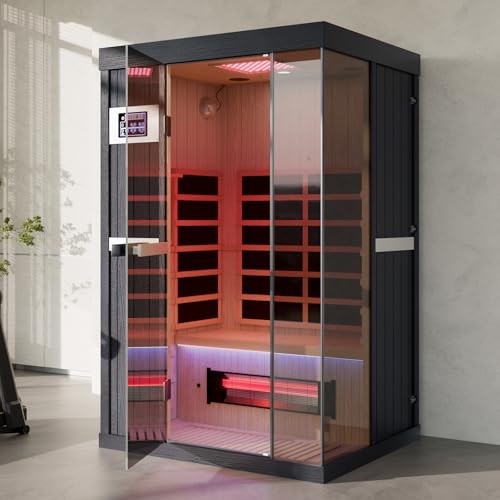
- Near-, mid-, and far-infrared wavelengths
- Stated 10-minute warm-up with dual heating tubes
- Red light therapy, air purification, and Bluetooth included
Best For: Two adults seeking a full-spectrum home or gym sauna
Best Overall – Low-EMF Okoume Wood Sauna
For shoppers seeking energy-efficient indoor infrared saunas with a traditional cabin design, this 1200W model combines low-EMF far-infrared heating with a compact footprint. Its six carbon heating panels, independently controlled foot heater, and adjustable 68°F–149°F range offer flexible at-home sessions.
Best For: Buyers who want a feature-rich wooden sauna with entertainment options and adjustable heating.
Pros:
- Natural Okoume wood provides an attractive, durable enclosure and heat insulation.
- Six low-EMF carbon panels and a separate foot heating plate support even warmth.
- Includes chromotherapy lighting, speakers, timer, temperature controls, and a seven-year after-sales service.
Cons:
- At 135 pounds, it is substantially less portable than fabric sauna designs.
- Its 27 x 35 x 61-inch footprint still requires a dedicated indoor space.
This is a strong choice when you value a permanent wood enclosure and extensive controls over portability. The 1200W rating and temperature-holding system also suit regular indoor use where efficient heat management matters.
Best Premium Cabin – Dynamic Elite 1-Person Sauna
This Dynamic Elite model is a polished option among energy-efficient indoor infrared saunas, using four ultra-low-EMF carbon panels in a compact one-person cabin. Its Pacific clear cedar construction, clasp-together assembly, and red light therapy add convenience and comfort for routine home sessions.
Best For: Individuals who want a compact cedar sauna with simple assembly, red light therapy, and Bluetooth audio.
Pros:
- Pacific clear cedar construction and a clear tempered glass door create a finished cabin feel.
- Four Carbon PureTech ultra-low-EMF panels provide infrared heat and air circulation.
- Includes chromotherapy, red light therapy, Bluetooth audio, and interior controls.
Cons:
- Designed for one person only.
- The music system includes Bluetooth and a speaker but no radio.
- Its five-year limited warranty applies to indoor use only.
With a typical operating range of 118°F–132°F and a maximum of 140°F, this sauna is suited to moderate, relaxing sessions rather than very high-temperature use. The clasp-together design is particularly helpful for buyers who want a less complicated setup.
Best Portable – SereneLife Foldable Infrared Sauna
For flexible, space-conscious use, this portable SereneLife model stands out among energy-efficient indoor infrared saunas. Its thermal-insulation fabric, three carbon fiber panels, foldable chair, and heated foot pad create a sit-in setup that can be stored when not in use.
Best For: Apartment dwellers and shoppers who prioritize portability, easy storage, and a comfortable seated design.
Pros:
- Foldable design and lightweight 19.16-pound build simplify storage and relocation.
- Three carbon fiber panels heat up to 140°F, with a remote for sessions of up to 60 minutes.
- Includes a folding chair, heated foot pad, armholes, and easy-access zippers.
Cons:
- Fabric construction offers a different feel from a rigid wood sauna cabin.
- The listed dimensions still require enough floor space for the seated enclosure and chair.
- Its maximum session time is 60 minutes.
This is the most practical pick for occasional users who do not want a permanent installation. The insulated fabric is designed to minimize heat loss, while the folding format makes it easier to clear the room after each session.
Best Low-Wattage Cabin – Aspen Low-EMF Sauna
This compact cabin is a compelling energy-efficient indoor infrared sauna for buyers watching power demands. Its five far-infrared panels use a listed 905W, work with a standard 120V/15A outlet, and reach up to 140°F while retaining a low-EMF design.
Best For: Apartment residents and home-gym users seeking a low-wattage one-person wooden sauna.
Pros:
- 905W heating system is compatible with a standard 120V/15A household outlet.
- European Aspen wood is resin-free, durable, and comfortable to the touch.
- Includes low-EMF heating, overheat protection, a vent, Bluetooth speakers, and digital controls.
Cons:
- Designed for one person and users up to 5’11”.
- The 36.6 x 29.3 x 63-inch cabin needs dedicated vertical and floor clearance.
- Its warranty is three years, shorter than some options in this roundup.
The 905W rating makes this a sensible option when lower power use is a priority, while the Aspen enclosure delivers a more traditional sauna experience than portable fabric models. Check the height and footprint carefully before ordering.
For shoppers comparing energy-efficient indoor infrared saunas, this three-person model combines carbon far-infrared panels with ceramic heating tubes in a hemlock enclosure. Its 1,950W system, low-EMF design claims, and 8–15-minute warm-up target make it a substantial option for shared home use.
Best For: Households that want a spacious, feature-rich sauna for up to three people.
Pros:
- Three-person capacity with a 600-pound seat limit.
- Eight far-infrared panels and three ceramic tubes are positioned for whole-body coverage.
- Includes colorful lighting, a reading light, and two Bluetooth speakers.
- Eastern Canadian hemlock provides insulation and a durable, hypoallergenic enclosure.
Cons:
- Its 62.99-by-42.91-inch footprint requires significant indoor space.
- The 20-amp, 110–120V electrical requirement may need planning before installation.
- Temperature away from the heating elements is listed up to 149°F, despite hotter ceramic tube surfaces.
This is the most capable choice here for group sessions, but its larger footprint and electrical requirements make it less suitable for compact rooms. The two-year limited warranty on the wood structure, heating, and electronics adds useful ownership support.
Best Portable Value – Red Light Infrared Steam Sauna Box
This folding sauna box is a practical alternative for shoppers seeking energy-efficient indoor infrared saunas without committing to a permanent wood cabin. It uses a 1,200W steamer, insulated waterproof fabric, and red-light panels while folding down for easier storage.
Best For: Renters, apartment dwellers, and buyers who need a portable personal sauna.
Pros:
- Large 71-by-32-by-32-inch interior accommodates users up to 6 feet 7 inches.
- Three-liter steamer offers nine temperature levels and heats in about 6–10 minutes under stated conditions.
- Includes 660nm red light and 850nm infrared light panels.
- Comes with a folding chair, remote control, double zipper, and storage pocket.
Cons:
- Maximum temperature is listed at 130°F, lower than the wood sauna models.
- Steam-tent construction may feel less substantial than a rigid sauna enclosure.
- Operation depends on filling and maintaining the steam kettle.
Choose this model when portability and quick setup matter more than a permanent spa-like installation. Its 1,200W steamer and insulated five-layer waterproof design support convenient home sessions, while the included chair makes seated use straightforward.
Best Compact Cabin – One-Person Low-EMF Infrared Sauna
For a compact take on energy-efficient indoor infrared saunas, this one-person cabin uses four carbon infrared panels plus dedicated foot heating. Its 110V design, six-square-foot footprint, and modular construction make it easier to fit into a bedroom, home gym, or other small indoor space.
Best For: Solo users who want a permanent infrared sauna in limited space.
Pros:
- Compact footprint of about six square feet with full-body carbon-panel coverage.
- Dedicated foot heating adds warmth to the lower body.
- Finnish spruce, tempered glass, and a door seal create a polished cabin-style design.
- Modular panels weigh 107 pounds and can be assembled by one person in about 20 minutes with basic tools.
Cons:
- One-person capacity is not suited to shared sessions.
- Reaches up to 149°F, but cold winter conditions may require additional preheating.
- At 60.2 inches high, interior fit should be checked carefully for taller users.
This is the strongest fit for buyers prioritizing a small, fixed installation with straightforward assembly. The four carbon panels and foot zone heating provide targeted coverage, while the roof vent and door seal support a more comfortable indoor setup.
Efficient Home Relaxation – Barcelona 1-2 Person Infrared Sauna
The Dynamic Saunas Barcelona is a practical choice for shoppers seeking energy-efficient indoor infrared saunas in a compact 1- to 2-person format. Its six low-EMF carbon PureTech panels, standard 120-volt plug, and indoor-friendly assembly make it suitable for a home or office wellness space.
Best For: Individuals or couples who want an easy-to-install sauna with red light therapy and built-in entertainment features.
Pros:
- Six carbon panels support efficient 360° heating and faster warm-up.
- Compact design fits 1-2 adults and can be installed on indoor surfaces, including carpet.
- Includes red light therapy, Bluetooth, MP3/Aux input, and built-in speakers.
- Uses a standard 15-amp, 120-volt plug and includes a 5-year limited indoor-use warranty.
Cons:
- Maximum temperature is 135°F, with a recommended range of 115°F to 130°F.
- At 250 pounds, it may require substantial effort to position during installation.
Choose this model if straightforward setup, moderate infrared temperatures, and a compact footprint matter more than higher heat output or a larger interior.
Connected Comfort Pick – 2-Person Low-EMF Infrared Sauna
This 2-person model suits shoppers comparing energy-efficient indoor infrared saunas with useful comfort and connectivity features. Its seven low-EMF carbon panels operate at 1760 watts and 120 volts, while the 10-minute preheat and timer support convenient at-home sessions.
Best For: Couples or home-gym users who want a spacious sauna with music, chromotherapy, foot warming, and device charging.
Pros:
- Seven low-EMF carbon panels provide full-body warmth with a stated 10-minute preheat.
- Roomy 47.2-by-39.4-by-72-inch design accommodates two people.
- Built-in timer, Bluetooth, FM radio, MP3 playback, USB port, and dual speakers add convenience.
- Includes seven-color chromotherapy, a reading light, oxygen bar, and dedicated foot warmer.
Cons:
- The 220-pound unit requires planning for delivery and placement.
- The notes request contact information to help ensure normal delivery.
This is a feature-rich option for shared sessions, especially if quick preheating and integrated entertainment are priorities alongside low-EMF heating.
Full-Spectrum Upgrade – 2-Person Full-Spectrum Infrared Sauna
For shoppers seeking energy-efficient indoor infrared saunas with broader wavelength coverage, this 2-person full-spectrum model combines six heating panels with dual heating tubes. It reaches operating warmth in a stated 10 minutes and adds a 12-by-12-inch red light therapy area for a more comprehensive home or gym setup.
Best For: Two adults who want full-spectrum infrared therapy, red light therapy, and a feature-rich indoor sauna.
Pros:
- Full-spectrum system combines near-, mid-, and far-infrared wavelengths.
- Dual heating tubes and six panels provide a stated 10-minute warm-up.
- Includes a 12-by-12-inch red light therapy area, air purification, and reading lamp.
- Offers Bluetooth, FM radio, USB connectivity, and ETL certification.
Cons:
- At 1990 watts, it requires a dedicated outlet with a 20-amp breaker.
- It cannot be installed on carpet, unlike some indoor sauna models.
- The 44-by-36-by-70-inch interior may feel compact for two larger adults.
This model is best when full-spectrum coverage and red light therapy justify the higher electrical requirement and more specific installation planning.
How We Picked These Energy-Efficient Indoor Infrared Saunas
We focused on practical specifications that influence ownership: stated wattage, voltage, capacity, construction materials, heater type, controls, portability, and included comfort features. We also considered low-EMF claims, red-light therapy additions, timers, Bluetooth or speaker systems, and whether a unit is better suited to a bedroom, home gym, apartment, or dedicated wellness room.
Because product specifications and electrical requirements can vary by seller or production run, verify the current listing before purchasing. A lower wattage does not automatically mean better efficiency if the cabin is poorly insulated or too small for your needs.
Quick Comparison
- Smallest footprint: Portable sauna boxes and compact sit-in designs are easiest to store and generally require the least space.
- Best for one person: One-person cabins offer a more comfortable seated experience while limiting heat-up volume and energy use.
- Best for couples: Two-person cabins provide shared use but typically draw more power and need more floor area.
- Best for families or groups: Three-person models offer more room but require a larger, well-ventilated installation area.
- Feature-focused options: Models with red-light panels, Bluetooth speakers, timers, and multiple heat settings add convenience but may increase cost and complexity.
Key Buying Factors for Energy-Efficient Indoor Infrared Saunas
Wattage, Voltage, and Operating Cost
Check both wattage and voltage before ordering. Many home units use a standard 120V outlet, but larger cabins can draw roughly 1,760W to 1,990W. Confirm that the circuit can safely support the load, and avoid using an extension cord unless the manufacturer specifically permits it. Actual energy cost depends on local utility rates, heat-up time, session length, insulation, and frequency of use.
Size and Installation Space
Measure the sauna’s exterior dimensions, door swing, ceiling clearance, and route into the room. Leave the manufacturer-recommended ventilation and service clearance. A one-person cabin is usually the most practical choice for regular solo sessions, while two- and three-person models make sense only if shared use justifies the larger footprint.
Heat, EMF, and Comfort Features
Look for adjustable temperature levels, reliable controls, an automatic timer, comfortable seating, interior lighting, and easy-clean surfaces. If low EMF is important, review the manufacturer’s testing details rather than relying only on marketing language. Red-light therapy, speakers, and Bluetooth can improve the experience, but they should not outweigh construction quality and safe electrical design.
Who Should Buy Which Energy-Efficient Indoor Infrared Saunas?
Choose a Portable Sauna Box or Sit-In Model If:
You have limited space, rent your home, or want a lower-commitment option that can be stored between sessions. These designs are convenient but usually feel less like a traditional cabin and may offer less seating comfort.
Choose a One-Person Cabin If:
You primarily use the sauna alone and want a balance of comfort, compact dimensions, and manageable power demand. This is often the best starting point for apartments, bedrooms, and smaller home gyms.
Choose a Two-Person Cabin If:
You plan to share sessions and have a suitable dedicated area. Compare wattage, bench dimensions, door clearance, and electrical capacity before prioritizing extra room or entertainment features.
Choose a Three-Person or Full-Spectrum Model If:
You have ample space and specifically want a roomier cabin or broader light and heater coverage. Expect higher upfront costs, greater power draw, and more demanding installation planning.