
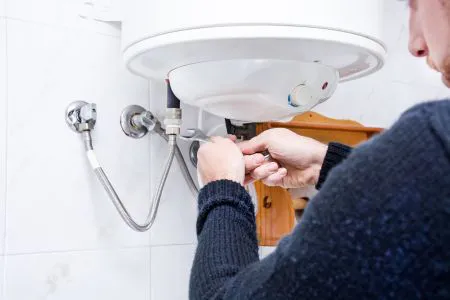
I once spent three hours trying to convince my wife that the low-frequency thrumming coming from our basement was actually a secret government experiment and not, in fact, our water heater preparing for takeoff. Spoiler alert: it was the water heater. After twelve years of getting my hands dirty in crawl spaces and accidentally flooding my laundry room (more than once), I’ve learned that a humming water heater isn’t usually a ghost—it’s just physics being annoying.
If your tank is making a noise that sounds like a distant beehive or a idling semi-truck, you’re probably worried it’s about to explode. Take a breath. It probably won’t. But that sound is your appliance’s way of telling you it’s working way harder than it needs to. Let’s get into why this happens and how you can fix it without calling a plumber who charges $150 just to knock on your door.
What Causes Water Heater Humming Noises?
The most common culprit behind that rhythmic hum is something called a loose upper heating element. Inside your electric water heater, there’s a metal rod that gets red hot to toast your water. When water flows past this element, it can create a vibration. Think of it like a guitar string; if it’s not held down tight, it’s going to rattle. In my early days, I ignored this in a rental property until the vibration actually shook the element so hard it snapped. That was a fun Monday morning spent mopping up 40 gallons of lukewarm mess.
Another sneaky reason for the hum is high water pressure. If the pressure coming into your house is set too high, the water literally “sings” as it forces its way through the narrow openings of your valves. It’s less of a “celestial choir” and more of a “my pipes are screaming” situation. Most people think more pressure is better for showers, but I’m telling you right now, anything over 80 PSI is just asking for a blown gasket and a very expensive call to your insurance agent.
Lastly, don’t rule out sediment buildup. While sediment usually makes a “popping” or “knocking” sound (like popcorn), a thin layer of scale on the heating element can cause it to vibrate at a high frequency. It’s like putting a playing card in the spokes of a bicycle wheel. It’s annoying, it’s constant, and it’s a sign that your heater is struggling to breathe through a layer of calcium “gunk.”
How to Tighten a Loose Heating Element
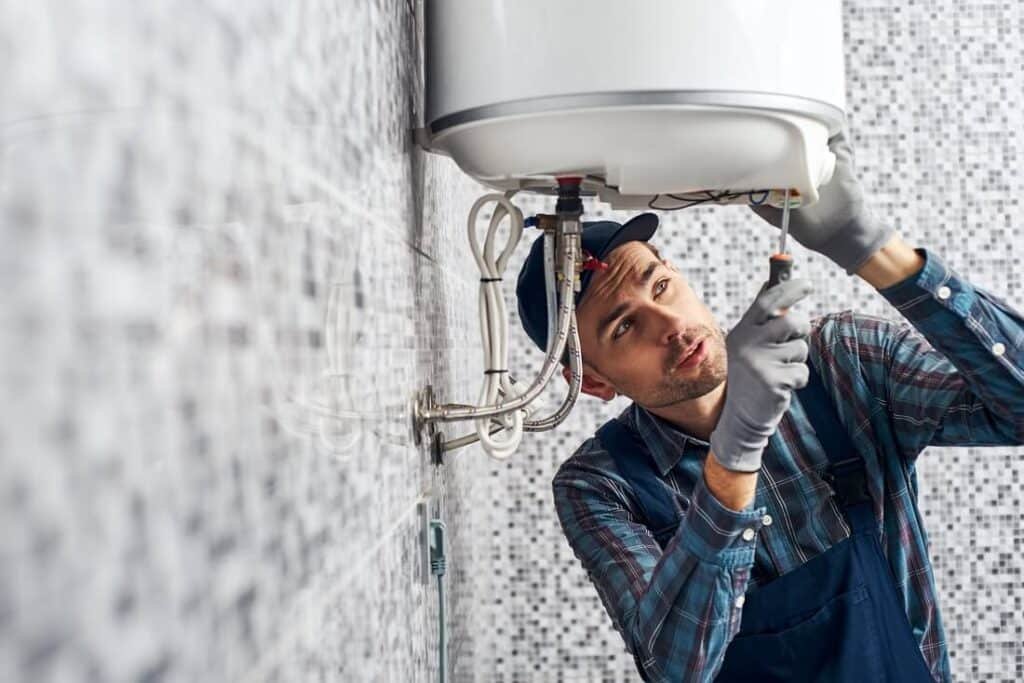
Fixing a vibrating element is the “Low Hanging Fruit” of DIY plumbing. First, you have to shut off the power at the breaker. Please, don’t skip this. I once forgot to flip the switch while working on a thermostat and ended up with a hairstyle that I can only describe as “electrocuted poodle.” Once the power is dead, remove the access panel on the side of the tank. You’ll see some insulation—move that aside—and you’ll find the element screwed into the tank.
You’re going to need a water heater element wrench. It’s a cheap, hollow tube of metal that costs about ten bucks at the hardware store. Don’t try to use a pair of pliers; you’ll just strip the nut and then you’re really in trouble. Simply fit the wrench over the element and give it a firm turn clockwise. You aren’t trying to win a weightlifting competition here; just make sure it’s snug. Often, just a quarter-turn is enough to stop the vibration and kill the hum.
If the tightening doesn’t work, the element might be slightly bent or “scaled up.” In that case, you’ll need to drain the tank and replace it entirely. I’ve found that trying to “clean” an old element is a total waste of time. For $20, just buy a new “low-watt density” element. They have more surface area, which means they don’t get as hot in one specific spot, making them way quieter and less likely to hum in the first place.
Adjusting Your Water Pressure Regulator
If you’ve tightened the elements and the hum persists, we need to talk about your Pressure Reducing Valve (PRV). This is usually located near your main water shut-off. If this valve fails, the “velocity” of the water entering your heater creates a harmonic vibration. I spent a whole summer wondering why my pipes hummed every time the dishwasher ran, only to realize my home pressure was at 95 PSI. My shower felt like a power washer, which was great for my back, but terrible for my plumbing joints.
To fix this, you’ll need a simple pressure gauge that screws onto an outdoor hose bib. If the needle jumps past 75-80 PSI, your PRV needs an adjustment or a replacement. To adjust it, loosen the locknut on the valve and turn the bolt counter-clockwise to reduce the pressure. Do this in small increments. Go check the kitchen sink, then check the gauge again.
If the PRV is old and crusty, don’t bother fighting it. Just replace it. A humming heater caused by high pressure is a warning sign that your pipes are under too much stress. It’s like driving your car at 100 mph everywhere you go; eventually, something is going to blow. Keeping your pressure around 50–60 PSI is the sweet spot for a quiet, happy home.
Sediment Flushing for a Quieter Tank
Sediment is the silent killer of water heaters. It’s basically a collection of minerals—mostly calcium and magnesium—that settles at the bottom of your tank. When the burner or element kicks on, it has to heat through that layer of “sand” before it can even touch the water. This causes the water trapped under the sediment to boil instantly, creating bubbles that vibrate the tank. This can manifest as a low hum or a “rolling” sound.
To flush the tank, hook a garden hose to the drain valve at the bottom and run the other end to a floor drain or outside. Pro tip: Don’t run hot water onto your grass unless you want a big brown patch of dead lawn. Ask me how I know. Open the valve and let it run until the water comes out clear. If you haven’t done this in years, you might see chunks that look like wet oatmeal. That’s the stuff that’s stealing your energy efficiency and making your heater noisy.
I recommend doing a “power flush.” Keep the cold water supply on while the drain valve is open. This creates turbulence at the bottom of the tank, kicking up the sediment so it can actually get sucked out the hose. If you just drain it via gravity, a lot of that heavy scale stays sitting on the floor of the tank. Do this once a year, and your water heater will live significantly longer than the one I ignored for six years until it started sounding like a rock tumbler.
Real Talk: When to Give Up and Buy a New One
Let’s be real for a second: if your water heater is more than 10 or 12 years old and it’s humming, clanking, and leaking from the bottom, no amount of DIY magic is going to save it. I’ve seen people spend $300 on parts and three weekends of labor trying to revive a tank that was basically a giant rusted tea kettle. At some point, you have to know when to fold ’em.
If you see rusty water coming out of your taps or notice a puddle under the tank that isn’t from a leaky pipe connection, the internal lining of your tank is toast. The “humming” might actually be the sound of your wallet screaming. Also, if you have a gas heater and the hum is accompanied by a heavy smell of gas, stop reading this, get out of the house, and call the gas company. No DIY “fix” is worth blowing up your kitchen.
Another thing that’s not worth the effort? Trying to “insulate” a noisy, old, inefficient heater with one of those “space blankets” to muffle the sound. It’s a fire hazard if not done perfectly, and it doesn’t fix the underlying problem. It’s like putting a band-aid on a broken leg. If the noise is internal, fix the internal component or replace the unit.
Bonus Side Note: If you’re replacing your unit anyway, look into a “Heat Pump” water heater. They’re weirdly quiet, they dehumidify your basement, and the tax credits usually make them cheaper than a standard electric model in the long run.
The Parting Wisdom
A humming water heater is usually just a minor annoyance caused by a loose part or high pressure, but ignoring it is how “minor annoyances” turn into “catastrophic floor-ruining events.” Tighten those elements, check your house pressure, and flush that sediment. Your ears (and your utility bill) will thank you.
If you’ve got a weird noise coming from your basement that I didn’t cover here—or if you’ve ever accidentally turned your basement into a swimming pool like I have—tell me about it in the comments.