A damp studio can damage equipment, encourage mold, and make the room feel uncomfortable. The right dehumidifier balances moisture removal with low energy use, quiet operation, and a footprint that suits your workspace.
These 10 energy-efficient studio dehumidifiers span compact thermoelectric units and larger Energy Star models, giving you options for bedrooms, project rooms, basements, and open creative spaces.
Best 10 Energy-Efficient Studio Dehumidifiers Picks for 2026
Efficient Large-Space Pick
Uthfy 38-Pint 3,000-Sq.-Ft. Dehumidifier

- 38-pint capacity for spaces up to 3,000 sq. ft.
- 35 dB sleep mode with auto defrost and restart
- Drain hose, washable filter, and R290 refrigerant
Best For: Large damp rooms and basements needing quiet, continuous operation
Compact Semiconductor Pick
ToLife 1,000-Sq.-Ft. Dehumidifier

- Portable design with a 95-ounce water tank
- Sleep mode rated below 30 dB
- Auto shutoff and two operating modes
Best For: Bedrooms, bathrooms, closets, and other smaller spaces
Maximum-Coverage Efficiency Pick
AEOCKY 5,500-Sq.-Ft. Dehumidifier

- Designed for coverage up to 5,500 sq. ft.
- Stated capacity reaches 80 pints per day in humid conditions
- Smart humidity control and power-off memory
Best For: Large homes and demanding basement moisture control
Small-Room Value Pick
60-Ounce Dual-Semiconductor Dehumidifier

- Covers spaces up to about 350 sq. ft.
- 1.8-liter tank with automatic shutoff
- 35 dB sleep mode and up to 48-hour timer
Best For: Bathrooms, closets, RVs, and compact studio spaces
Best Overall
Kesnos 30-Pint Energy Star Dehumidifier

- 30-pint capacity for spaces up to 2,500 sq. ft.
- 2025 ENERGY STAR certified with four operating modes
- Quiet 36 dB operation and included drain hose
Best For: Larger studios and medium-sized spaces
Best Compact Pick
Small 38-Ounce Semiconductor Dehumidifier
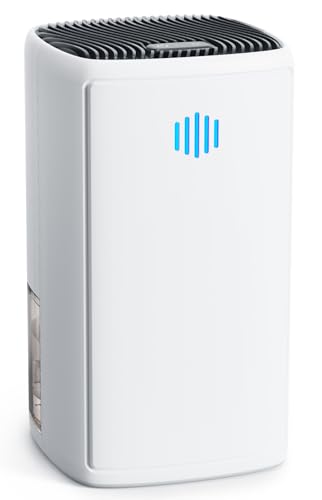
- 40-watt design for small-space moisture control
- Below-30 dB operation for bedrooms and offices
- Auto shutoff, full-tank alert, and auto defrost
Best For: Small studios, closets, and bathrooms
Best High-Capacity Pick
KNKA 80-Pint Energy Star Dehumidifier

- Up to 80 pints per day
- Adjustable 30%–80% RH control
- Continuous-drain support included
Best For: Large studios and persistent moisture
Best Heavy-Duty Pick

- Uses about 21–23 watts per hour
- Compact 215-square-foot coverage
- Quiet operation with auto shutoff
Best For: Small studios and targeted moisture control
Best Balanced Pick
DR.PREPARE 38-Pint Energy Star Dehumidifier

- 38-pint daily moisture removal
- 35 dB sleep mode
- Included hose for continuous drainage
Best For: Medium-to-large studios and daily humidity control
Efficient Large-Space Pick – Uthfy 38-Pint 3,000-Sq.-Ft. Dehumidifier
For shoppers comparing energy-efficient studio dehumidifiers, the Uthfy combines compressor-based moisture removal with automatic humidity control and a claimed ENERGY STAR Most Efficient 2025 designation. Its 38-pint capacity and continuous-drain option make it suitable for larger, persistently damp areas.
Best For: Basements, bedrooms, bathrooms, and other spaces up to 3,000 square feet where quiet operation and unattended drainage matter.
Pros:
- 38-pint daily capacity with a stated coverage area of up to 3,000 square feet.
- Includes a drain hose, auto shut-off, washable filter, and auto restart.
- Sleep mode is rated at 35 dB and uses an R290 refrigerant.
- Offers adjustable humidity control, a 24-hour timer, and auto defrost.
Cons:
- The 0.6-gallon tank is relatively small for its moisture-removal capacity if continuous drainage is unavailable.
- Its larger compressor design may be more than needed for a small studio or single room.
Choose this model when broad coverage, low-noise operation, and energy-conscious compressor performance are more important than compact size. The included hose is especially useful for long-running basement or home setups.
Compact Semiconductor Pick – ToLife 1,000-Sq.-Ft. Dehumidifier
The ToLife is a compact option for shoppers seeking energy-efficient studio dehumidifiers for lighter-duty moisture control. Its semiconductor technology, two operating modes, and portable form make it practical for bedrooms, bathrooms, closets, and other smaller areas.
Best For: Small rooms and portable use where quiet operation, a large 95-ounce tank, and simple controls are priorities.
Pros:
- Compact design with handles for moving between rooms.
- 95-ounce tank provides more capacity than many small portable units.
- Sleep mode operates below 30 dB according to the supplied notes.
- Automatic shutoff helps prevent overflow when the tank is full or misplaced.
Cons:
- Semiconductor technology is intended for lighter-duty use than a full-size compressor dehumidifier.
- Only two operating modes are listed, with no supplied information about continuous drainage.
- The stated 1,000-square-foot coverage may vary with humidity and room conditions.
The ToLife makes sense when portability and low noise outweigh maximum extraction speed. It is a convenient fit for localized dampness rather than demanding whole-home humidity control.
Maximum-Coverage Efficiency Pick – AEOCKY 5,500-Sq.-Ft. Dehumidifier
Among energy-efficient studio dehumidifiers, the AEOCKY stands out for its very large stated coverage area and compressor performance. It is designed for substantial moisture loads, with smart humidity sensing, power-off memory, and low-temperature operation intended for demanding basement environments.
Best For: Large basements, expansive homes, and high-humidity spaces requiring high extraction capacity and precise automatic control.
Pros:
- Rated for spaces up to 5,500 square feet.
- Supplied notes list up to 80 pints per day in specified hot, humid conditions.
- ENERGY STAR Most Efficient 2025 certification is highlighted in the product information.
- Smart humidity control, power-off memory, and low-temperature performance support unattended use.
Cons:
- Its large capacity is likely excessive for a small studio or single bedroom.
- The supplied notes do not provide a tank size, included hose, or noise rating.
- Real-world extraction depends on temperature and relative humidity.
This is the strongest match for buyers who need extensive coverage and serious moisture removal rather than a small portable appliance. Its memory and low-temperature features are particularly useful for basements or other spaces that run continuously.
Small-Room Value Pick – 60-Ounce Dual-Semiconductor Dehumidifier
This dual-semiconductor model is a practical choice for energy-efficient studio dehumidifiers when the target space is limited to roughly 350 square feet. It combines a 60-ounce tank, automatic shutoff, sleep mode, and timer controls in a portable design for bathrooms, cloakrooms, RVs, and similar areas.
Best For: Small rooms and mobile spaces needing quiet, portable moisture reduction with timer-based operation.
Pros:
- Dual semiconductor condensers are rated to remove up to 700 ml of moisture per day under stated test conditions.
- Large 1.8-liter tank and automatic shutoff reduce overflow concerns.
- 35 dB sleep mode and a selectable seven-color light support bedroom or nighttime use.
- 12-, 24-, 36-, and 48-hour timer settings help limit unnecessary runtime.
Cons:
- Its stated coverage is limited to about 350 square feet.
- Semiconductor extraction is better suited to small spaces than severe whole-room humidity problems.
- The supplied notes do not mention a continuous-drain connection.
For a bathroom, closet, RV, or compact studio area, this model offers useful portability and straightforward runtime control. Its modest coverage makes it less suitable for basements or large open-plan rooms.
Best Overall – Kesnos 30-Pint Energy Star Dehumidifier
For shoppers comparing energy-efficient studio dehumidifiers, the Kesnos JD-N combines substantial moisture removal with low-noise operation and flexible drainage. Its 30-pint capacity is rated for spaces up to 2,500 square feet, while 2025 ENERGY STAR certification supports more efficient daily operation.
Best For: Larger studios, bedrooms, basements, and other medium-sized spaces needing quiet, continuous humidity control.
Pros:
- Removes up to 30 pints per day and is rated for up to 2,500 square feet.
- 2025 ENERGY STAR certified, with claimed 35% lower power consumption than non-certified models.
- Runs at a quiet 36 dB and offers four modes, including Comfort and Turbo.
- Includes a drain hose, auto shutoff, automatic defrost, and memory restart.
Cons:
- The 0.39-gallon tank may require frequent emptying when continuous drainage is unavailable.
- The included 3.3-foot hose requires a suitable drain location; a 1/2-inch garden hose is not included.
This is a strong all-purpose choice when you want efficient, quiet moisture removal and the option to roll the unit between rooms. Its larger coverage rating may be more than necessary for a very small studio, but the preset modes and continuous-drain option add everyday convenience.
Best Compact Pick – Small 38-Ounce Semiconductor Dehumidifier
This compact option suits shoppers seeking energy-efficient studio dehumidifiers for limited spaces rather than whole-room moisture control. Its semiconductor design uses 40 watts, operates below 30 dB, and is intended for areas such as bedrooms, closets, bathrooms, offices, and RVs.
Best For: Small studios, closets, bathrooms, bedrooms, offices, and RVs where portability and quiet operation matter most.
Pros:
- Compact 6.5-by-6.5-by-9.5-inch design for small spaces.
- Uses 40 watts and operates below 30 dB for quiet nighttime or work-area use.
- Automatic shutoff and a flashing full-tank indicator help prevent overflow.
- Automatic defrost supports use in colder conditions.
Cons:
- Its 0.45-liter-per-day removal rate is intended for small spaces, not heavy moisture loads.
- The 38-ounce tank is considerably smaller than those on compressor-based models.
- Air inlets and the rear outlet must remain unobstructed for proper operation.
Choose this model when a small footprint and very low noise are more important than fast, high-volume dehumidification. For a damp studio or a space larger than its 280-square-foot rating, a 30-pint compressor unit will be better suited.
Best for Energy Savings – Waykar 30-Pint Energy Star Dehumidifier
The Waykar is a practical option for energy-conscious shoppers comparing energy-efficient studio dehumidifiers. Its 2025 ENERGY STAR Most Efficient certification, 30-pint capacity, and 1,500-square-foot coverage rating make it suitable for studios and adjoining living areas, with automatic or manual drainage for flexible setup.
Best For: Studios, bedrooms, offices, and basements where energy efficiency, adjustable humidity control, and flexible drainage are priorities.
Pros:
- Removes up to 30 pints per day and is rated for spaces up to 1,500 square feet.
- 2025 ENERGY STAR Most Efficient certified, with a claimed 50% lower energy use than traditional models.
- Adjustable humidity range from 30% to 80%, plus dehumidifying, drying, and continuous modes.
- Offers a 0.62-gallon tank or included 3.3-foot hose, along with auto shutoff and memory restart.
Cons:
- At 38 dB minimum, it is quiet but not as quiet as the smaller semiconductor model.
- The drain-pipe switch must be tightened when using the tank to help prevent leaks.
- Its 190-watt rating is higher than the compact 40-watt unit.
With a larger tank, strong coverage, and adjustable humidity settings, this Waykar offers a balanced fit for a studio that experiences recurring moisture. Its energy-saving certification is especially useful for regular operation, while the child lock and automated safety features add household convenience.
Best High-Capacity Pick – KNKA 80-Pint Energy Star Dehumidifier
For large studios or connected living spaces, the KNKA is a high-capacity option among energy-efficient studio dehumidifiers. Its Energy Star design, adjustable humidity control, and 80-pint-per-day maximum make it suited to persistent moisture, while continuous-drain support reduces hands-on maintenance.
Best For: Large studios, basements, laundry areas, and users who need strong moisture removal with flexible drainage.
Pros:
- Removes up to 80 pints per day in very humid conditions and 56 pints in typical basement conditions.
- Offers Auto, Dry, and adjustable 30%–80% RH modes.
- Supports continuous drainage with the included 6.56-foot hose and includes a washable filter, casters, timer, and child lock.
- Runs at a stated 40–45 dB and allows the display and indicator lights to be turned off.
Cons:
- The 1.45-gallon internal tank may require regular emptying without a drain setup.
- The optional 2.64-gallon external tank is sold separately.
- Its listed 5500-square-foot coverage may be more capacity than a small studio needs.
The KNKA stands out when moisture control and capacity take priority. Its efficiency-oriented operation, quiet design, and drainage options make it practical for demanding spaces, though smaller rooms may be better served by a compact unit.
Best Heavy-Duty Pick – Pro Breeze Mini Dehumidifier
The Pro Breeze is a small, low-power choice for targeted moisture control. As one of the most compact energy-efficient studio dehumidifiers, it uses about 21–23 watts per hour, operates quietly, and fits easily in bathrooms, closets, offices, RVs, or small studio zones.
Best For: Small studios, bathrooms, bedrooms, closets, offices, RVs, and other spaces up to about 215 square feet.
Pros:
- Compact 4-by-8-by-6-inch design with a 17-ounce tank.
- Uses approximately 21–23 watts per hour, with a stated running cost of about $0.07 per day.
- Whisper-quiet operation and automatic shutoff when the tank is full.
- Portable design works in kitchens, bedrooms, bathrooms, basements, garages, and caravans.
Cons:
- Removes up to 9 ounces of water per day, so it is not intended for severe or large-area humidity.
- Its optimal operating range is 59–86°F and it will not work below 41°F.
- The small tank requires more frequent emptying in humid conditions.
The Pro Breeze is best viewed as a supplemental or personal-space dehumidifier rather than a whole-studio solution. Its very low power draw and compact footprint are valuable when quiet, economical operation matters more than capacity.
Best Balanced Pick – DR.PREPARE 38-Pint Energy Star Dehumidifier
The DR.PREPARE offers a practical middle ground for studios that need more capacity than a mini unit without moving to the KNKA’s largest format. This Energy Star Most Efficient 2025 compressor model combines adjustable humidity control, quiet sleep operation, and included continuous drainage for everyday moisture management.
Best For: Medium-to-large studios, bedrooms, bathrooms, basements, garages, and travel trailers needing flexible daily control.
Pros:
- Removes up to 38 pints per day and is rated for areas up to 2600 square feet.
- Automatic humidity control can start and stop dehumidification to maintain the selected level and reduce energy use.
- Includes Auto, Continuous, and 35 dB Sleep modes, plus a 24-hour timer and child lock.
- Offers manual or continuous drainage with a 2-liter tank and included hose.
Cons:
- The 2-liter tank is smaller than the KNKA’s internal tank and may need frequent emptying without continuous drainage.
- Its 38-pint capacity may be insufficient for extremely damp, very large spaces.
- The humidity reading is taken at the air inlet and may differ from an external meter.
For many studios, the DR.PREPARE provides the most balanced feature set: efficient compressor operation, quiet nighttime performance, and straightforward drainage. It is a strong fit when you want meaningful capacity without choosing the largest model.
How We Picked These Energy-Efficient Studio Dehumidifiers
We focused on models that address the needs of a working studio: efficient operation, manageable noise, useful humidity controls, and practical maintenance. The lineup includes compact units for closets or small rooms, as well as compressor dehumidifiers for larger studios or spaces with persistent dampness.
We also considered rated coverage, tank capacity, automatic shutoff, continuous-drain support, portability, sleep modes, and Energy Star labeling where provided. Coverage claims are best treated as estimates because climate, ceiling height, insulation, and the severity of the moisture problem all affect real-world performance.
Quick Comparison
| Studio need | Best type to consider | Features to prioritize |
|---|---|---|
| Small booth, closet, or desk area | Compact thermoelectric unit | Quiet operation, small footprint, auto shutoff |
| Small-to-medium studio | Portable compressor model | Adjustable humidity target, larger tank, sleep mode |
| Large or consistently damp room | High-capacity compressor model | Continuous drainage, washable filter, Energy Star efficiency |
| Overnight operation | Quiet compressor or semiconductor model | Low-noise setting, timer, display dimming |
Key Buying Factors for Energy-Efficient Studio Dehumidifiers
Room Coverage and Moisture Load
Choose by the room’s actual size and dampness, not just the largest advertised square-foot number. A basement studio, laundry-adjacent room, or poorly ventilated space may need more capacity than a dry, enclosed bedroom of the same size.
Energy Use and Operating Style
Energy Star certification is a useful starting point for compressor models, but efficiency also depends on runtime. A correctly sized unit that reaches its humidity target and cycles off can use less power than an undersized model running continuously. A hygrometer helps confirm whether the room stays near a comfortable 40% to 60% relative humidity.
Noise and Placement
Thermoelectric models are often quieter and more portable, but they generally remove less moisture. Compressor units offer stronger performance and are better for larger spaces, though fan and compressor noise matter for recording, editing, or sleep. Look for sleep modes and place the unit on a level surface with clear airflow.
Drainage and Maintenance
A small tank is acceptable when you can empty it frequently. For unattended use, choose automatic shutoff plus a drain hose connection and place the hose at a reliable downhill angle. Clean the filter and tank regularly to preserve airflow, efficiency, and indoor air quality.
Who Should Buy Which Energy-Efficient Studio Dehumidifiers?
- Choose a compact 38- or 60-ounce model for a small studio corner, closet, bathroom, or occasional spot treatment where portability and low noise matter most.
- Choose a mini 17-ounce unit for very small enclosed areas, equipment cabinets, or personal workspaces with mild humidity—not for a whole studio.
- Choose a 1,000- to 1,500-square-foot model for a typical bedroom-sized studio or moderately damp apartment room.
- Choose a 2,500- to 2,600-square-foot model when you need stronger moisture removal and the convenience of a drain hose.
- Choose a 3,000- to 5,500-square-foot Energy Star model for large, open, or persistently damp studios, especially when continuous drainage is available.
Before buying, measure the room, identify where water can drain, and decide whether quiet operation or maximum moisture removal is the higher priority. Those three choices usually narrow the list quickly.