Fresh indoor air should not require constant filter changes, complicated controls, or high operating costs. The best low-maintenance whole-house ventilation systems make it easier to exchange stale air, manage heat, and improve comfort with minimal ongoing attention.
This roundup compares whole-house fans, energy recovery ventilators, through-wall systems, and garage-focused options so you can match airflow, efficiency, noise, and installation requirements to your home.
Best 10 Low-Maintenance Whole House Ventilation Systems Picks for 2026
High-Capacity Pick

- 5,024 CFM high airflow
- Wireless control with 12-hour timer
- R5 damper box included
Best For: Average-size homes needing powerful cooling and ventilation
Balanced-Air Choice

- Balanced supply and exhaust
- Heat and moisture recovery
- Automatic frost protection
Best For: Year-round fresh-air exchange with humidity recovery
Compact Cooling Pick
- 2,465 CFM high airflow
- 25 dB listed noise level
- Wireless timer control included
Best For: Bedrooms and smaller areas requiring remote-controlled ventilation
HVAC-Coordinated Option
Panasonic SelectCycler SACG2K-04

- Programmable ventilation controller
- Supports supply or balanced modes
- Includes motorized supply damper
Best For: Compatible HVAC and fan systems needing coordinated ventilation control
Garage Cooling Powerhouse

- Up to 1,834 CFM of airflow
- Uses as little as 133 watts
- Includes fire damper and wireless control
Best For: Large garages with an attic installation space
Balanced Fresh-Air Specialist

- Supplies and exhausts up to 213 CFM
- Uses an energy recovery core
- Includes washable MERV 6 filters
Best For: Ducted whole-home balanced ventilation
Smart Filtered Air Exchange
- Three-stage HEPA and carbon filtration
- Wi-Fi, remote, and button controls
- Quiet 30 dB through-wall operation
Best For: Localized ventilation in bedrooms and offices
Best Whole House Fan for Sealed Attic Efficiency

- R38 insulated doors seal when the fan is off
- Remote-controlled, two-speed operation
- Up to 1,600 CFM with lifetime warranty
Best For: Seasonal cooling with reduced attic air leakage
Best Balanced Fresh-Air Ventilation System
- Balanced ventilation up to 180 CFM
- Recovers heat and humidity with an enthalpy core
- Washable MERV 6 filters and automatic defrost
Best For: Year-round filtered air exchange in compact spaces
Best High-Capacity Whole House Fan
- High airflow for larger one- and two-story homes
- Three-speed wall switch with timer and temperature control
- R-5 insulated damper and long motor warranty
Best For: Powerful cooling airflow in larger homes
High-Capacity Pick – QuietCool QC-5400 RF
For shoppers comparing low-maintenance whole house ventilation systems, the QuietCool QC CL-5400 RF emphasizes straightforward wireless control and high airflow. Its 5,024 CFM rating is designed for homes up to 2,510 square feet, while the included R5 damper box helps insulate the attic when the fan is off.
Best For: Cooling and ventilating average-size homes that need high airflow and remote operation.
Pros:
- Moves up to 5,024 CFM on high and 4,406 CFM on low.
- Wireless RF control includes a glass switch and up to a 12-hour countdown timer.
- R5 damper doors help reduce attic exposure during colder seasons.
- Includes acoustical ducting, ceiling grille, window locks, and a 20-foot power cord.
Cons:
- Its 74-pound weight and ceiling-mount installation may require substantial installation planning.
- The larger 634-watt high setting uses more power than the smaller QuietCool model.
The QC-5400 RF is a strong choice when rapid whole-house air movement matters most. Its included controls and damper box support convenient seasonal use, but the size and installation requirements are worth considering before purchase.
Balanced-Air Choice – VENTS-US Frigate ERV 150 EC
The VENTS-US Frigate ERV 150 EC is suited to buyers seeking low-maintenance whole house ventilation systems with balanced air exchange. It supplies fresh air while removing stale air, and its enthalpic core recovers heat and moisture for more consistent indoor comfort.
Best For: Year-round balanced ventilation where heat and humidity recovery are priorities.
Pros:
- Provides up to 186 CFM of balanced airflow.
- Enthalpic core recovers both heat and moisture.
- Automatic electronic frost protection helps prevent freezing in low temperatures.
- Steel casing with an anti-corrosion coating supports long service life.
Cons:
- Its 186 CFM capacity is lower than the airflow offered by the QuietCool whole house fans.
- The supplied notes do not specify a programmable control or timer.
Unlike a conventional whole-house exhaust fan, this ERV is designed for simultaneous intake and exhaust. That makes it a practical fit for controlled fresh-air exchange, especially where preserving indoor heat and humidity balance is important.
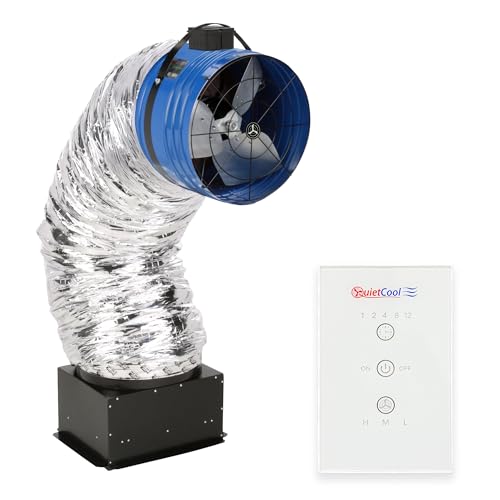
Compact Cooling Pick – QuietCool QC-2250 RF
The QuietCool QC CL-2250 RF offers a simpler scale for bedrooms and smaller areas while fitting the low-maintenance whole house ventilation systems category. It delivers up to 2,465 CFM, includes wireless control with a countdown timer, and is designed for spaces up to 1,235 square feet.
Best For: Large bedrooms or smaller homes needing quiet, remote-controlled cooling and ventilation.
Pros:
- Provides up to 2,465 CFM on high and 1,910 CFM on low.
- Rated at 25 dB in the supplied specifications.
- Wireless RF control includes a glass switch and up to a 12-hour timer.
- R5 damper doors help insulate the home from the attic when unused.
Cons:
- Its 1,235-square-foot recommended coverage is limited compared with the QC-5400 RF.
- It is a ceiling-mounted system, so installation access still needs to be considered.
The QC-2250 RF is the more manageable QuietCool option for smaller spaces and buyers who want strong airflow without stepping up to the larger model. Its quieter listed operation and included wireless controls add everyday convenience.
HVAC-Coordinated Option – Panasonic SelectCycler SACG2K-04
The Panasonic SelectCycler SACG2K-04 takes a system-management approach to low-maintenance whole house ventilation systems. For 4-inch ducting, it coordinates a central HVAC system, dampers, and compatible WhisperGreen Select fans, with a programmable controller that calculates run cycles and operating times.
Best For: Homes using compatible ventilation fans that need programmable supply or balanced ventilation control.
Pros:
- Coordinates the HVAC system, dampers, and compatible ventilation fans.
- Includes a programmable wall-mounted controller with system-status information.
- Supports supply or balanced ventilation strategies through dual operating modes.
- Includes a 24VAC motorized supply damper and Fanconnect wall switch.
Cons:
- It is a control system rather than a standalone high-CFM whole-house fan.
- Compatibility with WhisperGreen Select or another 110VAC ventilation fan is required.
- This version is designed for 4-inch ducting.
The SelectCycler is best viewed as a coordination and control upgrade rather than an all-in-one air-moving appliance. It makes the most sense when paired with compatible fans and a central HVAC setup, particularly for buyers prioritizing programmed ventilation cycles.
Garage Cooling Powerhouse – QuietCool GA PRO-2.0
For shoppers comparing low-maintenance whole house ventilation systems for a garage, the QuietCool GA PRO-2.0 emphasizes strong airflow with simple operation. It moves up to 1,834 CFM, uses as little as 133 watts, and includes a ceiling box, fire damper, thermostat, and wireless RF control.
Best For: Cooling garages with an attic above the installation area, especially larger garages needing high airflow.
Pros:
- High airflow of up to 1,834 CFM with two operating speeds.
- Low-power operation rated at as little as 133 watts.
- Integrated two-hour-rated fire damper, thermostat, and wireless RF switch included.
- Plug-and-play design with a 15-year warranty.
Cons:
- Requires an attic above the garage for installation.
- Designed for garage ventilation rather than general whole-home room-by-room ventilation.
The GA PRO-2.0 is a practical choice when garage heat control and straightforward upkeep matter most. Its two-speed motor and included controls simplify daily use, while the required attic space may limit installation options.
Balanced Fresh-Air Specialist – VENTS-US BRIG ERV 200
The VENTS-US BRIG ERV 200 is a strong option among low-maintenance whole house ventilation systems for balanced fresh-air exchange. It continuously supplies outdoor air while exhausting stale air, and its energy recovery core helps reduce the efficiency penalty of ventilation.
Best For: Homes needing continuous balanced ventilation with energy recovery and washable filters.
Pros:
- Provides up to 213 CFM through a 6-inch duct connection.
- Energy recovery core helps recover energy from outgoing air.
- Electronic defrost protection helps protect the recovery core in freezing conditions.
- Washable MERV 6 filters and three-step onboard controls support simpler routine care.
Cons:
- Requires ductwork and a dedicated ventilation installation.
- Built-in controls provide standby, low, and medium settings; additional controls may be needed for boost operation.
With balanced airflow, washable filtration, and automatic defrost protection, the BRIG ERV 200 is geared toward dependable continuous ventilation. It is best suited to buyers prepared for a ducted installation rather than a quick room-level retrofit.
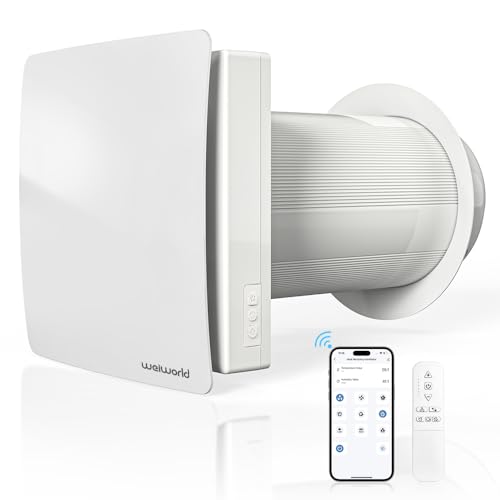
Smart Filtered Air Exchange – VT501F HEPA Ventilation Fan
The VT501F HEPA ventilation fan offers a compact approach to low-maintenance whole house ventilation systems for individual rooms and enclosed spaces. Its through-wall design combines fresh-air intake, exhaust, and circulation with three-stage filtration, app control, and an energy-efficient EC motor.
Best For: Bedrooms, home offices, attics, basements, or garages that need localized filtered air exchange without complex ductwork.
Pros:
- Three-stage filtration includes a pre-filter, HEPA filter, and activated carbon layer.
- Wi-Fi app, remote, and button controls support intake, exhaust, and circulation modes.
- Quiet 30 dB operation and an efficient brushless EC motor.
- Magnetic front panel provides quick access for cleaning and G4 pre-filter replacement.
Cons:
- Airflow is limited to 60 cubic meters per hour, making it better for localized ventilation than large whole-home systems.
- Through-wall installation still requires a suitable wall opening and power connection.
- Includes a one-year warranty.
This fan is a convenient choice when smart controls, quiet operation, and filtration are more important than high-volume whole-home airflow. Its accessible front panel helps simplify maintenance, while its capacity is best matched to a single room or enclosed area.
Best Whole House Fan for Sealed Attic Efficiency – Tamarack HV1600R38
For homeowners seeking low-maintenance whole house ventilation systems, the Tamarack HV1600R38 offers straightforward cooling with remote operation and self-sealing insulated doors. It exhausts hot, stale air through attic vents while drawing in cooler outdoor air, helping reduce reliance on air conditioning when conditions are favorable.
Best For: Homes that need economical, seasonal whole-house cooling with reduced attic air leakage.
Pros:
- R38 insulated doors open automatically during operation and seal when the fan is off.
- Uses remote controls and offers two speed settings for convenient operation.
- Provides up to 1,600 CFM of airflow and uses substantially less energy than central air conditioning, according to the manufacturer.
- Mounts horizontally or vertically on 16- or 24-inch-center joists and includes a lifetime manufacturer’s warranty.
Cons:
- It relies on suitable attic vents or gables and cooler outdoor air to provide effective cooling.
- At 39 pounds, installation may require planning and assistance.
The HV1600R38 is a practical choice when sealing the fan opening during off-seasons matters as much as airflow. Its remote controls and insulated doors simplify everyday use, while the installation still depends on compatible attic framing and ventilation.
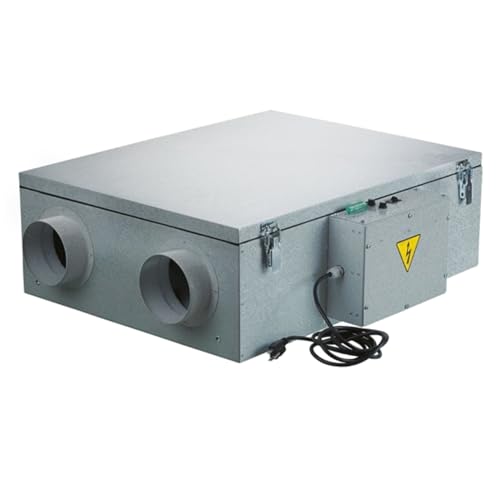
Best Balanced Fresh-Air Ventilation System – VENTS-US Frigate ERV 150
The VENTS-US Frigate ERV 150 is a strong option for shoppers comparing low-maintenance whole house ventilation systems that exchange indoor and outdoor air year-round. Its enthalpy core recovers heat and moisture, while washable MERV 6 filters and automatic frost protection help simplify routine ownership.
Best For: Homes needing balanced ventilation with heat and humidity recovery in a compact ceiling-mounted design.
Pros:
- Supplies filtered outdoor air while exhausting stale indoor air at up to 180 CFM.
- Enthalpy recovery helps retain warmth and humidity in winter and reduce cooling loss in summer.
- Includes washable MERV 6 filters, automatic electronic defrost, and a no-drain enthalpy core.
- The 9.6-inch-deep steel casing has a corrosion-resistant finish and operates at 1.9 sones.
Cons:
- Its push-button control and single power level provide less adjustment than multi-speed systems.
- Permanent ceiling mounting requires suitable installation space and planning.
With balanced supply and exhaust airflow, this ERV is better suited to continuous fresh-air management than rapid whole-house cooling. Its slim housing, washable filters, and automatic defrost features support a relatively simple maintenance routine.
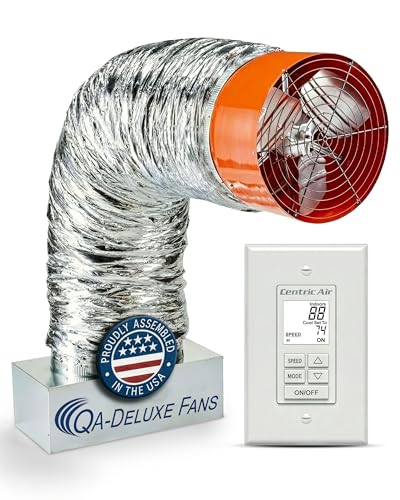
Best High-Capacity Whole House Fan – QA-Deluxe ECM 4800
The QA-Deluxe 4800 ECM is designed for homeowners who want high airflow and convenient controls in a low-maintenance whole house ventilation system. Its ECM motor, three-speed wall switch, timer, temperature control, and insulated damper make it a capable choice for cooling larger homes when outdoor conditions allow.
Best For: Two-story homes up to 2,800 square feet or one-story homes up to 1,900 square feet that need powerful whole-house airflow.
Pros:
- Delivers 4,203 CFM, or 3,209 CFM under the listed California Title 24 airflow specification.
- Three-speed wall control includes timer and temperature-control functions.
- R-5 insulated damper helps limit hot attic air from entering the living space when the fan is off.
- Fits 16- to 24-inch on-center joists without framing and includes a 10-year motor and three-year parts warranty.
Cons:
- Its 51 dB noise rating may be more noticeable than quieter ventilation-focused systems.
- Installation requires 4.0 square feet of attic ventilation.
- The larger airflow capacity and 491-watt rating may be more than smaller homes need.
The ECM 4800 stands out for capacity and control rather than minimal size. The insulated damper and included support hardware help simplify installation, but buyers should confirm attic ventilation, joist spacing, and the fan’s airflow are appropriate for the home.
How We Picked the Best Low-Maintenance Whole House Ventilation Systems
We focused on systems that support regular whole-home air exchange while reducing routine upkeep. Our comparison considers airflow capacity, motor efficiency, control options, noise-conscious design, installation format, and features that can simplify ownership. Because whole-house fans and ERVs solve different ventilation problems, we treated each product according to its intended use rather than ranking every model by airflow alone.
We also looked for practical details such as wireless controls, insulated or fire-rated dampers, washable or accessible components, duct requirements, and energy recovery. Always confirm local code requirements and have electrical or ductwork installation completed by a qualified professional when needed.
Quick Comparison
| System type | Best for | Main advantage | Potential trade-off |
|---|---|---|---|
| Whole-house fan | Cooling homes with outdoor air | High airflow and relatively simple operation | Depends on suitable outdoor temperature and humidity |
| ERV | Balanced year-round ventilation | Exchanges air while helping manage energy loss | Usually requires more involved duct installation |
| Through-wall ventilator | Targeted room-by-room fresh air | Useful where full ductwork is impractical | May provide less whole-home coverage |
| Garage whole-house fan | Garage or adjacent-area ventilation | Moves substantial air from a specific zone | Requires careful placement and safety planning |
Key Buying Factors for Low-Maintenance Whole-House Ventilation Systems
Airflow and Home Size
CFM indicates how much air a fan can move, but the right capacity depends on home size, ceiling height, layout, climate, and the available intake and exhaust paths. More airflow is not automatically better if it creates excessive noise or pressure.
Ventilation Type and Climate
Whole-house fans are most useful when outdoor air is cooler and reasonably dry. ERVs are better suited to consistent mechanical ventilation because they transfer some heat and moisture between outgoing and incoming air. In humid or very cold climates, energy recovery can improve comfort and reduce conditioning losses.
Maintenance and Controls
Look for accessible filters, durable EC motors, simple speed controls, and clearly stated replacement parts. Wireless remotes can make operation convenient, while timers or automatic controls help prevent unnecessary runtime. Even low-maintenance systems still need periodic cleaning and filter inspection.
Installation, Noise, and Safety
Check duct diameter, wall or ceiling requirements, electrical specifications, damper design, and available attic or mechanical-room space before buying. Insulated doors and fire dampers may be important in certain installations. Compare published noise ratings, but remember that duct design and mounting can significantly affect perceived sound.
Who Should Buy Which Low-Maintenance Whole House Ventilation Systems?
Choose a high-airflow whole-house fan if your priority is quickly cooling a home during favorable outdoor conditions. Select an ERV if you want more controlled, year-round fresh-air exchange with improved energy efficiency. A through-wall Wi-Fi ventilator is a practical choice for an addition, apartment, or room where installing a full duct network is unrealistic. Garage-specific models make sense when the garage is the main area needing ventilation, but they should not be treated as a substitute for a properly designed residential system.