The best space-saving smart home ventilation controllers make it easier to improve airflow without giving up valuable room, wall, or ceiling space. This roundup compares compact inline fans, register boosters, through-wall systems, and smart exhaust units for different ventilation needs.
Whether you want app control, automatic temperature and humidity response, quieter operation, or a simple remote, the right controller depends on your installation, airflow target, and level of automation.
Best 10 Space-Saving Smart Home Ventilation Controllers Picks for 2026
Quiet App-Controlled Pick

- Compact 4-inch inline design
- App-based temperature and humidity automation
- Quiet EC motor with up to 226 CFM
Best For: Targeted ducted ventilation in grow rooms, AV closets, and odor-control setups
HVAC-Synced Control
Honeywell Fresh Air Ventilation Control

- Coordinates ventilation with heating and cooling
- Supports ASHRAE 62.2-2010 guidance
- Compact housing with simple adjustment dials
Best For: Residential split-system HVAC ventilation installations
High-Output Wall Option
VEVOR 10-Inch Smart Exhaust Fan

- Up to 1,000 CFM airflow
- Automatic temperature and humidity programming
- Steel housing with rain-blocking shutter
Best For: Attics, garages, sheds, and workshops needing powerful exhaust
Room-by-Room Comfort
SmartCocoon 4x10 Register Booster
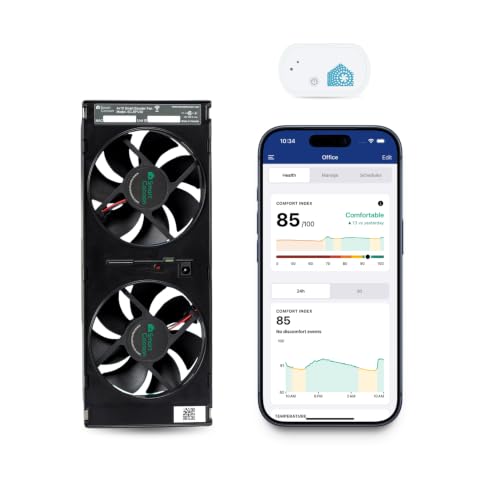
- Boosts airflow at a 4x10 floor register
- Temperature and humidity sensing
- App, Ecobee, and Nest integration
Best For: Bedrooms or individual rooms with weak but present HVAC airflow
Best Grow-Tent Pick
VEVOR 205 CFM Smart Inline Duct Fan

- App and PWM control with four auto modes
- Complete 4-inch fan, filter, and ducting kit
- Quiet low-speed operation at 27.1 dB
Best For: Small grow tents and indoor gardens
Best Compact Climate Monitor
AC Infinity AIRTITAN T3 Smart Exhaust Fan

- Automates temperature and humidity-based ventilation
- WiFi app supports monitoring and scheduling
- Compact 120 CFM crawlspace exhaust design
Best For: Basements and crawlspaces needing humidity control
Quiet Register Booster

- Drops into standard 4 x 10-inch registers
- Temperature-controlled heating and cooling modes
- Quiet 16 dB operation with 10 speeds
Best For: Targeted airflow improvement in bedrooms, offices, and distant rooms
Remote Shutter Ventilation

- Exhausts up to 820 CFM
- Remote temperature and humidity control
- Weather-resistant aluminum shutters
Best For: Attics, garages, workshops, bathrooms, and utility spaces
Intelligent Climate Exhaust

- Programmable temperature and humidity triggers
- 1,000 CFM EC motor with nine speeds
- Automatic weatherproof aluminum shutters
Best For: Greenhouses, garages, workshops, grow rooms, and attics
Quiet App-Controlled Pick – CLOUDLINE T4 Inline Duct Fan
For space-saving smart home ventilation controllers, the AC Infinity CLOUDLINE T4 combines a compact 4-inch inline fan with app-based climate automation. Its temperature and humidity programming, scheduling, timers, and adjustable speed control make it practical for targeted exhaust or air transfer.
Best For: Grow rooms, AV closets, odor control, and compact ducted ventilation setups.
Pros:
- Compact 6.9 x 11.9 x 7.4-inch design with 226 CFM airflow.
- App control supports temperature, humidity, scheduling, and automation.
- EC motor and mixed-flow design are rated for quiet, energy-efficient operation.
Cons:
- Designed for 4-inch inline duct installations rather than open-room ventilation.
- Indoor use is specified, so it is not intended for exposed outdoor mounting.
The CLOUDLINE T4 is a strong fit when you need smart environmental control in a small ducted system. Its compact form and remote programming add convenience without requiring a large wall-mounted fan.
HVAC-Synced Control – Honeywell Fresh Air Ventilation Control
The Honeywell W8150A1001 is a compact choice among space-saving smart home ventilation controllers for central HVAC systems. It coordinates ventilation calls with heating and cooling and uses simple input dials to customize airflow for the installation.
Best For: Residential split-system installations that need code-conscious, HVAC-integrated ventilation control.
Pros:
- Helps support ventilation codes and the ASHRAE 62.2-2010 standard.
- Syncs ventilation calls with heating and cooling operation.
- Compact 8.03 x 4.41 x 2.24-inch housing with easy-to-use dials.
Cons:
- Uses physical dials rather than app-based remote control.
- Requires a compatible split-system installation and wiring.
This Honeywell controller is best for buyers prioritizing straightforward HVAC coordination over app features. Its small enclosure and adjustable dials make it a practical control component for a properly planned residential ventilation system.
High-Output Wall Option – VEVOR 10-Inch Smart Exhaust Fan
For large spaces that need powerful air removal, the VEVOR 10-inch fan offers a high-capacity approach to space-saving smart home ventilation controllers. Its temperature and humidity triggers, 10 speed settings, timer, and automatic shutter provide hands-off exhaust control.
Best For: Attics, garages, sheds, workshops, and other areas needing rapid high-volume exhaust.
Pros:
- Delivers up to 1,000 CFM for fast removal of heat, odors, and stale air.
- Temperature and humidity controller offers automatic adjustment across 10 speeds.
- Steel construction and an automatic rain-blocking shutter suit demanding installations.
Cons:
- At 62 dB, it is substantially louder than the compact inline options.
- Wall-mounted 10-inch construction requires more installation space.
- Its listed 240-volt specification may require electrical compatibility checks.
The VEVOR is the performance-focused choice in this group. It is less suited to quiet living areas, but its high airflow, environmental triggers, and protective shutter make it useful where fast, automated exhaust matters most.
Room-by-Room Comfort – SmartCocoon 4×10 Register Booster
The SmartCocoon 4×10 booster fan is a compact option for space-saving smart home ventilation controllers when the goal is to improve airflow at an existing floor register. Its temperature and humidity sensor, app control, schedules, and Ecobee and Nest integration support room-level comfort management.
Best For: Bedrooms and individual rooms with an accessible 4×10 register and nearby power outlet.
Pros:
- Fits a 4×10 register and provides up to 120 CFM of boosted airflow.
- Tracks temperature and humidity for responsive operation.
- App supports schedules, fan-speed control, noise adjustment, and multiple fans.
- Works with conventional thermostats and integrates with Ecobee and Nest.
Cons:
- Requires existing duct airflow; it will not help if the vent has no airflow or already has strong airflow.
- Needs a nearby outlet, with a listed 6-foot cord.
- It is a register booster, not a whole-home exhaust fan.
This SmartCocoon model is a practical choice for correcting uneven room comfort without installing a larger ventilation system. Confirm the register dimensions, existing airflow, and outlet location before buying.
Best Grow-Tent Pick – VEVOR 205 CFM Smart Inline Duct Fan
For compact grow tents and indoor gardening setups, this VEVOR kit combines space-saving smart home ventilation controllers with an inline fan, carbon filter, ducting, and app-based adjustment. Its 10-speed control and temperature and humidity monitoring make it practical for managing airflow in a small enclosed space.
Best For: Small grow tents, hydroponics areas, and indoor gardens needing app-controlled exhaust ventilation.
Pros:
- Includes an inline fan, carbon filter, ducting, clamps, and hanging straps.
- App and PWM controller provide four auto modes and 0–10 speed levels.
- Delivers 205 CFM with noise as low as 27.1 dB at low speed.
- Energy-efficient EC pure copper motor is designed for extended operation.
Cons:
- Its 4-inch duct size and 205 CFM capacity are aimed at smaller installations.
- Noise varies by speed and can be higher than the low-speed rating.
This is a well-equipped compact ventilation package when odor reduction, airflow control, and remote monitoring matter more than high-capacity whole-room ventilation.
Best Through-Wall Option – 300 CFM Smart Room-to-Room Fan
This hardwired room-to-room fan is a space-saving smart home ventilation controller for moving air between adjacent rooms without occupying floor or window space. Its flush wall-mount design, thermostat, remote, and three operating modes support targeted temperature balancing throughout the home.
Best For: Bedrooms, kitchens, basements, laundry rooms, and other adjacent spaces that need controlled air transfer.
Pros:
- Moves up to 300 CFM through an interior wall.
- Fits wall thicknesses from 3.8 to 7.4 inches for flush installation.
- Offers heating, cooling, and continuous ventilation modes.
- Includes five speeds, thermostat control, and an infrared remote.
Cons:
- Requires hardwired electrical installation and has no standard plug.
- It is intended for indoor through-wall air transfer rather than ducted exhaust.
Choose this model when reclaiming room space and balancing temperatures between nearby rooms are the priorities. Plan for electrical installation before buying.
Best Compact Climate Monitor – AC Infinity AIRTITAN T3 Smart Exhaust Fan
The AC Infinity AIRTITAN T3 is a compact choice among space-saving smart home ventilation controllers, designed to exhaust stale, humid air from crawlspaces and basements. Its temperature, humidity, and VPD programming can automate ventilation while the WiFi app provides remote climate monitoring and scheduling.
Best For: Crawlspaces and basements where humidity, odors, and stale air require automated exhaust control.
Pros:
- Supports temperature, humidity, and VPD programming with timers and schedules.
- WiFi app enables remote access to climate data and automation settings.
- Compact 6-inch design delivers 120 CFM airflow.
- IP55-rated fan and anodized aluminum frame resist dust and liquids.
Cons:
- Its 120 CFM capacity is lower than the larger room-transfer fan in this roundup.
- Offers three speed levels rather than a broader multi-speed range.
- Designed primarily for crawlspaces and basements, not general whole-home circulation.
This is a strong fit for small, moisture-prone areas where automated climate routines and remote app access are more valuable than maximum airflow.
Quiet Register Booster – Smart 4 x 10 Vent Fan
For targeted, space-saving smart home ventilation controllers, this register booster fan is designed to drop into a standard 4 x 10-inch floor or wall register. Its temperature sensor, heating and cooling modes, remote control, and 10 speed settings help improve airflow without changing existing ductwork.
Best For: Bedrooms, offices, and other rooms with weak HVAC airflow or noticeable hot and cold spots.
Pros:
- Fits standard 4 x 10-inch register openings and installs without ductwork changes.
- Automatically responds to room temperature in heating or cooling mode.
- Quiet 16 dB operation, 10 speeds, remote control, and low 9-watt power draw.
- Built-in aromatherapy tray adds an optional air-freshening feature.
Cons:
- Designed specifically for 4 x 10-inch register openings.
- Its 130 CFM capacity is intended for localized airflow boosting rather than whole-room exhaust.
This is the most compact choice for fine-tuning comfort at an individual vent. It suits buyers who want automated, quiet airflow assistance while keeping installation simple.
Remote Shutter Ventilation – 10-Inch Smart Exhaust Fan
This 10-inch wall-mounted exhaust fan offers a practical option among space-saving smart home ventilation controllers for garages, attics, sheds, and similar areas. Its wireless remote adjusts temperature, humidity, and fan speed, while the aluminum shutters are designed for moisture and heat resistance.
Best For: Attics, garages, workshops, bathrooms, and other spaces needing high-volume exhaust ventilation.
Pros:
- Moves up to 820 CFM and lists coverage for areas up to 1,200 square feet.
- Wireless digital remote controls temperature, humidity, and three speed settings.
- Weather-resistant aluminum shutters help withstand moisture and heat.
- Fully enclosed, thermally protected motor is permanently lubricated for easier maintenance.
Cons:
- Wall-mounted installation requires a suitable opening and electrical connection.
- Uses 66 watts, making it less minimal than a small register booster.
- The supplied specifications list three speeds rather than a broad variable-speed range.
Choose this model when the priority is exhausting substantial heat or stale air through a wall. It provides remote environmental control, but its larger wall-mounted format is better suited to utility spaces than living areas.
Intelligent Climate Exhaust – 10-Inch EC Shutter Fan
For buyers seeking space-saving smart home ventilation controllers with more detailed environmental automation, this 10-inch wall-mount fan combines temperature and humidity triggers with a high-output EC motor. The wireless controller offers programmable thresholds, nine speeds, and memory functionality for garages, workshops, greenhouses, and attics.
Best For: Greenhouses, garages, workshops, grow rooms, and attics requiring automatic temperature or humidity response.
Pros:
- Delivers up to 1,000 CFM with an EC motor rated as 60% more energy-efficient than standard AC models.
- Programmable temperature ranges from 32–212°F and humidity settings from 0–100%.
- Wireless controller provides nine speeds and memory functionality.
- Automatic aluminum shutters help block rain, wind, and debris when the fan is off.
Cons:
- Wall mounting and a suitable ventilation opening are required.
- Quiet operation is specified as under 62 dB, so it is not as quiet as a small register fan.
- Its higher output is likely excessive for small rooms needing only modest airflow assistance.
This is the strongest fit for spaces where temperature and humidity automation matter more than silent operation. The included template and pre-wired cord support DIY installation, while the durable construction suits more demanding environments.
How We Picked the Best Space-Saving Smart Home Ventilation Controllers
We compared these 10 products by looking at installation format, airflow capacity, control options, noise-conscious design, sensing features, and likely use cases. The selection includes inline duct fans, register boosters, room-to-room fans, and wall-mounted exhaust units so you can match the controller to the space rather than forcing one design to do everything.
We also considered practical details such as variable-speed adjustment, temperature and humidity automation, timers, remotes, app connectivity, and whether a unit is better suited to a small room, attic, greenhouse, bathroom, or ducted HVAC system.
Quick Comparison
- Best for compact ducted ventilation: AC Infinity CLOUDLINE T4 and VEVOR’s 4-inch inline duct fan kit.
- Best for HVAC fresh-air control: Honeywell Fresh Air Ventilation Control.
- Best for boosting a register: The 4 x 10-inch smart register booster fans.
- Best for high-volume wall exhaust: The VEVOR, iLiving, and GOCHIFIX 10-inch shutter fans.
- Best for transferring air between rooms: The 300 CFM through-wall fan.
- Best for targeted crawl-space or cabinet ventilation: AC Infinity AIRTITAN T3.
Key Buying Factors for Space-Saving Smart Home Ventilation Controllers
Installation and Available Space
Measure the opening, duct diameter, register size, wall depth, and clearance around the fan before buying. Inline models fit inside duct runs, register boosters sit within standard floor or wall openings, and shutter fans generally need a suitable exterior wall or attic opening.
Airflow and Room Size
CFM indicates how much air a fan can move, but the useful result depends on duct length, bends, filters, grilles, and static pressure. Small register fans are designed for localized airflow, while 10-inch exhaust models are better for larger spaces that need rapid air exchange.
Automation and Controls
Temperature and humidity sensors can turn ventilation on when conditions change, reducing the need for manual adjustments. App control is useful when you want scheduling or remote monitoring; a wired controller or remote may be preferable when simplicity and reliability matter more.
Noise, Speed, and Energy Use
Variable-speed control lets you balance airflow against noise and power consumption. For bedrooms, offices, and living areas, prioritize a model with multiple speed settings and a quiet operating profile. For attics, workshops, or greenhouses, maximum airflow may be more important than low noise.
Who Should Buy Which Space-Saving Smart Home Ventilation Controllers?
Choose a compact inline controller if you are improving a ducted system or ventilating a confined space. Pick a register booster when one room consistently receives weak heating or cooling. A through-wall fan makes sense when you need direct air transfer between adjacent rooms without adding ductwork.
For attics, garages, greenhouses, and other high-heat or high-humidity areas, a wall-mounted shutter fan with automatic sensing offers strong, straightforward ventilation. If you want centralized fresh-air management, the Honeywell controller is the more HVAC-focused choice. Finally, choose an app-enabled model when remote scheduling and detailed control are worth the added setup.